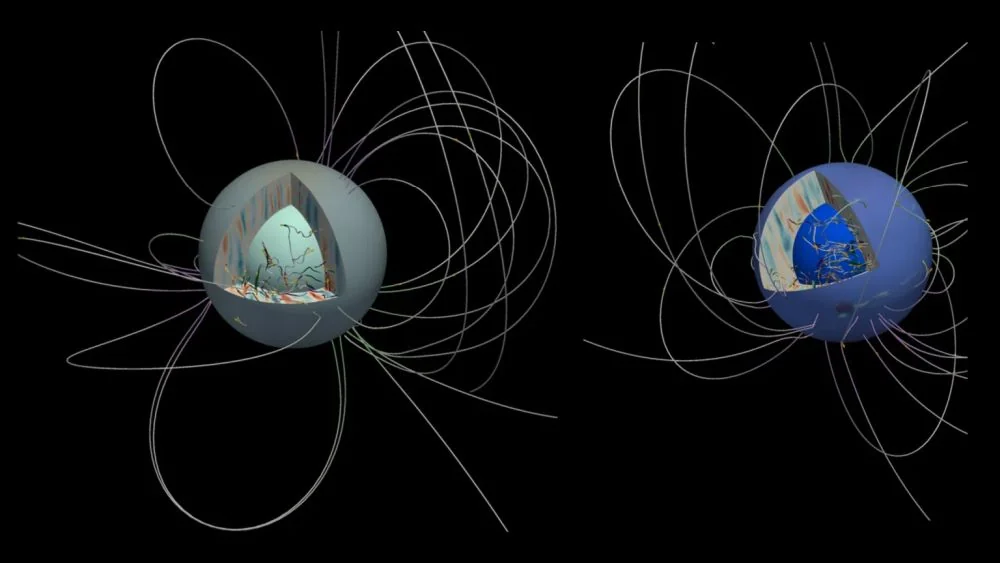
Uranus and Neptune possess magnetic fields fundamentally different from Earth's, according to research published in Nature Communications Physics. Their fields are tilted sharply from their rotational axes, offset from their planetary centers, and asymmetrical in strength.
Earth's magnetic field originates from its molten core and internal convection, with north and south poles that drift slowly. The ice giants' fields arise instead from water, ammonia, and methane ices under extreme pressure and temperature, transformed into ionic and superionic phases that conduct electricity.
Voyager 2 revealed the strangeness of these fields when it visited both planets. Unlike Earth's well-defined dipolar structure, Uranus and Neptune exhibit non-dipolar, non-axisymmetric fields with powerful M=1 components representing lopsided, asymmetric features.
A new study led by Chi Yan, a research associate at the University of Texas Jackson School of Geosciences, modeled how electrical conductivity that increases with depth could generate these anomalous fields. Yan explained that under extreme conditions deep inside the ice giants, water molecules break apart into ions, making the material increasingly electrically conductive.
The models show both planets' magnetic fields could shift and change substantially over decades. Yan noted that Earth's magnetic tilt drifts about one degree every 50 years, but "our models show the ice giants can behave very differently. In some stretches the tilt swings by tens of degrees within decades."
Voyager 2 captured only a single snapshot of each planet's field. The researchers write that both planets' magnetic fields are "likely configured much differently than when Voyager 2 visited." The James Webb Space Telescope has observed auroral activity at Neptune that could confirm whether magnetic fields have shifted since Voyager 2's encounter, with researchers still analyzing those observations.