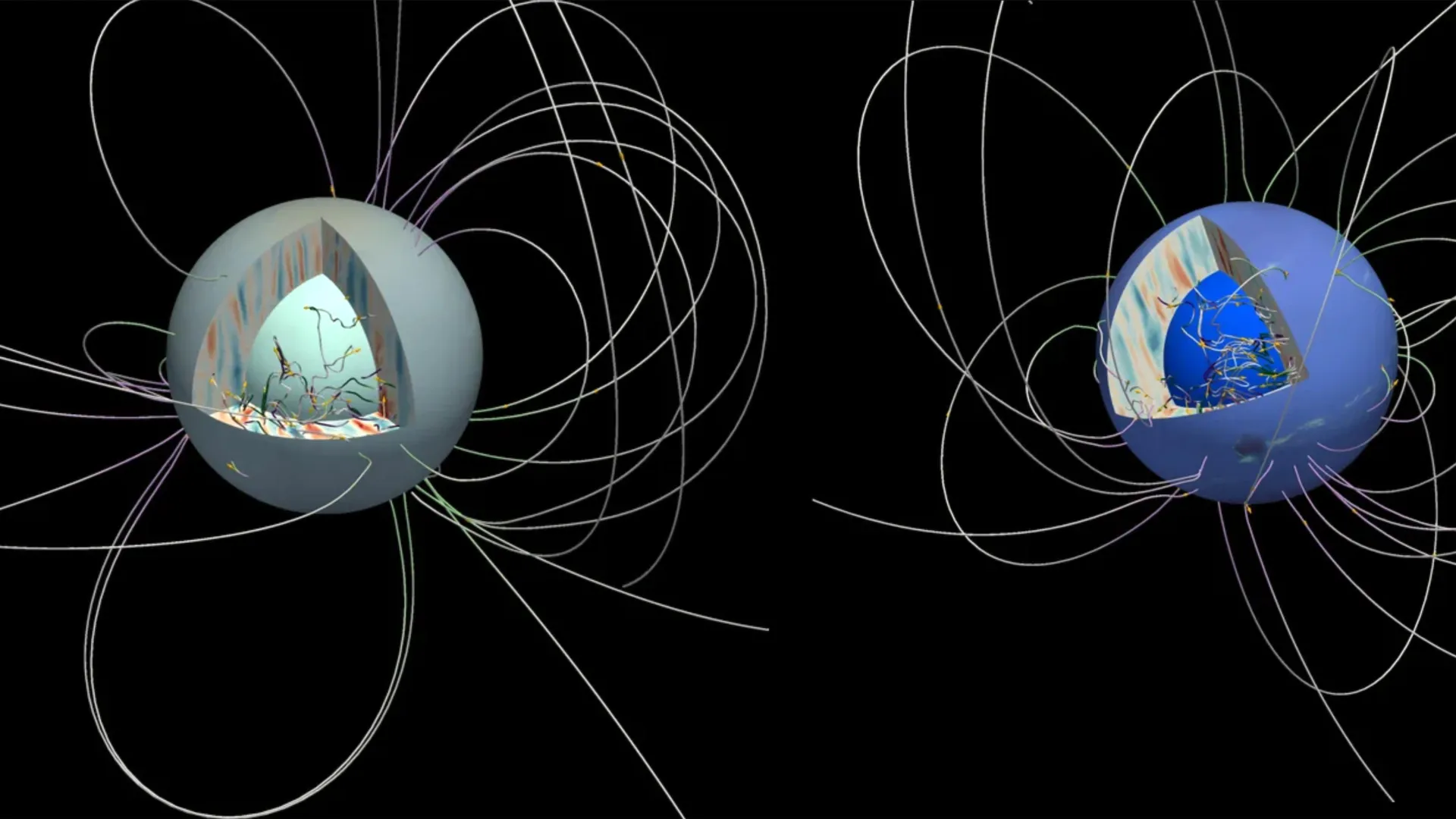
Voyager 2's visits to Uranus and Neptune in the 1980s revealed magnetic fields tilted at 59 and 47 degrees respectively, far more extreme than Earth's 11-degree tilt. A new study published in Communications Physics proposes that changes in electrical conductivity deep within these ice giants may explain the distorted magnetism.
Researchers at the University of Texas at Austin, working with colleagues from UCLA, Imperial College London, and Northumbria University, developed computer simulations of how material inside Uranus and Neptune could generate their unusual magnetic fields. Under the extreme pressures and temperatures in these planets, water molecules break apart into ions that increase electrical conductivity with depth. This changing conductivity may drive the dynamo process that creates their magnetic fields.
The simulations produced an unexpected result. The models suggest that Uranus and Neptune's magnetic axes could shift by tens of degrees within only a few decades, far more dramatically than Earth's magnetic tilt, which drifts about one degree per 50 years.
Researchers are now examining infrared images from the James Webb Space Telescope to test whether the magnetic poles have actually shifted since Voyager 2's observations. Auroras in the planets' atmospheres and patterns in their ionospheres may reveal magnetic changes, according to Tom Stallard, a professor at Northumbria University who led the JWST observation campaign.
Scientists emphasize that fully understanding the planets' interiors will require new spacecraft missions to Uranus and Neptune.