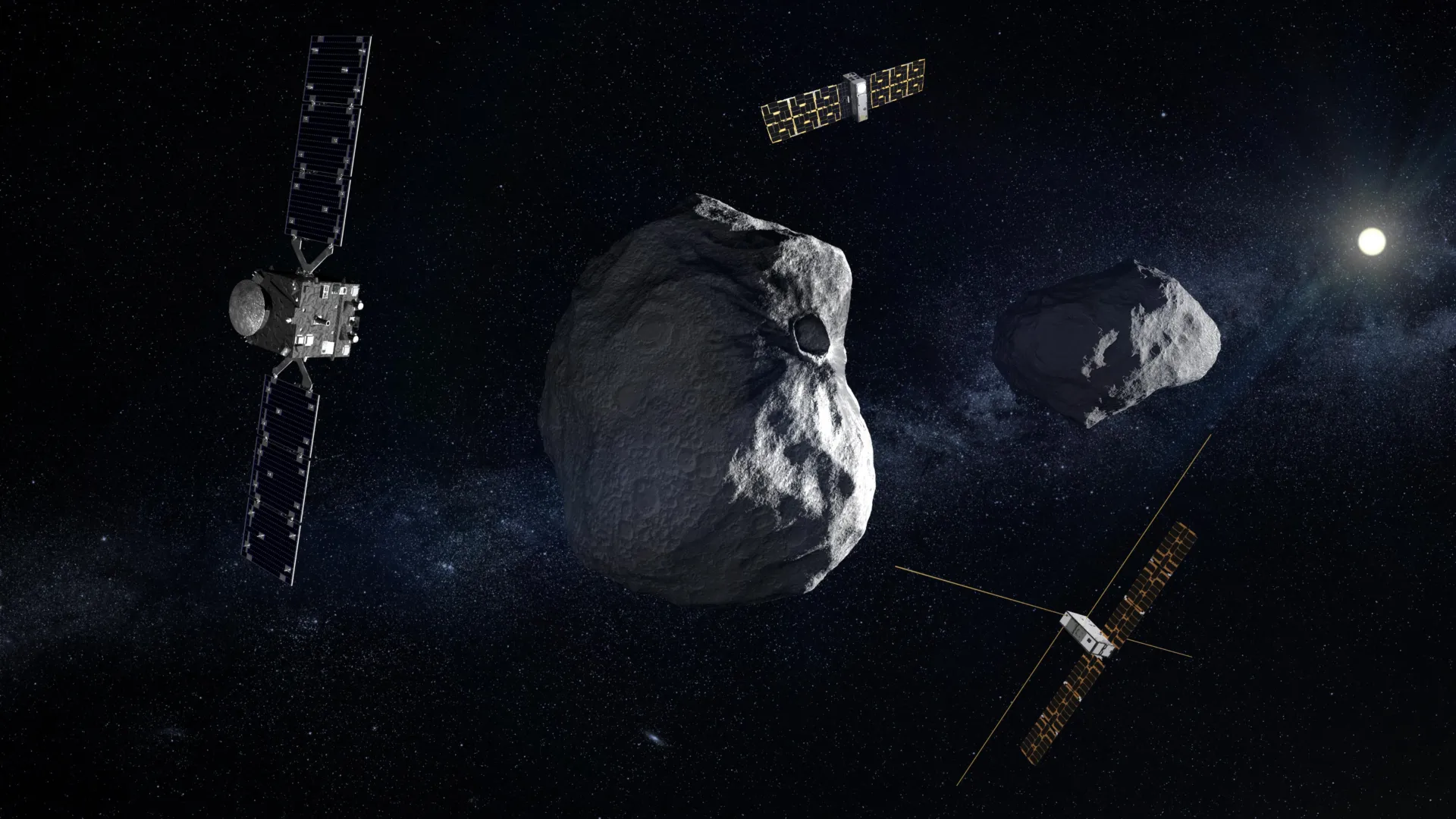
The European Space Agency's Hera spacecraft has arrived near the Didymos asteroid system, traveling 25 to 30 kilometers from the pair of asteroids. The spacecraft is now in its "early characterization phase," gathering broad observations of the two bodies.
Hera's primary target is Dimorphos, the smaller asteroid that NASA's DART spacecraft struck in September 2022 at 6.1 kilometers per second. That collision shortened Dimorphos' orbit around Didymos by approximately 33 minutes, testing whether kinetic impact could alter an asteroid's trajectory for planetary defense purposes.
Mission scientist Michael Kueppers stated: "During this phase, our images will reveal for the first time what a small asteroid looks like globally, having experienced a hypervelocity impact in the context of the first asteroid deflection test, when NASA's DART spacecraft impacted it to change its orbit in 2022."
The weak gravity at this location makes conventional orbits impractical. Didymos measures roughly 780 meters across with gravity about 40,000 times weaker than Earth's. Dimorphos spans 151 meters with gravity roughly 200,000 times weaker than Earth's. Hera travels at approximately 12 centimeters per second around their shared center of gravity, following nearly straight paths that change direction 90 degrees every three to four days using thruster firings. These maneuvers create "rectangular orbits" that keep the spacecraft at safe distance while requiring minimal propellant.
Next month, Hera will enter its "detailed characterization phase," moving closer to the asteroids along hyperbolic trajectories beginning at approximately 20 kilometers. The mission control team operates from ESA's ESOC center in Darmstadt, Germany, maintaining contact through four 35-meter Deep Space Antennas in Argentina, Spain, and Australia.
Hera will investigate unanswered questions about DART's impact. Scientists still do not know whether the collision excavated a large crater or reshaped the entire asteroid, and they need precise information about Dimorphos' composition, internal structure, and mass. The impact produced a much larger orbital change than computer simulations predicted. Over coming months, Hera will deploy two CubeSats to collect additional measurements and eventually conduct landing operations.