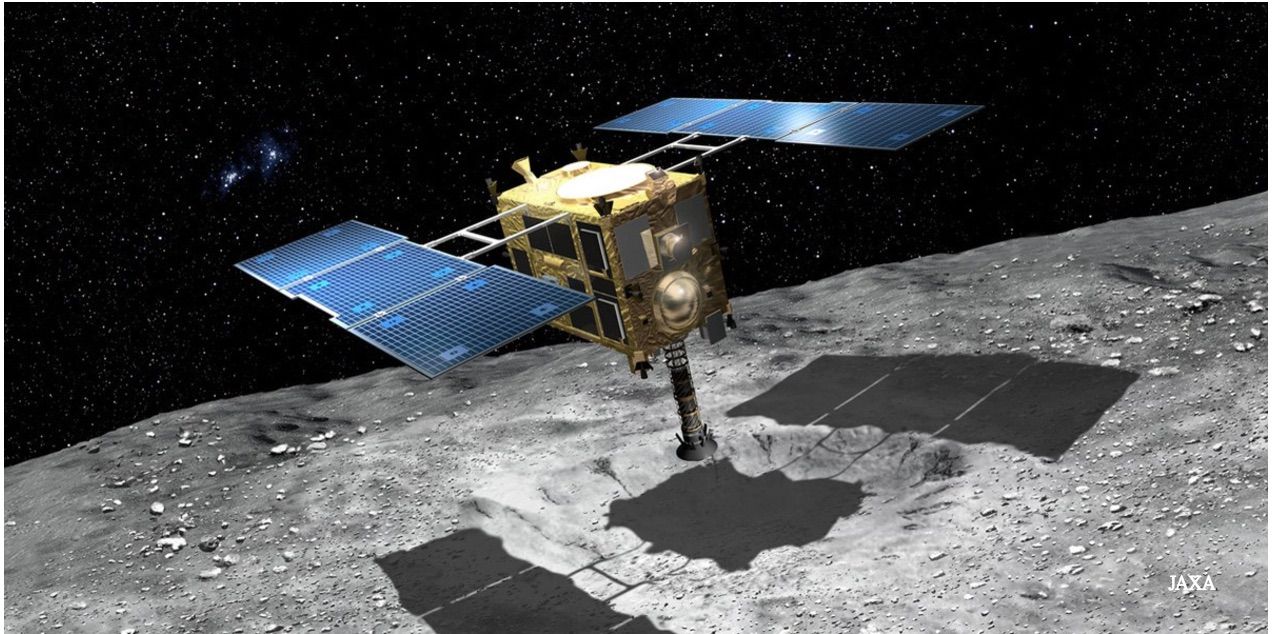
On Nov. 19, 2005, Japan's Hayabusa spacecraft achieved the first liftoff from an asteroid surface after landing on Itokawa. The Japan Aerospace Exploration Agency (JAXA) launched Hayabusa on May 9, 2003, targeting the asteroid for sample collection and return to Earth. The spacecraft arrived at Itokawa on Sept. 12, 2005, after a solar storm delayed its journey by degrading its solar arrays.
During its first landing on Nov. 19, Hayabusa descended to 56 feet above the asteroid before losing contact for 3 hours. After contact was restored, JAXA confirmed the probe had landed. The spacecraft bounced off the surface multiple times and rested on the asteroid for about 39 minutes before lifting off. "The spacecraft actually bounced off the surface a few times and spent about 39 minutes resting on the asteroid, but apparently the samplers never fired," Andrew Cheng, a Hayabusa science team member at Johns Hopkins University Applied Physics Laboratory, told Space.com.
Hayabusa made a second landing on Nov. 26, 2005. Its sample-return capsule reached Earth in June 2010. Scientists initially remained uncertain whether the spacecraft had captured any material, since the collector mechanism did not fire during either landing. In November 2010, JAXA announced that Hayabusa had collected 1,500 dust grains from Itokawa, with material jammed into the collector despite the mechanism's failure.
The mission's success led JAXA to develop Hayabusa2, which launched in December 2014, arrived at asteroid Ryugu in 2018, and returned samples to Earth in December 2020.