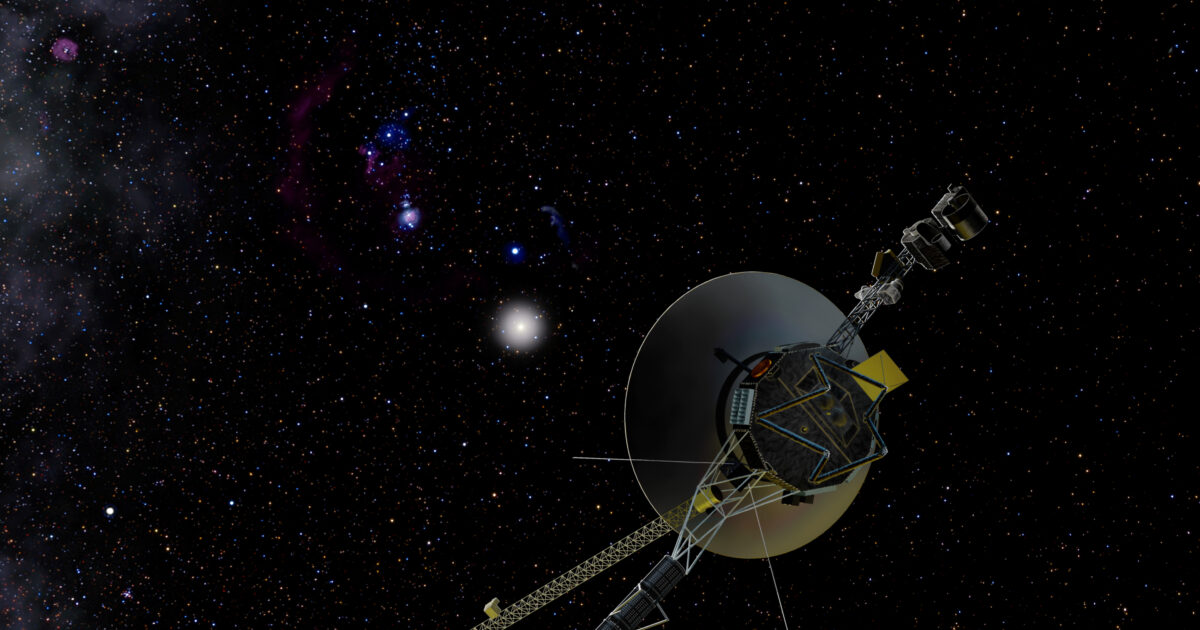
NASA's Voyager 1 reached one light-day from Earth on November 18, 2026, becoming the first human-made object to achieve this distance. At 25.9 billion kilometers (16 billion miles) away, light from Earth now requires a full day to reach the spacecraft.
The twin Voyagers launched in 1977 on a mission intended to last only a few years. They exploited a rare alignment of the outer planets occurring roughly once every 175 years to travel from one giant planet to the next. At Saturn, the team directed Voyager 1 on a close pass by Titan that ejected it from the planetary plane and onto its current trajectory. Voyager 2 continued to Uranus and Neptune, remaining the only spacecraft to have visited those ice giants.
Voyager 1 crossed the heliopause in 2012, entering interstellar space as the first human-made object to do so. The heliopause marks where the Sun's solar wind and magnetic field meet the interstellar medium. Voyager 2 will reach one light-day around 2035 but is unlikely to still function by then, making Voyager 1 probably the only spacecraft to transmit from that distance during human lifetimes.
Linda Spilker, Voyager project scientist at NASA's Jet Propulsion Laboratory, joined Spilker's first job after college in 1977. She attended every planetary flyby and later led the Cassini-Huygens mission to Saturn before returning to Voyager as project scientist.
Voyager 1 currently travels at approximately 61,000 kilometers per hour (38,000 miles per hour). The spacecraft operates at 172.5 astronomical units from Earth. The team continuously manages the spacecraft's power budget, with Voyager losing four watts every four years. Engineers recently executed a procedure called the Big Bang, turning off powerful heaters and activating less powerful ones to extend operations.