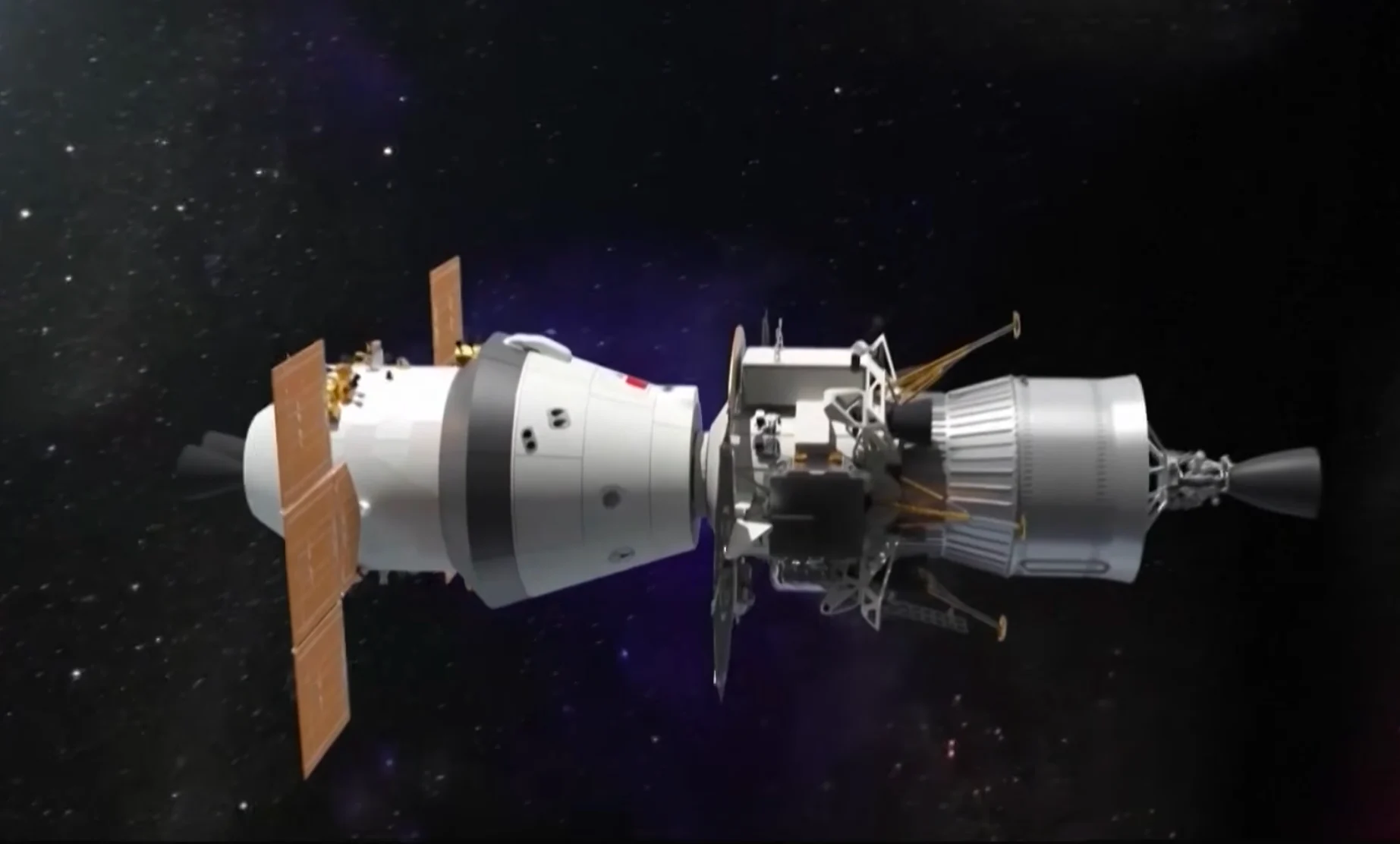
China has outlined its detailed roadmap for a crewed lunar landing before 2030, built on experience from its Tiangong space station operations. The plan calls for three uncrewed missions before attempting the country's first crewed landing.
The crewed spacecraft Mengzhou will rendezvous in lunar orbit with the lander Lanyue, which will already be waiting there. Two crew will descend to the lunar surface for approximately three days while a third crew member remains in orbit aboard Mengzhou. The crew will conduct daily extravehicular activities during their stay, then ascend and dock with Mengzhou for the return home.
Unlike Apollo or Artemis, China plans no crewed test missions in low-Earth orbit before the lunar attempt. Instead, the country will leverage experience from its robotic Chang'e missions, which demonstrated autonomous lunar ascent and docking during Chang'e 5 in 2020 and Chang'e 6 in 2024.
The first uncrewed Mengzhou mission, dubbed Mengzhou-1, will launch on a Chang Zheng 10A rocket to the Tiangong station in early 2027, validating orbital docking and re-entry procedures. A second uncrewed mission around 2028 will send an uncrewed Lanyue lander to the Moon to demonstrate landing and ascent using a Chang Zheng 10 heavy-lift vehicle. The final uncrewed test, expected around 2029, will conduct a full dress rehearsal using two Chang Zheng 10 launches, one carrying Mengzhou and one carrying Lanyue.
Wang Xiang, Deputy Chief Designer of China's human spaceflight program and Chief Designer of the merged Lunar Exploration Project, outlined two principles guiding the effort. Any operation planned for lunar orbit will first be verified in near-Earth orbit using Tiangong. Anything involving crew will first fly uncrewed.
The Mengzhou spacecraft exists in two variants. The lunar version carries four engines and full-size tanks, while the low-Earth orbit version has two engines and smaller tanks. The Lanyue lander also comes in multiple configurations under consideration, including cargo, rover, and habitat-module versions.
Uncrewed landers will collect environmental data including lunar surface temperature, dust conditions, and spacecraft performance data to inform the design requirements for the Wangyu lunar suits and Tansuo rover systems during the planned three-day crew stay.