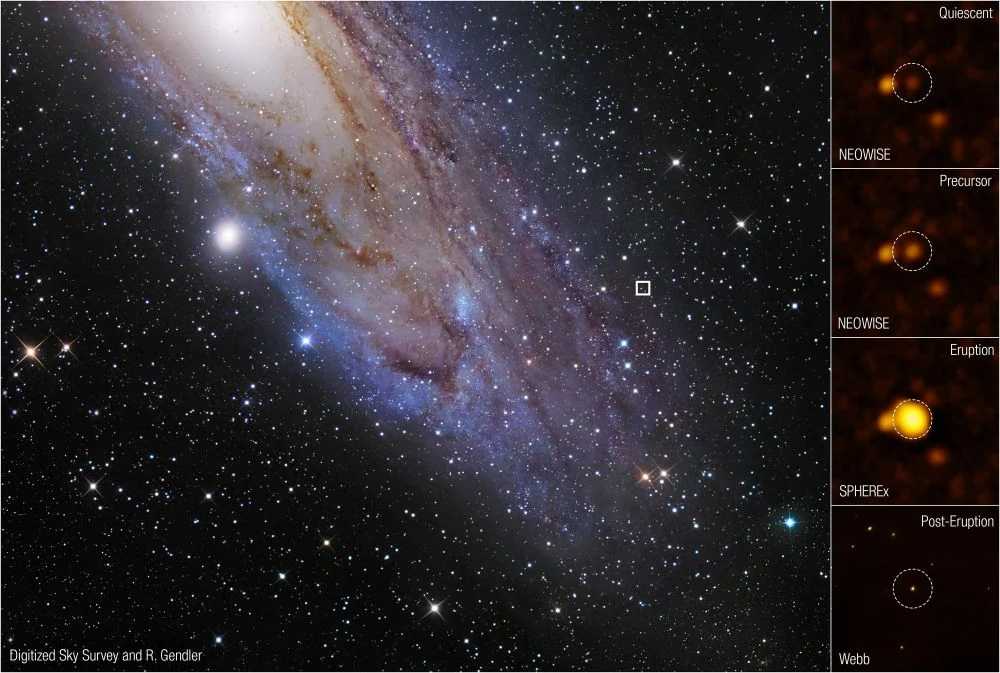
Astronomers observed the first real-time merger of two stars during common envelope evolution in the Andromeda Galaxy. The event, labeled AT 2025abao and nicknamed Bao, involved a primary star seven times more massive than the Sun merging with a companion star of only 0.7 solar masses.
Common envelope evolution occurs when one star in a binary system expands and engulfs its companion in a shared envelope of gas. Friction from this envelope drags the stars inward, eventually forcing them to merge and explode as a luminous red nova.
Astronomers detected unusual activity in Bao starting in 2023 and monitored it through 2025. The companion star spiraled into the primary in just seven orbits over about seven years, far faster than the thousands of years typical for such systems. In October 2025, the system erupted, brightening 100 times in the r-band over 25 days.
The James Webb Space Telescope observed Bao only 47 days after the eruption peaked, the earliest follow-up observation of such an event. Webb captured detailed spectroscopy showing how the companion's surface peeled away as orbital drag forced it inward.
"Stellar mergers are very, very difficult to observe in real time because they are hard to predict," said Viraj Karambelkar, first author of the study published in Nature and a NASA Hubble Fellow at Columbia University. "However, we noticed something unusual was going on in 2023 and continued to monitor the system to see what it would do. Then, in 2025, it erupted!"
The research combined telescope observations with simulations to reconstruct the merger. The primary star possessed a radius 350 times larger than the Sun and shone 18,000 times brighter. Data from SPHEREx, a near-infrared space observatory, provided crucial spectroscopic measurements during the event's rapid optical fading phase.