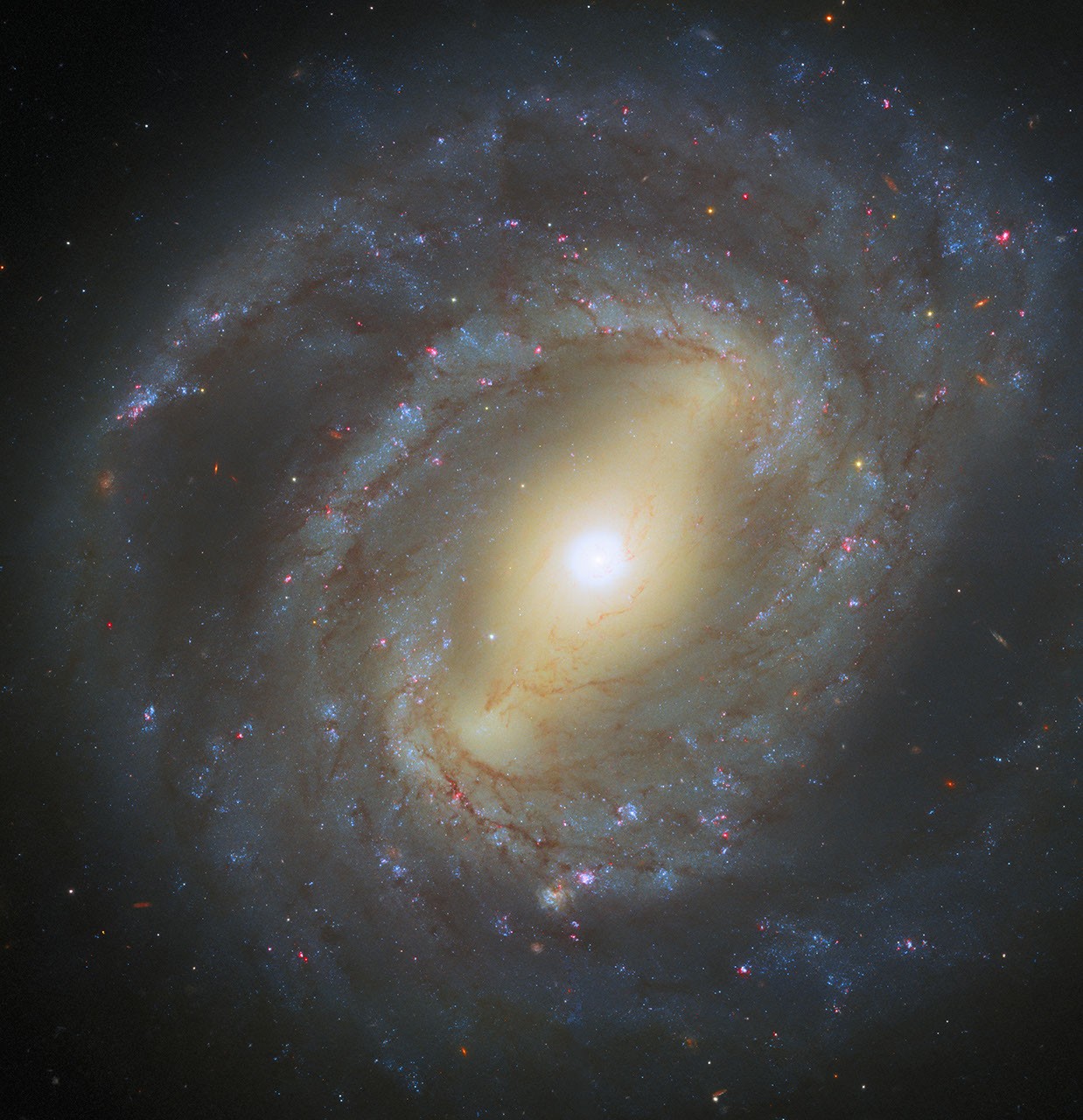
The Hubble Space Telescope captured a new image of NGC 4394, a barred spiral galaxy located 55 million light-years away in the constellation Coma Berenices. The galaxy is a member of the Virgo Cluster, the galaxy cluster closest to Earth, and contains more than 1,000 galaxies.
NGC 4394 resembles how the Milky Way would appear if viewed face-on. Its most striking feature is a galactic bar, a straight streak of stars running through the galaxy's center. Astronomers estimate that 65 percent of nearby spiral galaxies contain such bars.
Galactic bars form when a galaxy's disk of stars becomes unstable due to gravitational interactions with passing galaxies, stellar interactions, or other forces. Once unstable, the circular orbits of stars become elongated, creating the barred shape. Observations show that barred galaxies are more common today than they were several billion years ago, though research suggests this prevalence is temporary. As bars accumulate mass, they can themselves become unstable.
NGC 4394 and the Milky Way may share another feature: a LINER, or low-ionization nuclear emission-line region, an area near a galaxy's center with specific ionized or neutral elements in its spectra. Researchers do not yet know exactly how LINERs form, though supermassive black holes or intense star formation likely play a role.
The image combines observations from two Hubble programs. A previous image from a decade ago captured NGC 4394 as a parallel observation while studying the neighboring galaxy Messier 85. The new image incorporates recent observations using Hubble's Wide Field Camera 3 to determine the ages of individual star clusters in NGC 4394, one of 40 galaxies studied to understand how star formation ends in dense cluster environments.