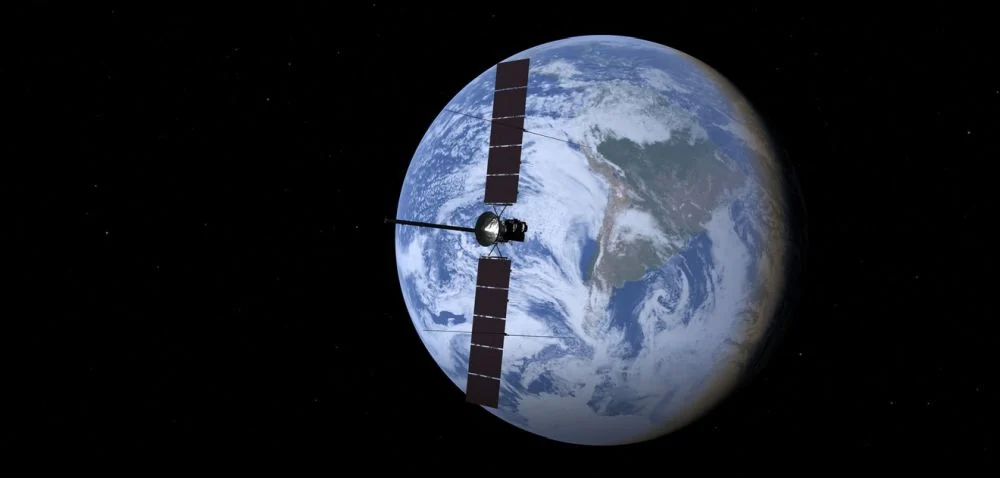
NASA's Europa Clipper will perform a gravity-assist maneuver on December 3rd to accelerate toward Jupiter. The spacecraft will pass within 3,140 to 3,450 kilometers above West Africa at 3:14 p.m. EST, becoming visible in backyard telescopes across Africa and southern Europe.
The maneuver conserves propellant by using Earth's gravity to increase the Clipper's velocity and alter its trajectory. Even with half of its launch mass as propellant, the spacecraft needs this flyby and an earlier gravity-braking maneuver at Mars in March 2025 to reach Jupiter, where it will enter orbit in April 2030.
During the Earth flyby, all 11 of the Europa Clipper's science instruments will activate for calibration. The nine science teams will compare their Earth data to known information about the planet to refine their measurements before reaching Europa.
The magnetometer receives particular attention during the flyby. It must distinguish Europa's magnetic field, which would be generated by a conductive salty subsurface ocean, from Jupiter's vast and powerful magnetic field. Earth's well-understood magnetosphere provides an ideal calibration target. The magnetometer also must account for over 300 magnetic sources within the spacecraft itself, though a boom called the Magboom positions the sensor as far as possible from these sources.
Robert Pappalardo, Europa Clipper's project scientist at NASA's Jet Propulsion Laboratory, explained the purpose: "The flyby will enable us to calibrate the instrument absolutely, using its observations at Earth to refine other calibrations done before launch and in flight."
Other instruments will also test their capabilities. The E-THEMIS thermal imaging system will scan Earth every eight hours. The MISE spectrometer and Europa-UVS ultraviolet spectrograph will operate alongside the Lunar Reconnaissance Orbiter, which will make simultaneous observations for cross-calibration.