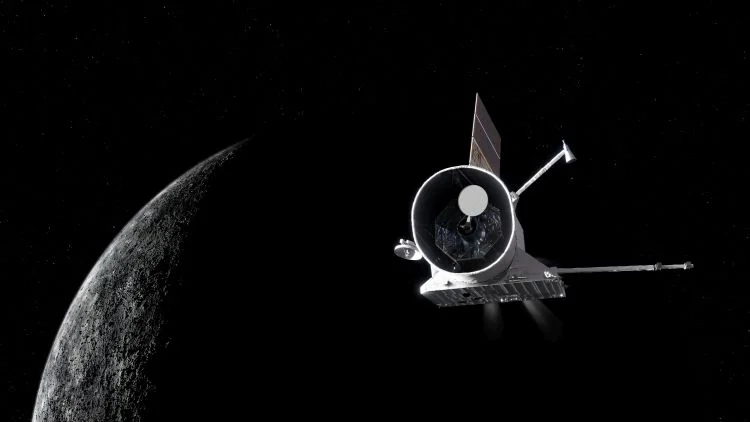
BepiColombo, a joint mission by the European Space Agency and Japan Aerospace Exploration Agency, achieved Mercury orbit insertion on November 21 at 18:27 UTC after traveling for 8 years, 1 month, and 1 day since its October 20, 2018 launch. The spacecraft completed one Earth flyby, two Venus flybys, and six Mercury flybys to reach orbit.
BepiColombo becomes the second spacecraft to orbit Mercury. NASA's MESSENGER orbited the planet from March 2011 to April 2015, completing more than 4,100 orbits and obtaining almost 300,000 images of Mercury's surface.
The mission consists of two orbiters currently attached: ESA's Mercury Planetary Orbiter (MPO) and JAXA's Mercury Magnetospheric Orbiter, called Mio. The two spacecraft will separate in early December 2026. The MPO will study Mercury's surface features and composition while Mio investigates Mercury's magnetic field and its interaction with the solar wind.
Science operations are expected to begin in April 2027 and run through April 2028, with a potential extended mission lasting until December 2029. Before reaching its final orbit, BepiColombo's thrusters will fire several times over the coming months to adjust its trajectory.
Dr. Geraint Jones, Lead Project Scientist for ESA's BepiColombo, said the almost 600-strong science team will begin revealing more about Mercury from its interior and surface to the space around it.