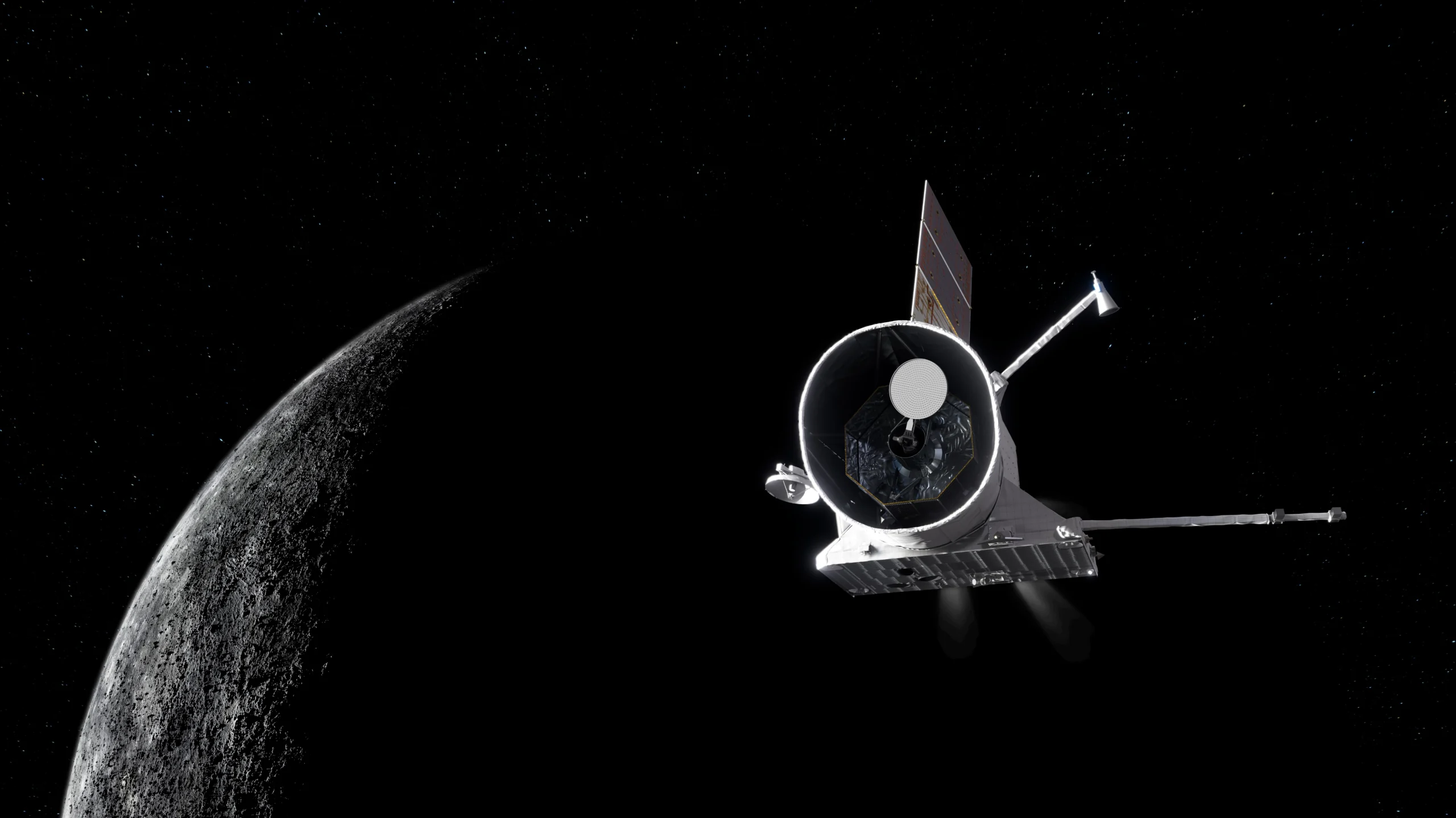
The European Space Agency and Japan Aerospace Exploration Agency's BepiColombo mission fired its thrusters at 18:24 UTC on Nov. 21 to enter orbit around Mercury. The 37-minute burn successfully placed the two-spacecraft stack into Mercury orbit, though a software issue caused the thrusters to fire for a shorter-than-expected duration.
BepiColombo reestablished contact with Earth at 01:02 UTC on Nov. 22. Mission teams stated that little corrective action would be needed to carry out the mission, as they had designed the trajectory with adequate margins for unexpected scenarios.
The mission launched on Oct. 20, 2018, from French Guiana atop an Ariane 5 rocket. It reached Mercury after a complex seven-year journey involving nine gravity-assist flybys: one at Earth, two at Venus, and six at Mercury. The second Venus flyby on Aug. 10, 2021, occurred just 33 hours after ESA's Solar Orbiter performed a similar gravity assist at the same planet.
BepiColombo comprises the Mercury Planetary Orbiter, built by ESA, and the Mercury Magnetospheric Orbiter, built by JAXA. The Mercury Transfer Module, which provided propulsion during the long cruise, separated on Sept. 3, 2026. The mission's instruments began limited science operations during the planet flybys, with the first Mercury flyby on Oct. 1, 2021, passing within 199 km of the surface.