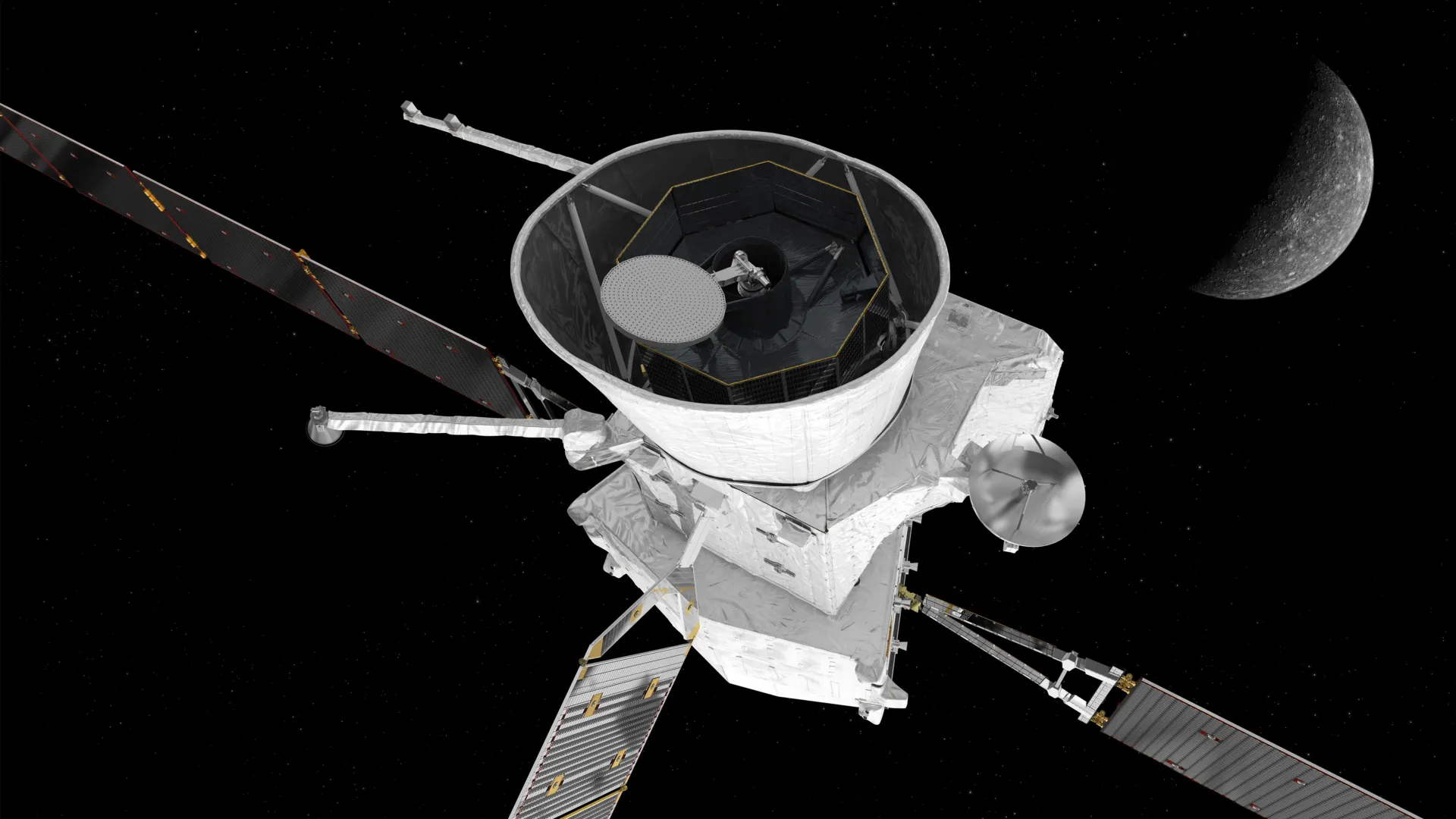
The Mercury Imaging X-ray Spectrometer (MIXS) aboard the ESA and Japan Aerospace Exploration Agency's BepiColombo mission has successfully detected X-rays from the Crab Nebula after eight years in space and a 10 billion kilometer journey. The British-built instrument, operated by scientists at the University of Leicester, captured the observations on September 11 and 12 following the separation of BepiColombo's Mercury Transfer Module, which had blocked the telescope's view until early September.
The team selected the Crab Nebula, located 6,500 light-years from Earth, as MIXS's first target because its strong and predictable X-ray signal provides an ideal reference for testing instrument performance. Over 39 hours, the spacecraft made 55 controlled orientation changes to collect data. Analysis showed that MIXS delivered slightly sharper angular resolution than it achieved during laboratory tests in 2015.
Professor Emma Bunce, Principal Investigator for MIXS at the University of Leicester, stated: "We have waited a long time to make measurements with MIXS and it is fantastic to see it operating brilliantly in space. This is testament to our engineering and technical team, and our international partners who we have worked with over many years to build this incredible instrument. 80% of the technology on MIXS is new!"
The detector shows no radiation damage after eight years in space. Engineers detected no stray visible light interfering with images, and cosmic ray effects are understood well enough to be filtered during data processing. The instrument exhibits some self-fluorescence when sunlight strikes its optics, but this will not affect observations of Mercury's dayside surface. Some effects remain under investigation, with further optimization expected during Mercury commissioning.
BepiColombo enters orbit around Mercury on November 21. MIXS will map Mercury's surface composition by detecting fluorescent X-rays released when solar X-rays strike rocks. It is the first imaging X-ray telescope aboard a planetary science mission and the only UK-led scientific instrument on BepiColombo. The instrument will work with the Solar Intensity X-ray and particle Spectrometer (SIXS) to monitor solar radiation reaching Mercury.
Dr. Adrian Martindale, MIXS Instrument Scientist, has worked on the project since 2003 as an undergraduate student. He said: "This first data is mind-blowing to me. The last time we could see through this telescope it was in the basement under the School of Physics and Astronomy in Leicester, but after a rocket launch, eight years in space and 10 billion kilometers traveled it looks just the same."