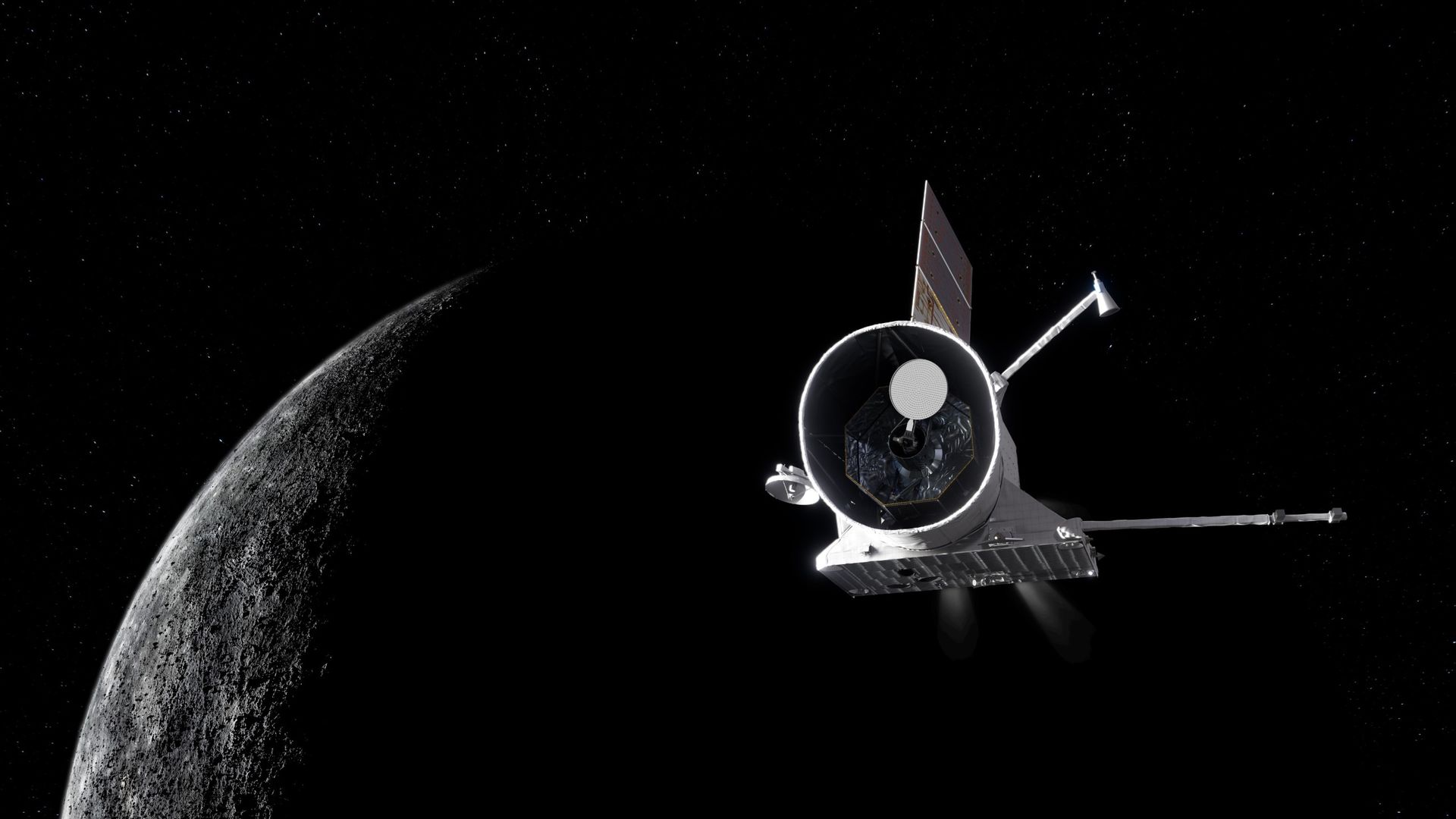
The European Space Agency and Japan's Aerospace Exploration Agency reached Mercury orbit today with their BepiColombo mission, arriving after more than eight years of spaceflight. The orbit-insertion burn began at 1:24 p.m. EST and lasted 37 minutes.
BepiColombo carries two spacecraft. ESA's Mercury Planetary Orbiter and JAXA's Mercury Magnetospheric Orbiter, also called Mio, launched from French Guiana in October 2018 aboard an Ariane 5 rocket. A power and propulsion element called the Mercury Transfer Module carried both orbiters on a looping path through the inner solar system.
Reaching Mercury requires a complex trajectory because the planet sits so close to the sun. Solar gravity accelerates approaching spacecraft to high velocities, forcing them to shed enormous energy to be captured by Mercury's weaker gravity. BepiColombo's route included one Earth flyby, two of Venus, and six of Mercury over roughly seven years. A solar panel issue extended the journey by one additional year.
The two orbiters remain connected today and will separate around December 9. Mio will enter a highly elliptical polar orbit, while ESA's MPO will conduct engine burns before settling into a less elliptical polar orbit on March 10, 2027. BepiColombo begins science operations on April 6, 2027.
The probes will study Mercury's magnetosphere and its interaction with the solar wind, the planet's internal structure and iron core, and the origin of its magnetic field. ESA officials stated the data will help scientists understand how planets evolve near their parent star and reveal more about solar system formation overall.