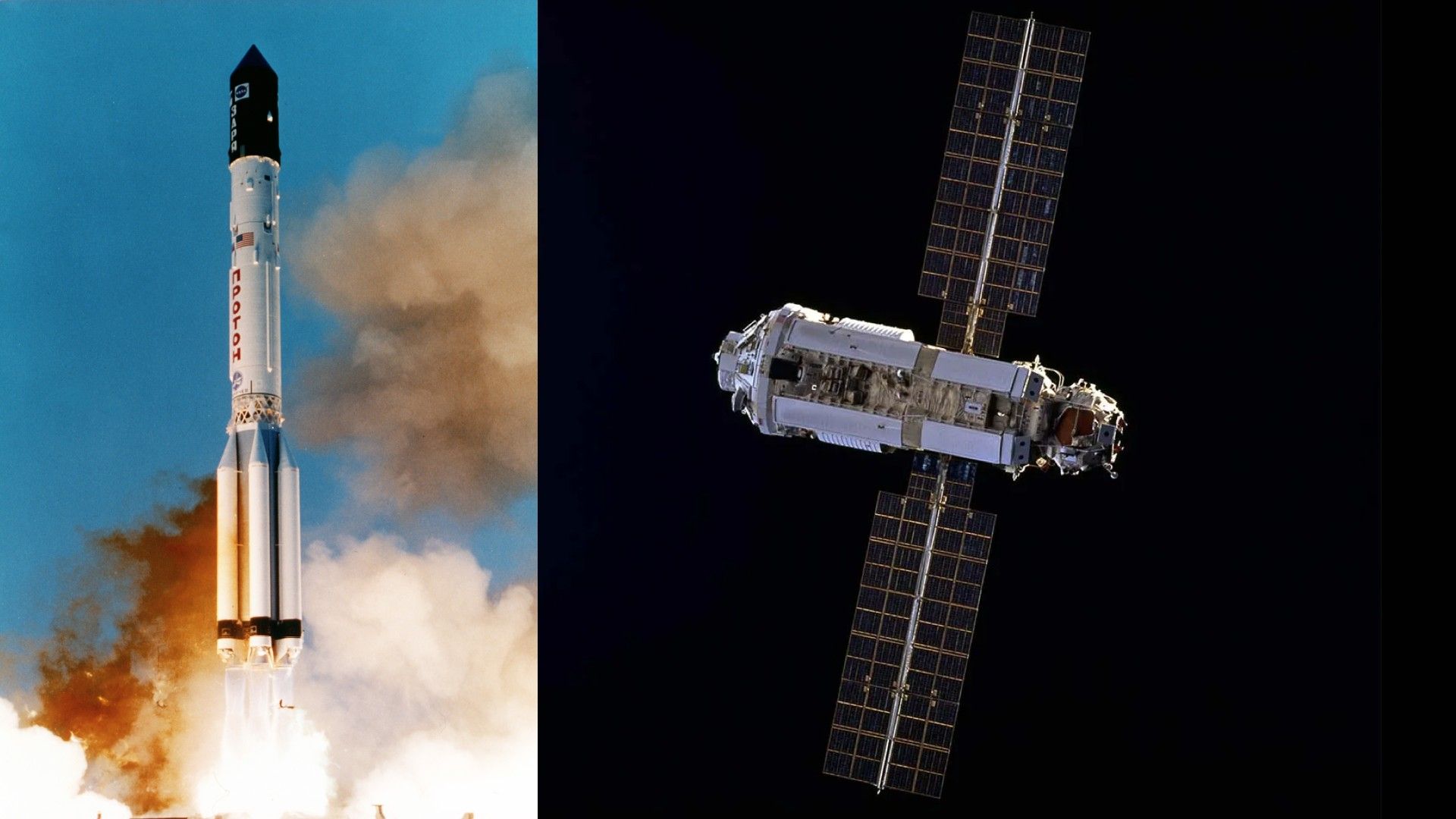
On November 20, 1998, Russia launched Zarya, the first module of the International Space Station, aboard a Proton rocket. The 42,000-pound module measures roughly 41 feet long and 13.5 feet wide, about the size of a tour bus. NASA paid $220 million for its construction at the Krunichev State Research and Production Space Center in Moscow, selecting a Russian company to build it for half what Lockheed Martin would have charged.
Two weeks after Zarya's launch, NASA's space shuttle Endeavour delivered the Unity module on STS-88. Astronauts aboard Endeavour connected the two modules in orbit. Zarya serves as the core module around which all other ISS components attach. It carries two solar arrays for power and 16 external tanks for propellant storage. The module also features docking ports for Russian Progress cargo ships and Soyuz spacecraft.
Russia's Zvezda service module launched in 2000 and docked with Zarya's aft port. Only then did the station grow large enough to accommodate its first three-person crew, Expedition 1. Over 28 years, components built by Russia, NASA, Europe, Canada, and Japan expanded the station to roughly the size of a football field, now hosting up to seven crewmembers. Many ISS components could not be tested together on the ground, meaning their first connection occurred in space during construction.