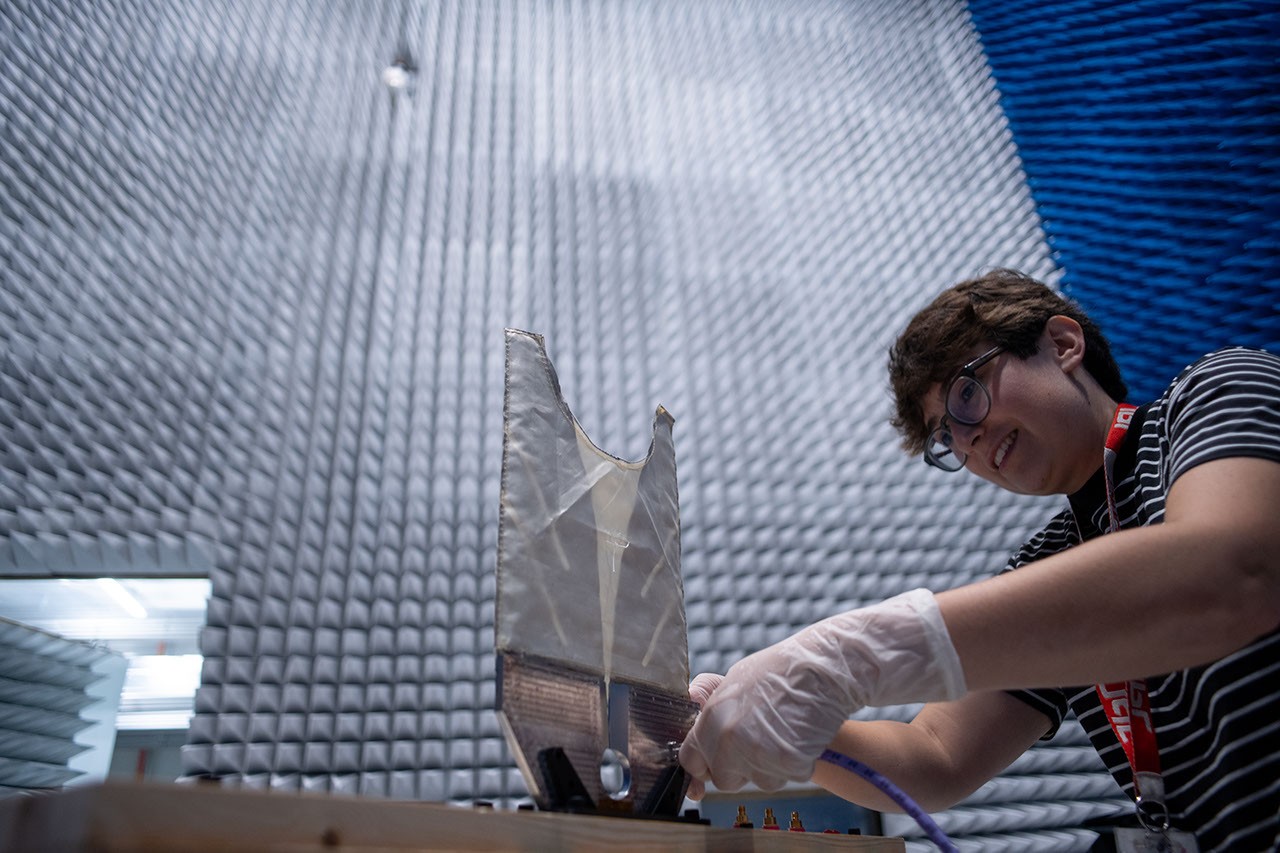
NASA's SkyFall mission is undergoing critical antenna validation at the Jet Propulsion Laboratory in Southern California. Engineer Maya Román and her team are testing ground-penetrating radar equipment in the Environmental Test Lab's electromagnetic interference chamber, a facility designed to isolate signals from external noise sources.
The SkyFall spacecraft carries four instruments per antenna configuration. Ground-penetrating radar represents one of the mission's core sensing technologies, enabling subsurface analysis of planetary bodies and celestial objects. During testing, technicians orient the antenna upward to minimize reflections and interference patterns that could corrupt measurement data. This precision approach ensures the instruments will function reliably once deployed in space.
Antenna testing represents a foundational phase of spacecraft development. Engineers must verify that each component transmits and receives signals exactly as designed before launch. Any deviation in antenna performance can compromise the entire mission's scientific objectives. The electromagnetic interference chamber provides a controlled environment where engineers can measure antenna patterns without contamination from external radio signals or reflected waves.
SkyFall joins NASA's growing fleet of radar-equipped orbiters and landers designed to map subsurface geology. Similar instruments aboard spacecraft like Mars Reconnaissance Orbiter and Lunar Reconnaissance Orbiter have revealed water ice deposits, underground voids, and geological structures invisible to optical cameras. Ground-penetrating radar penetrates meters to hundreds of meters below the surface, depending on the target material and frequency.
The mission's multi-instrument payload reflects NASA's shift toward comprehensive planetary reconnaissance. By equipping SkyFall with redundant instruments and rigorous testing protocols, the agency maximizes the probability of mission success and data quality. Validation work like Román's testing occurs years before launch, building the technical foundation for space exploration.