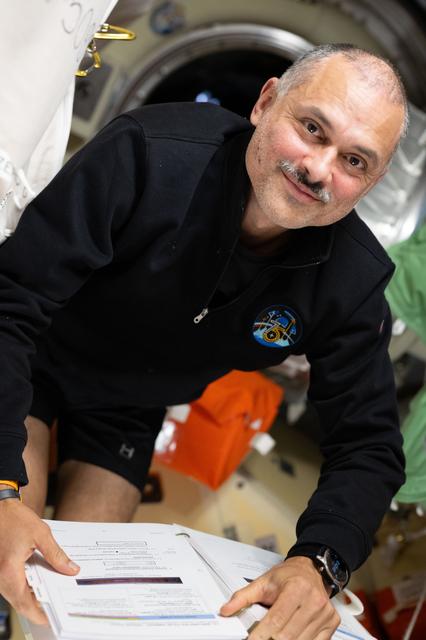
NASA Astronaut Anil Menon will conduct an in-flight question-and-answer session with students from New Hampshire on Thursday, September 24, starting at 11:40 a.m. EDT. Menon will respond to prerecorded STEM questions submitted by students while orbiting aboard the International Space Station, roughly 250 miles above Earth.
The Earth-to-space call represents a direct connection between classroom learners and active spaceflight operations. These educational exchanges have become routine components of ISS mission timelines, allowing NASA to engage young audiences in real time with astronauts conducting experiments and maintaining the orbital laboratory.
Menon joined NASA's astronaut corps in 2021 as part of the agency's 2021 class. He brings expertise in engineering and scientific research to the program. His presence aboard the ISS underscores NASA's commitment to staffing the station with crew members capable of executing complex research objectives while simultaneously supporting outreach activities that inspire the next generation of scientists and engineers.
The prerecorded format allows students to submit questions in advance, giving them time to craft inquiries about spaceflight, microgravity research, station operations, or broader topics in STEM fields. Students typically ask about daily life aboard the ISS, how experiments work in weightlessness, what astronauts eat, and how the spacecraft operates. These exchanges demystify space exploration and demonstrate that the work conducted aboard the station connects directly to problems being solved on Earth.
New Hampshire students will join a long tradition of educational outreach from the ISS program. NASA designates specific communication windows during each mission to accommodate school groups, typically scheduling them during daylight hours when the station passes over populated regions. The timing on September 24 allows the ISS to be visible from New Hampshire during the call window, creating conditions for optimal signal reception.
The International Space Station continues as humanity's only permanently crewed orbital laboratory. It hosts experiments in materials science, biology, physics, and Earth observation that cannot be replicated under Earth gravity conditions. Menon and his crewmates conduct these investigations while maintaining the station's systems, performing spacewalks when necessary, and receiving cargo resupply missions.
NASA encourages educators to incorporate these live calls into classroom activities, treating them as teachable moments that connect abstract STEM concepts to tangible space operations. Schools often prepare students by reviewing mission objectives, studying the effects of microgravity, or researching the astronauts' backgrounds and previous flight experience.
For New Hampshire students, this September 24 call offers an opportunity to interact with someone actively participating in one of humanity's most complex technical endeavors. Such exchanges reinforce that careers in science, technology, engineering, and mathematics lead to meaningful work at the frontier of human spaceflight. The questions students ask and answers Menon provides will ripple through classrooms and beyond, shaping how young people perceive possibility in space exploration.