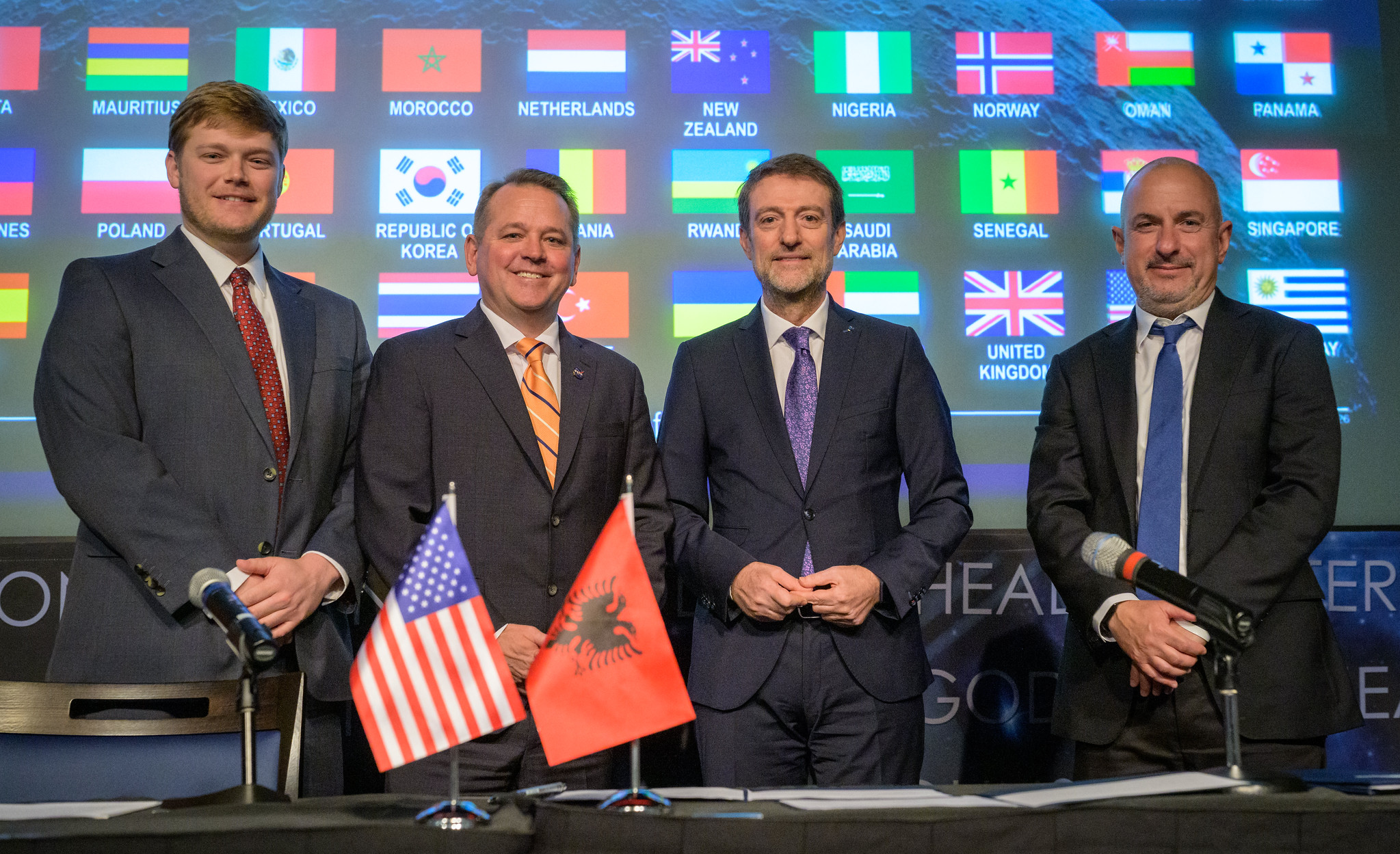
Albania became the 73rd nation to sign the Artemis Accords on Monday, joining a coalition of countries committed to responsible space exploration under the framework NASA established in 2020. The signing ceremony took place at NASA headquarters in Washington, marking another step in building international consensus around lunar exploration governance.
The Artemis Accords represent NASA's effort to establish shared principles for space activity as multiple nations pursue lunar missions. The agreement emphasizes transparency, safety, and the peaceful use of space resources. Signatories commit to operating in accordance with the Outer Space Treaty, the foundational 1967 international agreement that bars weapons of mass destruction in space and on celestial bodies.
Since NASA unveiled the Artemis Accords five years ago alongside the United States Space Force, the initiative has grown steadily. The accords now encompass nations across Europe, Asia, the Americas, and Africa, reflecting broadening international interest in structured space exploration. Albania joins established space agencies and emerging spacefaring nations in endorsing the framework.
The accords address practical concerns that emerge as multiple countries operate on the Moon simultaneously. They establish guidelines for deconfliction of landing sites, safety zones around operational areas, and procedures for protecting historical sites. Signatories agree to publicly release scientific data from their missions and conduct environmental impact assessments before beginning operations. The framework also recognizes countries' rights to extract and use space resources, addressing concerns that had previously divided space-faring nations over resource ownership.
For NASA, each new signatory strengthens the coalition's legitimacy as the de facto standard for responsible lunar exploration. With the Artemis program targeting human lunar landings in the coming years, establishing international norms now prevents conflicts that could obstruct exploration later. The accords have attracted nations with varying levels of space capability, from countries with established space agencies to those building their first satellite programs.
Albania's addition reflects how the Artemis framework appeals across geopolitical lines. The Eastern European nation joins signatory countries including Poland, Romania, and other European states working within both NATO and EU structures alongside space-faring partners like Japan, South Korea, and Canada.
NASA continues recruiting additional signatories, aiming to build the broadest possible coalition before lunar operations intensify. The accords do not create binding international law but establish a political commitment that carries weight among participating nations. Countries that sign pledge to align their space activities with the principles, though enforcement mechanisms remain limited to diplomatic pressure and exclusion from partner programs.
The Artemis Accords serve as a template for managing shared space environments. As private companies accelerate lunar resource extraction plans and multiple national programs pursue lunar bases, establishing consensus on operational standards becomes increasingly essential. Albania's signature adds another voice to the growing agreement that cooperation and transparency will govern humanity's return to the Moon.