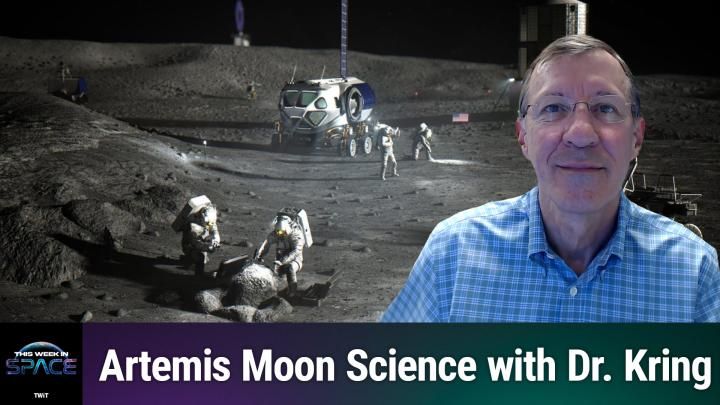
# Artemis Program Sets Ambitious Lunar Science Targets for Human Exploration
NASA's Artemis Program represents the most comprehensive lunar return mission framework since the Apollo era, and this week's episode of "This Week In Space" podcast examined the scientific foundation driving humanity's next steps on the Moon.
Episode 224 featured Dr. David Kring, a lunar scientist whose research has shaped NASA's understanding of the Moon's geology and resource potential. Kring joined hosts Rod Pyle and guest Rick Jenet to parse the technical and scientific objectives that distinguish Artemis from its predecessors.
The Artemis Program encompasses multiple phases. Artemis I, an uncrewed test flight of the Space Launch System (SLS) heavy-lift rocket and Orion capsule, completed its lunar orbit mission in December 2022. Artemis II will send four astronauts around the Moon without landing. Artemis III aims for a crewed lunar landing, targeting the Moon's south polar region. This geographic choice reflects a strategic shift in lunar exploration priorities.
The south pole offers conditions not available at Apollo landing sites. Permanently shadowed craters contain water ice, a resource critical for future human missions. Water can provide drinking water, oxygen production, and hydrogen fuel. The region also preserves a geological record older than sites visited by Apollo astronauts. Ancient impact basins there expose lunar bedrock from early Solar System formation, enabling scientists to study processes that shaped planetary bodies billions of years ago.
Kring's research has centered on understanding lunar geology and the potential for extracting resources. His work influenced NASA's selection of landing zones for Artemis III. The agency prioritized areas where scientific return and resource accessibility overlap, a departure from Apollo's emphasis on relatively flat, safe terrain near the lunar equator.
Artemis carries different instruments than those Apollo missions deployed. Modern sensors, spectrometers, and drilling equipment will characterize subsurface composition. Ground-penetrating radar will map ice deposits. Sample collection will target materials representing different geological ages and compositions. These samples return to Earth for laboratory analysis by teams of geologists, not just the handful of scientists who studied Apollo samples.
The program also establishes the Artemis Base Camp, a permanent lunar outpost concept. Unlike Apollo's brief sorties, Artemis envisions sustained human presence. This requires understanding local geology to support construction, resource extraction, and long-term operations. Scientists like Kring assist engineers in identifying terrain suitable for habitats, power systems, and mining infrastructure.
International collaboration shapes Artemis planning. The Artemis Accords, a set of principles endorsed by numerous space agencies, establish norms for lunar resource use and scientific cooperation. NASA partners with ESA, JAXA, CSA, and other agencies to share scientific data and coordinate lunar activities.
Timeline pressures influence Artemis science planning. NASA targets Artemis III landing around 2026, though this date remains subject to vehicle development and testing. The compressed timeline means scientists must prioritize the most valuable investigations. Every kilogram of payload carries trade-offs. Instrumentation, sample collection capacity, and crew activities require rigorous optimization.
The podcast discussion explored how Artemis bridges two exploration eras. Apollo satisfied the geopolitical imperative to reach the Moon first. Artemis prioritizes sustained presence and scientific discovery. The difference shapes where missions go, what they measure, and how long they stay.
For the broader space exploration agenda, Artemis establishes a foothold for deep space operations. The Moon serves as proving ground for technologies and procedures needed for Mars missions decades ahead. Human lunar presence demonstrates life support systems, radiation protection, and resource utilization techniques essential for farther worlds.