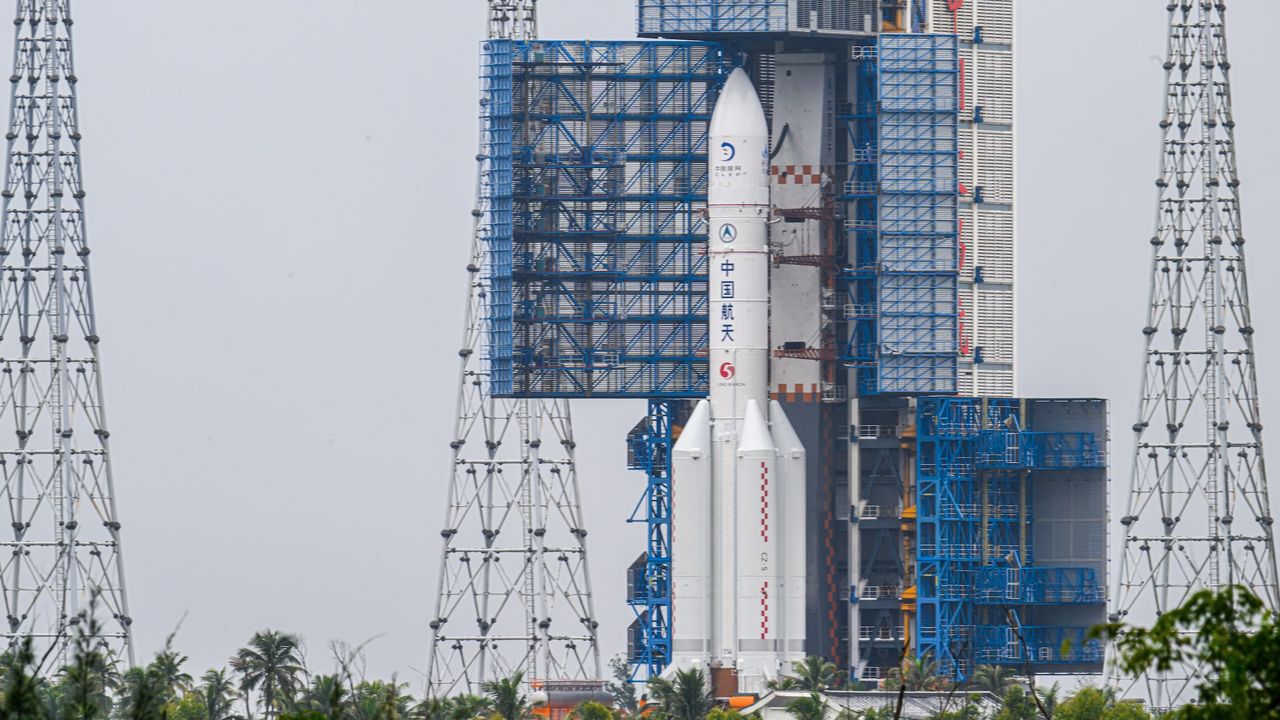
China postponed the launch of Chang'e 7, its most ambitious lunar exploration effort to date, after severe weather threatened operations at the launch facility. The mission targets the moon's south polar region, where scientists believe water ice deposits lie beneath the surface. A fresh launch window has not yet been set.
Chang'e 7 represents a major step forward in China's national lunar program. The mission will land a spacecraft equipped with instruments designed to detect and analyze subsurface ice at the moon's south pole, a region of intense scientific interest. Water ice at the lunar poles would transform human spaceflight plans. It offers a local resource for drinking water, oxygen production, and rocket fuel manufacture. These capabilities would make extended lunar habitation economically feasible.
The south polar region poses extreme navigation and landing challenges. Permanently shadowed craters trap cold enough to preserve water ice for billions of years. But these same features create communications dead zones and treacherous terrain for landing systems. China's spacecraft must operate in near-total darkness while transmitting data through relay satellites positioned at the lunar L2 point, roughly 65,000 kilometers beyond the moon's far side.
Chang'e 7 follows the success of Chang'e 5, which returned lunar samples to Earth in 2020. That mission collected 1,731 grams of material, the most extensive sample haul since NASA's Apollo 17 in 1972. Chang'e 7 advances beyond sample collection. It will deploy multiple instruments to measure ice concentrations, map terrain, and assess the energy environment. A rover and stationary lander will conduct coordinated observations across different locations within a target crater.
The Chinese National Space Administration (CNSA) selected the mission as part of its broader strategy to establish a lunar research station at the south pole in partnership with Russia. The station, called the International Lunar Research Station (ILRS), would support long-term scientific investigation and serve as a testbed for technologies needed for human lunar exploration. Chang'e 7 contributes critical reconnaissance data that will inform landing site selection and operational planning.
Weather delays at launch facilities occur routinely across all spacefaring nations. Storms, high winds, and lightning pose genuine hazards to rocket systems and ground personnel. The facility hosting Chang'e 7, identified as China's Wenchang Satellite Launch Center on Hainan Island, sits in a tropical region prone to severe weather systems. Meteorological forecasting precedes every launch attempt, and engineers abort when conditions fall outside safety parameters.
The delay does not affect China's broader lunar timeline. Multiple Chang'e missions remain in development. Chang'e 8, already in preparation, will conduct additional south polar surveys and test technologies for the ILRS. These missions, combined with crewed lunar programs under development, position China as a primary driver of polar exploration efforts.
The race for lunar south pole resources intensifies globally. NASA's Artemis program aims to land astronauts near Shackleton Crater, one of the most promising ice-bearing locations. India's Chandrayaan-3 landed successfully at the south pole in 2023. Russia and China frame the ILRS partnership as an alternative to NASA's Artemis program and its international consortiums.