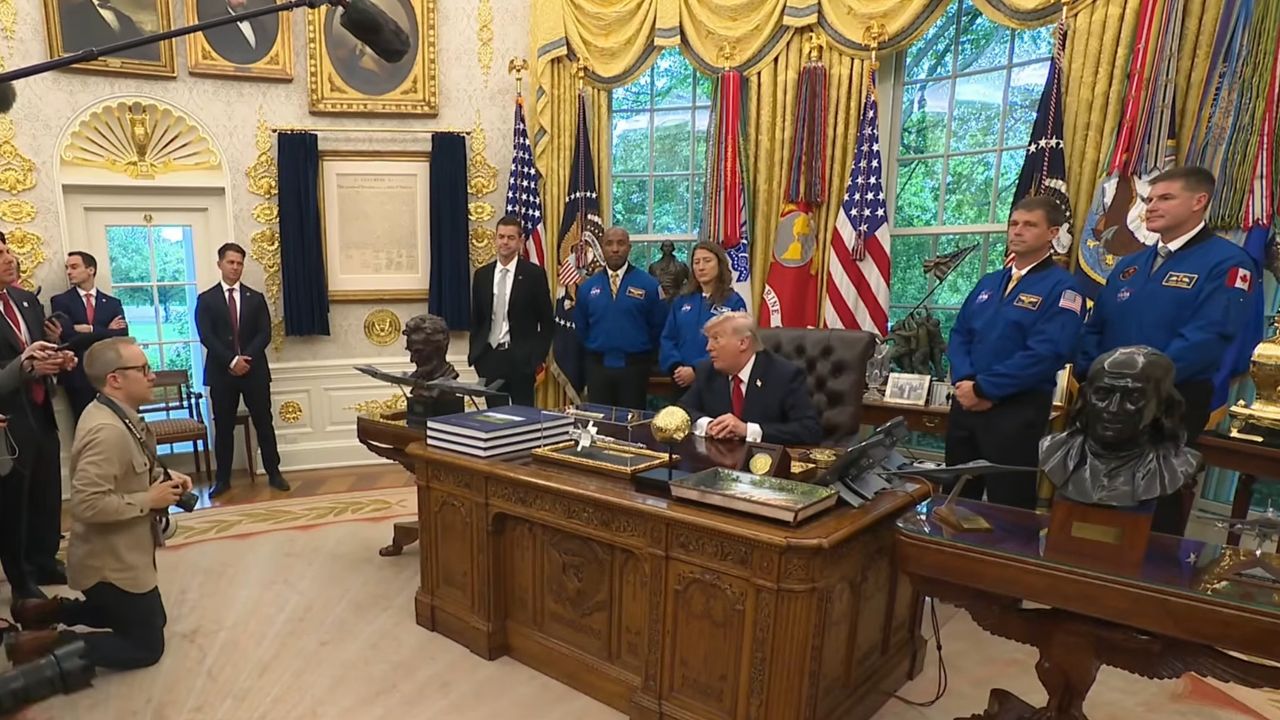
President Trump will present the Congressional Space Medal of Honor to the four NASA astronauts aboard Artemis II during a White House ceremony on August 28. The award recognizes Reid Wiseman, Victor Glover, Christina Koch, and Jeremy Hansen for their achievements in lunar exploration.
Artemis II launched in November 2022 and completed a ten-day mission that took the crew 270,000 miles from Earth to orbit the moon. The astronauts did not land on the lunar surface. Instead, they flew a figure-eight trajectory around the moon before returning to Earth in December 2022. This mission validated the Space Launch System rocket and the Orion spacecraft ahead of the planned Artemis III landing mission, which aims to put astronauts back on the moon for the first time since Apollo 17 in 1972.
The Congressional Space Medal of Honor stands as the highest civilian space award in the United States. Congress established the medal in 1978 to honor exceptional service and contribution to the aerospace field. Previous recipients include Sally Ride, the first American woman in space, and John Glenn, who orbited Earth in 1962.
Reid Wiseman served as commander of Artemis II. A U.S. Navy captain and veteran of two Space Shuttle missions and two International Space Station expeditions, Wiseman logged more than 500 hours in space before the lunar voyage.
Victor Glover held the pilot position. A U.S. Air Force colonel and experienced test pilot, Glover previously served as a flight engineer on the ISS and accumulated extensive spaceflight experience.
Christina Koch filled the mission specialist role. Koch gained prominence as the astronaut who logged the longest single spaceflight by a woman during her stay on the ISS in 2019. She spent 328 days in orbit.
Jeremy Hansen represented the Canadian Space Agency as a mission specialist, making him the first Canadian to travel beyond Earth orbit. Hansen's participation underscores the international nature of lunar exploration and NASA's partnerships with allied nations.
The Artemis II mission demonstrated critical capabilities required for human lunar exploration in an era of renewed space competition. The Soviet Union achieved the first human moon landing via Luna 2 in 1959, though unmanned. The United States accomplished six crewed moon landings through the Apollo program between 1969 and 1972. More than fifty years have passed since humans last walked on the lunar surface.
NASA's Artemis program aims to establish sustainable human presence on the moon and use it as a testing ground for deep space exploration. The agency plans to send humans to Mars in the 2030s or 2040s. Artemis III, scheduled for late 2026, will attempt the first crewed landing near the lunar south pole, targeting a region that may contain water ice and other resources.
The Congressional Space Medal of Honor carries scientific and symbolic weight. It acknowledges the extraordinary risks astronauts assume and validates government commitment to space exploration. The award comes as NASA navigates budget constraints and competing priorities in an era of expanded commercial spaceflight activity through companies like SpaceX and Blue Origin.