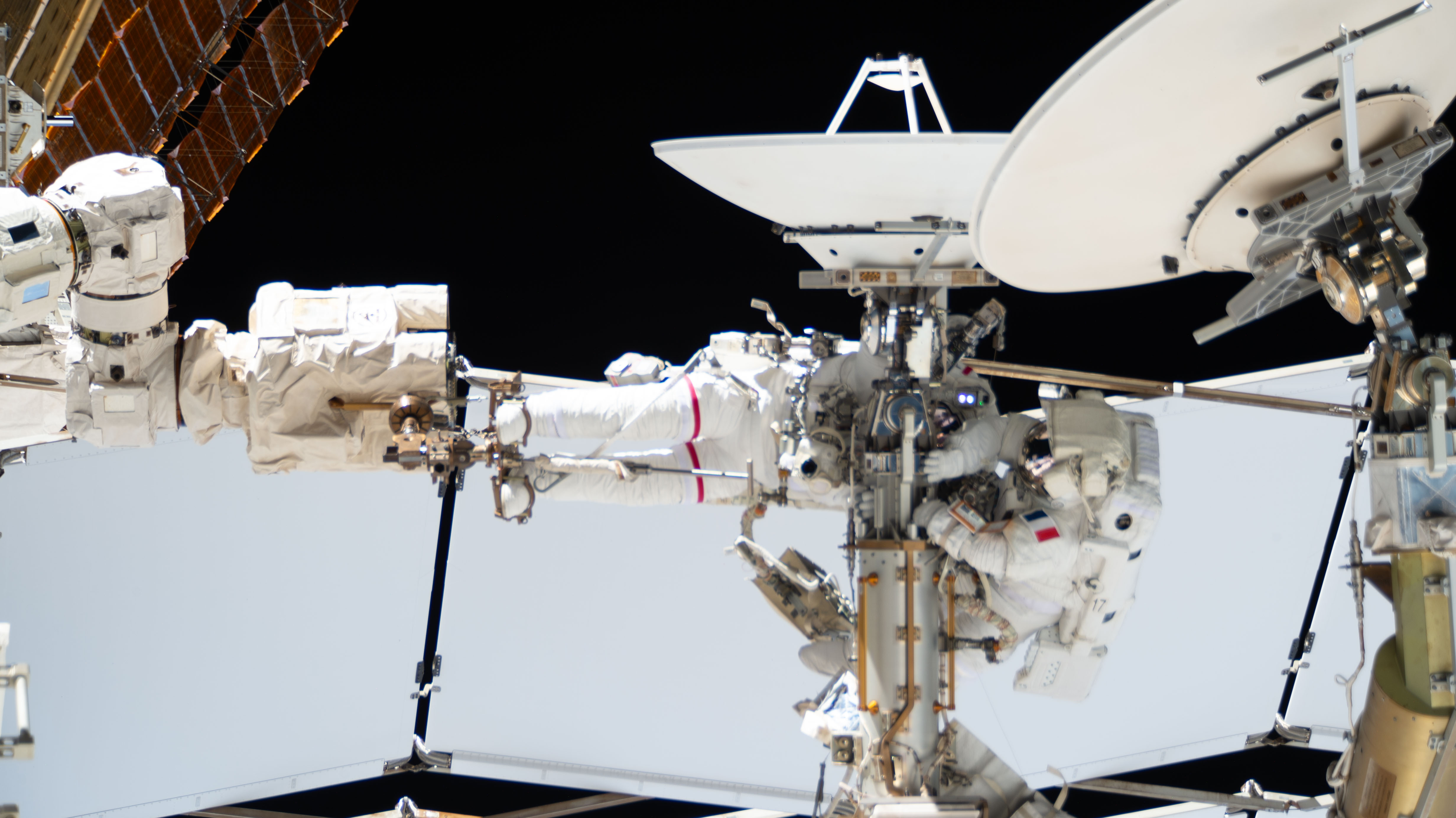
NASA astronaut Anil Menon and European Space Agency astronaut Sophie Adenot conducted a six-hour and 23-minute spacewalk on August 18, 2026, while stationed aboard the International Space Station as part of Expedition 75. The two flight engineers worked in tandem outside the orbital laboratory to advance installation of high-speed communications hardware, marking another step in the station's ongoing modernization efforts.
The spacewalk represents continued cooperation between NASA and ESA in maintaining and upgrading the ISS, the orbiting research platform operated by five space agencies. Menon, identifiable by the red stripe on his spacesuit legs, and Adenot, representing Europe's space program, executed tasks requiring precision work in the microgravity environment beyond the station's protective hull. The specific hardware they installed enhances data transmission capabilities critical for conducting scientific research aboard the station and coordinating operations with mission control centers on Earth.
Spacewalks remain among the most dangerous and technically demanding activities in human spaceflight. Astronauts rely on sophisticated suits that maintain pressurization, regulate temperature, supply oxygen, and protect against radiation and micrometeorite impacts. The six-plus-hour duration reflects the complexity of installation work performed during extravehicular activity. Each movement requires careful planning, as work gloves limit dexterity and astronauts operate tethered to the station to prevent drifting into space.
Menon and Adenot's mission aligns with ISS modernization priorities established by NASA and its international partners. The high-speed communications systems they installed enable faster transfer of experimental data from dozens of research facilities onboard the station. This infrastructure upgrade supports investigations in materials science, biology, physics, and Earth observation conducted by scientists worldwide.
The International Space Station continues operating as a collaborative endeavor involving NASA, ESA, Roscosmos, the Canadian Space Agency, and the Japan Aerospace Exploration Agency. Regular spacewalks maintain station systems, repair equipment, and implement upgrades ensuring the facility remains operational beyond its original planned completion date. As commercial space stations develop, ISS continues serving as a testing ground for technologies and procedures essential for long-duration human spaceflight.
Expedition 75 crew members like Menon and Adenot typically spend six months aboard the station conducting research, maintaining systems, and preparing for eventual hand-off to successor crews. Their spacewalk on August 18 contributed to the station's operational readiness and demonstrated the technical proficiency required for advanced human spaceflight operations.
The successful completion of this extravehicular activity reinforces international partnerships in space exploration and the ongoing commitment to maintaining humanity's permanent foothold in low Earth orbit. Future ISS operations will depend on continued spacewalk campaigns to address aging systems and implement new technological capabilities supporting both scientific research and preparation for missions to the Moon and Mars.