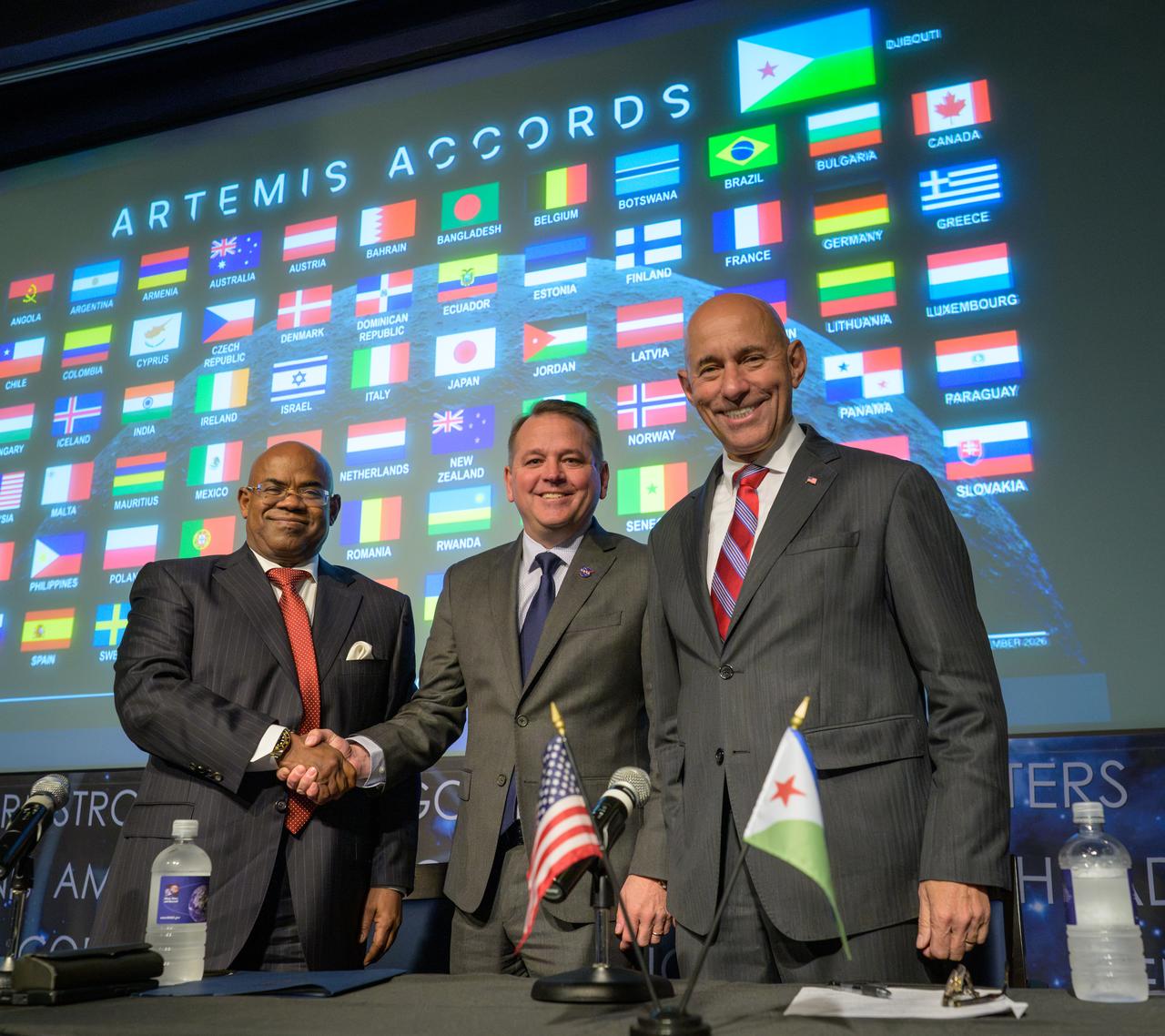
The Republic of Djibouti signed the Artemis Accords on Monday, becoming the 72nd nation to endorse NASA's framework for sustainable space exploration. The ceremony took place at NASA Headquarters in Washington, solidifying Djibouti's commitment to international cooperation in lunar and planetary missions.
The Artemis Accords represent a binding commitment to principles designed to govern how nations conduct space exploration. Established in 2020, the accords establish shared standards for safety, transparency, and coordination as countries pursue missions to the Moon, Mars, and deep space. Signatories pledge to conduct space operations transparently, register space objects with the United Nations, and work together to preserve the space environment for future generations.
Djibouti's signature marks a watershed moment for African participation in this framework. The East African nation becomes the eighth African country to join, following signatories including Nigeria, Rwanda, Kenya, South Africa, Angola, Benin, and Ghana. This expansion reflects growing momentum across the continent for structured engagement with space exploration governance at a time when emerging space nations seek to establish themselves as responsible actors in orbital and lunar activity.
The Artemis Accords emerged from NASA's vision for the Artemis program, the agency's initiative to return humans to the Moon and eventually establish a sustained presence there. Unlike previous space exploration frameworks that focused primarily on outer space as a global commons, the Artemis Accords specifically address practical coordination mechanisms. They establish peaceful principles for resource extraction, research zones around landing sites, and safety protocols for operations in the lunar environment.
The framework gained rapid international adoption. Within its first year, over 30 nations signed on. Today, with Djibouti's addition, the accords represent a de facto standard for space-faring nations and those preparing to become space-faring. The agreement does not require signatories to contribute financially to NASA's Artemis program. Rather, it establishes a shared legal and operational foundation that makes international space missions more predictable and reduces the risk of conflicts over territorial claims or resource disputes.
For Djibouti, signing carries particular strategic weight. Located at the mouth of the Red Sea, the nation hosts multiple international military and commercial operations. Its entry into the Artemis framework positions it alongside global partners in space governance and reflects its commitment to international law and cooperation on emerging domains. The signature also signals Djibouti's interest in participating in the broader ecosystem of space technology, potentially opening doors for scientific collaboration and commercial opportunities.
The accords remain voluntary, and no enforcement mechanism compels compliance beyond diplomatic pressure and potential exclusion from coordinated NASA-led initiatives. However, their near-universal acceptance among spacefaring nations demonstrates broad agreement that transparent, safety-first exploration serves everyone's interests. As competition for lunar resources and landing sites intensifies in the coming decade, the accords provide an agreed-upon ruleset that reduces uncertainty and maintains the peaceful exploration of space as a shared objective rather than a zero-sum competition.