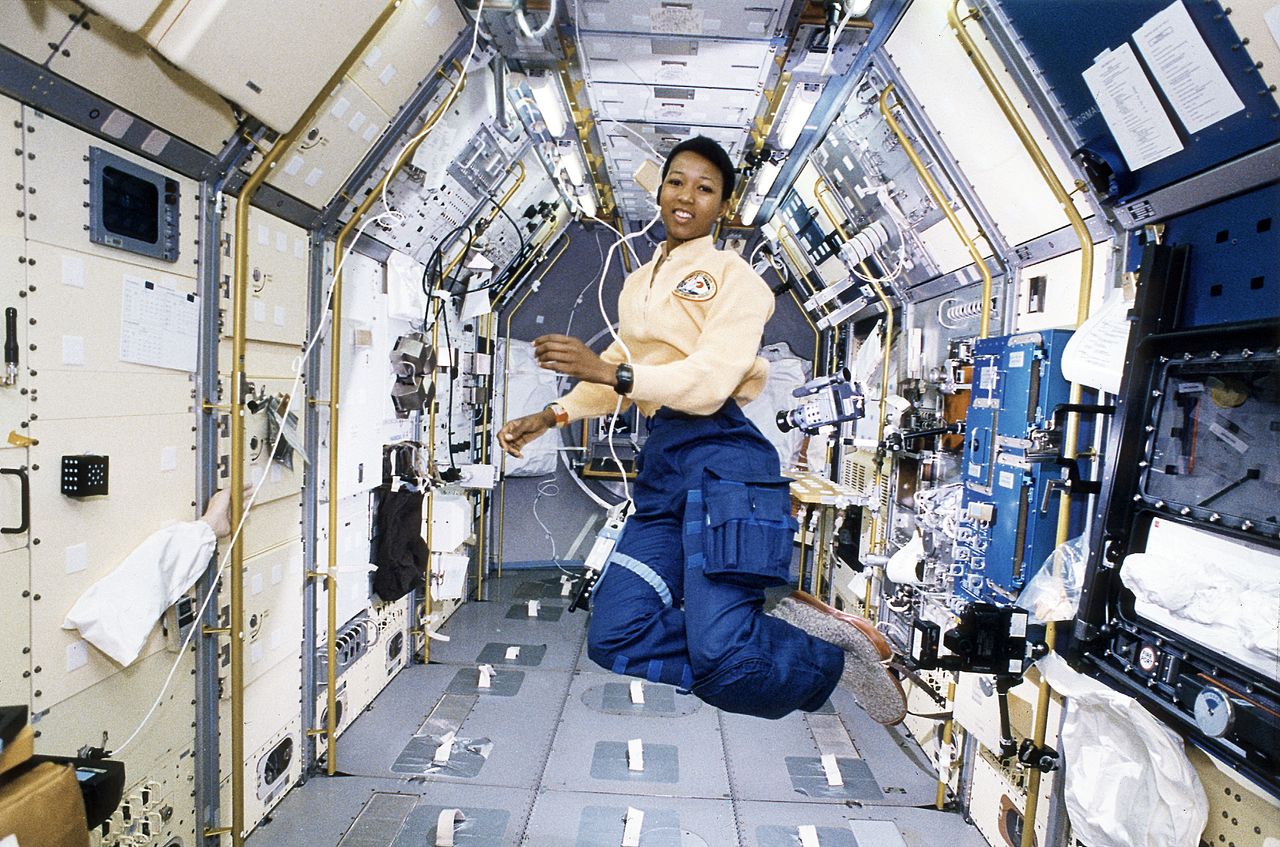
On September 12, 1992, Mae Jemison launched aboard Space Shuttle Endeavour as a mission specialist, becoming the first Black woman to reach orbit. The eight-day STS-47 mission carried Jemison and six crewmates to conduct experiments in life sciences and materials research in the shuttle's Spacelab module.
Jemison's ascent represented a watershed moment for representation in the American spaceflight program. She arrived at NASA after earning a medical degree from Cornell University and serving as a general practitioner and flight surgeon in the U.S. Air Force. She joined the astronaut corps in 1987, selected as part of the first group to include women with diverse backgrounds following the shuttle program's expansion in the 1980s.
Her flight came nearly two decades after Sally Ride became the first American woman in space in 1983, and more than a decade after Guion Bluford Jr. became the first African American astronaut in orbit in 1983. Yet the intersection of those two barriers remained unbroken until Jemison's launch. She was only the second African American astronaut to fly to space, and her achievement highlighted the persistence of systemic gaps in aerospace careers despite earlier breakthroughs.
During STS-47, Jemison worked as the primary investigator for two experiments. She conducted a bone cells study examining how microgravity affected cellular growth, research directly applicable to understanding osteoporosis and muscle atrophy during spaceflight. She also performed experiments on motion sickness in space, gathering data that would improve crew health protocols for future missions.
Jemison's presence in the astronaut office signaled a shift at NASA toward broadening the pool of talent recruited for space operations. Her flight demonstrated that excellence in science, medicine, and engineering could come from backgrounds historically excluded from the space program. After leaving NASA in 1993, she founded The Jemison Group and established the 100 Year Starship Initiative, focusing on developing technologies for interstellar travel within a century.
The symbolism of her mission resonated far beyond the technical achievements. Young Black women and girls witnessed an astronaut who looked like them conducting sophisticated research aboard the most complex machine humanity had built. Jemison became a visible proof that leadership roles in space exploration were not limited by race or gender, only by talent and dedication.
STS-47 occurred during a period of intense shuttle operations. NASA was flying missions approximately every two weeks in the early 1990s. Endeavour, the third shuttle orbiter, had entered service in 1992 just months before Jemison's flight. The mission deployed the Japanese Spacelab-J module, a collaborative effort between NASA and Japan's space agency that emphasized the shuttle's role in international scientific cooperation.
Jemison's flight path into space illustrated how astronaut selection had evolved since the Mercury program's early emphasis on military test pilots. NASA increasingly sought scientists and physicians whose expertise would drive a shift from pure exploration toward sustained orbital research. Her mission contributed critical data on human physiology in microgravity, knowledge essential for longer-duration spaceflight.