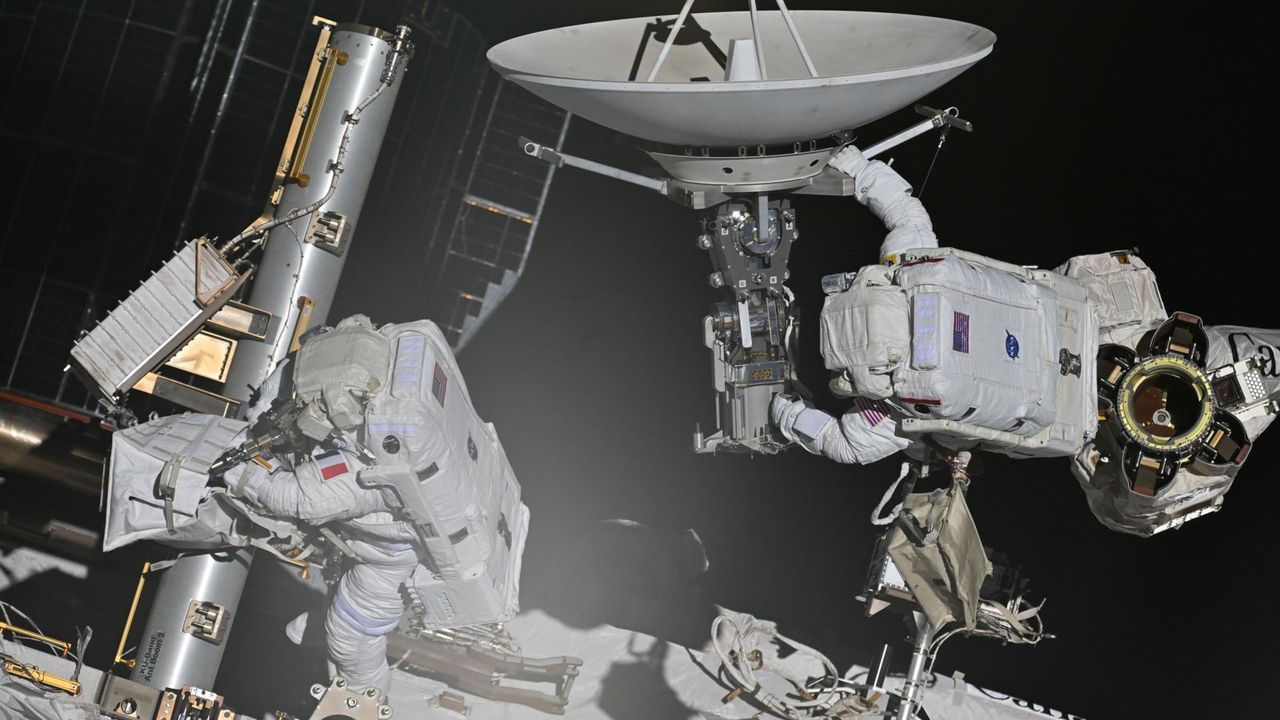
ESA astronaut Sophie Adenot and NASA astronaut Anil Menon completed a spacewalk on August 18, 2026, conducting repair work on the International Space Station. The mission marked a notable achievement in human spaceflight, demonstrating the ongoing collaboration between European and American space agencies to maintain the orbiting laboratory.
The spacewalk occurred during Expedition 76 aboard the ISS, where both astronauts operated in the vacuum of space to address maintenance priorities on the station. Menon, a veteran of multiple missions, worked alongside Adenot, the first woman astronaut from the European Space Agency to conduct extravehicular activity in service of ISS operations. Their combined expertise enabled them to complete complex repair tasks that required direct human intervention outside the station's pressurized modules.
Spacewalks remain among the most demanding and dangerous activities in human spaceflight. Astronauts must rely on their spacesuits, tethers, and precise training to survive in an environment where the ambient pressure is near vacuum and temperatures swing between extremes. The decision to conduct spacewalks reflects the ISS program's commitment to extending the station's operational life beyond its original design timeline. As the station approaches its third decade of continuous human habitation, maintenance has become increasingly critical.
The August 2026 mission contributed to the broader objective of sustaining the ISS as a permanent research platform. The station serves as a microgravity laboratory where scientists conduct experiments in biology, materials science, physics, and Earth observation. Research conducted aboard the ISS has applications in medicine, manufacturing, and climate monitoring. Repairs like those performed by Adenot and Menon directly enable this scientific work by ensuring the station remains functional and safe.
The partnership between NASA and ESA on this spacewalk reflects the international structure of ISS operations. NASA provides command and core modules, while ESA contributes the Columbus laboratory module and plays a major role in crew rotation and resupply logistics. Russian, Japanese, and Canadian agencies also maintain critical roles in station operations, though geopolitical tensions in recent years have strained some partnerships.
Spacewalk frequency on the ISS has increased as the station ages. Early missions typically conducted one or two spacewalks per year. By the 2020s, the rate had climbed to four, five, or more annually. This uptick reflects both the accumulation of aging equipment and the need for system upgrades. Solar arrays, cooling systems, docking mechanisms, and external instruments all require periodic maintenance and replacement.
The work performed by Adenot and Menon carried symbolic weight as well. Adenot's participation underscored ESA's expanding role in human spaceflight operations. The agency has placed increasing emphasis on training its astronauts for all aspects of ISS operations, not just scientific research. Her presence outside the station demonstrated ESA's commitment to contributing equally to the practical maintenance demands of the mission.
Future ISS operations will likely depend on continued spacewalks well into the 2030s. As commercial space stations enter development, the ISS will eventually transition to retirement. Until that transition occurs, spacewalks like the one conducted by Adenot and Menon remain essential to keeping the station operational, safe, and available for the science that makes its continued existence valuable to space-faring nations worldwide.