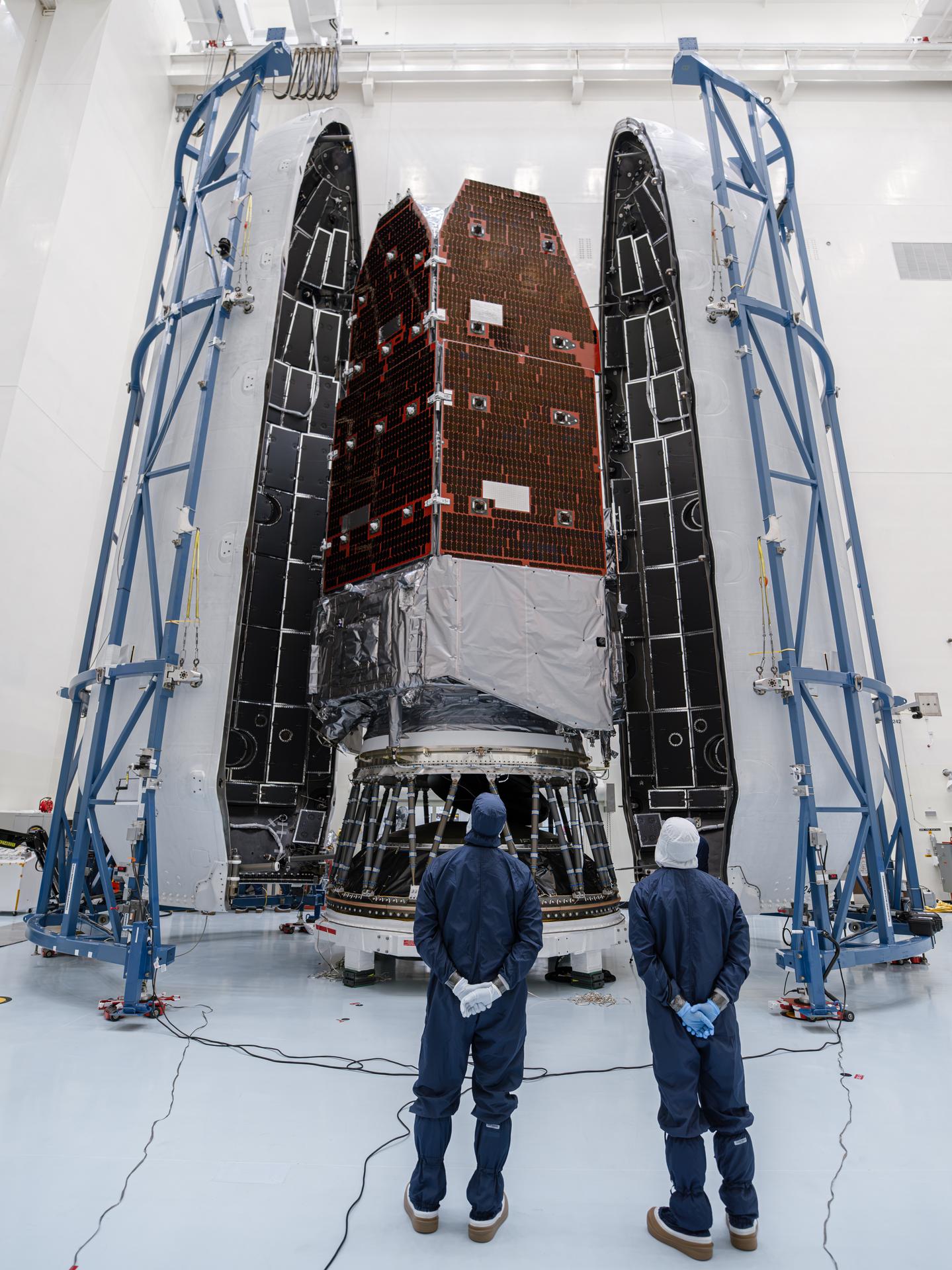
NASA has finalized media and public coverage plans for the Nancy Grace Roman Space Telescope, the agency's flagship observatory scheduled to launch from Kennedy Space Center in Florida on August 30, 2025. The mission will lift off aboard a SpaceX Falcon Heavy rocket at no earlier than 7:26 a.m. EDT.
Roman represents NASA's next major step in space-based observational astronomy. The telescope will conduct wide-field infrared surveys of the cosmos, with particular focus on two of modern physics' deepest questions: the nature of dark energy and the prevalence of exoplanets around distant stars. The mission builds directly on Hubble's legacy while employing imaging technology and spectroscopic capabilities that extend far beyond current space telescope limits.
The Roman Space Telescope carries a 2.4-meter primary mirror, identical in aperture to the Hubble Space Telescope but equipped with infrared detectors and a wide field of view roughly 100 times larger than Hubble's. This combination allows Roman to survey vast swaths of sky rapidly while maintaining exceptional resolution. The telescope's primary science objectives include mapping the distribution of dark matter and dark energy across cosmic time, searching for Earth-like exoplanets through microlensing techniques, and observing supernovae and other transient phenomena.
SpaceX's Falcon Heavy rocket provides the launch vehicle for this mission. The Heavy variant, with its trio of reusable cores, offers the payload capacity needed to deliver Roman to its operational orbit at the Sun-Earth L2 Lagrange point, approximately one million miles from Earth. This location allows the telescope to maintain stable thermal conditions and uninterrupted observation of the celestial sphere.
NASA's coverage plans include prelaunch activities, the launch broadcast, and post-launch operations briefings. The agency will provide real-time commentary explaining Roman's departure from Earth and its journey toward L2. Once operational, typically several months after launch, Roman will begin its primary survey mission lasting at least five years.
Roman's development represents a substantial investment in space infrastructure. The mission builds on technological advances from missions including the James Webb Space Telescope, incorporating lessons learned from infrared space observatory operations. Unlike JWST, which required extensive on-orbit commissioning and alignment procedures, Roman's design emphasizes operational readiness and scientific productivity shortly after reaching operational temperature.
The telescope holds particular relevance for understanding the cosmos at large scales. Dark energy comprises approximately 68 percent of the universe's content, yet remains fundamentally mysterious. Roman's observations will constrain dark energy's properties through multiple independent techniques, including weak gravitational lensing measurements and supernovae distance measurements. For exoplanet science, Roman's microlensing capability will detect planets around distant stars in ways complementary to current detection methods, revealing planetary populations in the galaxy's inner regions.
The August 30 launch window marks the culmination of years of assembly, testing, and preparation. NASA's coverage announcements indicate final readiness for deployment of this observatory, positioning the agency to advance understanding of fundamental cosmic structure for the next decade and beyond.