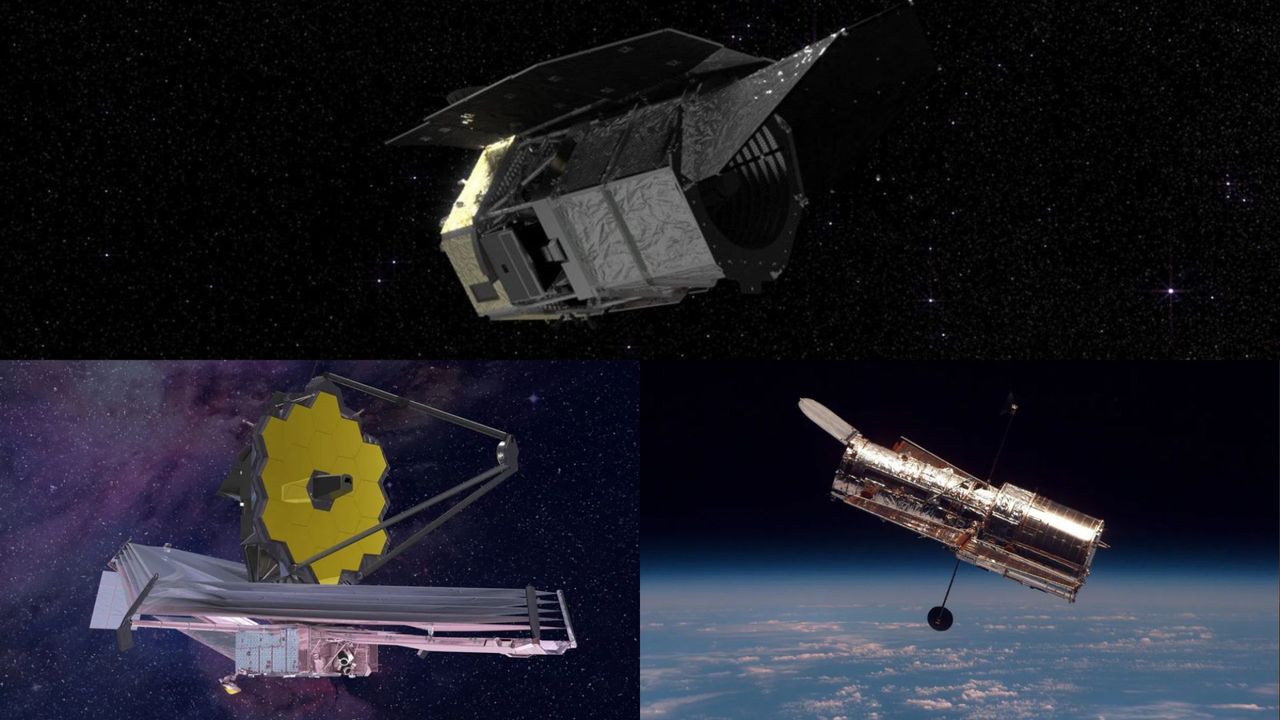
NASA's Roman Space Telescope will fundamentally alter how astronomers observe the cosmos by delivering images of unprecedented scale and clarity. Unlike the James Webb Space Telescope and Hubble Space Telescope, which excel at deep observation of small sky patches, Roman will capture vast panoramic views of the universe in a single exposure.
The telescope's primary advantage lies in its field of view. Roman's primary imaging instrument, the Wide Field Instrument, spans 0.281 square degrees. This represents roughly 100 times the area that JWST can image at comparable resolution. The scale of Roman's observations creates a technical problem that underscores its revolutionary capability: the resulting images are so expansive that no existing computer display can render them in their entirety.
Roman will operate primarily in infrared wavelengths, peering through cosmic dust to observe distant galaxies, exoplanet systems, and the large-scale structure of the universe. NASA designed the telescope specifically to answer questions about dark energy, the mysterious force driving cosmic expansion. By cataloging billions of galaxies across cosmic time, Roman will map how the universe's expansion has accelerated and decelerated over billions of years.
The telescope carries a 2.4-meter primary mirror, identical in size to Hubble's main optics. However, Roman's advanced detectors and optical design deliver sensitivity far exceeding Hubble's capabilities across infrared wavelengths. The observatory will also include a coronagraph instrument designed to directly image exoplanets around nearby stars, technology that complements JWST's exoplanet spectroscopy work.
Roman's survey strategy differs fundamentally from how Hubble and JWST operate. Rather than targeting small, preselected regions for deep observation, Roman will conduct wide-area surveys. This approach creates an inventory of the observable universe and enables astronomers to discover transient events, gravitational lensing systems, and rare astronomical objects through sheer statistical coverage.
The mission enters final assembly and testing phases at NASA's Goddard Space Flight Center in Maryland. Launch is targeted for the mid-2020s aboard a SpaceX Falcon Heavy rocket. Roman will deploy to a solar orbit near the Sun-Earth L2 Lagrange point, approximately 930,000 miles from Earth, placing it roughly 15 times farther from Earth than Hubble orbits.
Roman's observational approach complements rather than competes with JWST and Hubble. The three telescopes form a hierarchy of cosmic observation. Hubble serves as a visible-light surveyor and detailed observer. JWST probes the earliest galaxies and provides exquisite spectroscopy of distant objects. Roman surveys billions of galaxies across cosmic time, detecting patterns and structures invisible to targeted deep-field observations.
The scale of Roman's data products will reshape astronomical research. Each processed image will contain gigabytes of information. Astronomical archives will expand exponentially. The telescope will generate discoveries that individual astronomers and small research teams can access, democratizing access to universe-scale datasets that previously required resources concentrated at major observatories.