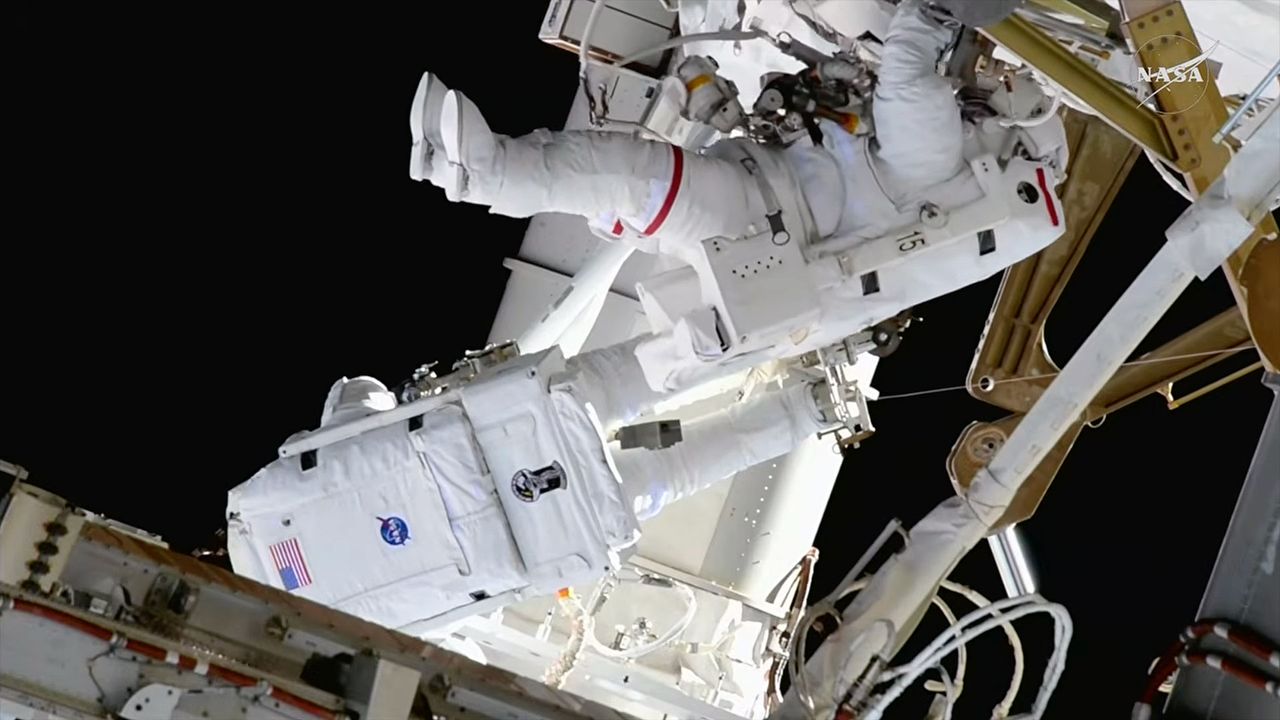
NASA astronaut Anil Menon and French astronaut Sophie Adenot conducted a spacewalk on August 25 to replace a failed space-to-ground antenna on the International Space Station. The antenna replacement represents routine but essential maintenance on the orbital laboratory that houses six crew members and operates continuously 250 miles above Earth.
The ISS relies on multiple antennas to transmit data and communications between the station and ground control centers. When an antenna fails, redundancy systems take over, but replacing the damaged unit restores full operational capacity. Menon and Adenot performed this extravehicular activity, or spacewalk, to swap out the malfunctioning hardware with a new unit. Both astronauts have trained extensively for spacewalk procedures, which require meticulous preparation and real-time problem-solving at 17,500 miles per hour.
Menon, a NASA astronaut and former naval flight officer, brings substantial experience in complex orbital operations. Adenot, selected by the European Space Agency, represents France's commitment to ISS operations and serves as a trained specialist in external maintenance tasks. The partnership underscores how ISS operations integrate expertise from multiple space agencies including NASA, ESA, Roscosmos, JAXA, and CSA.
Spacewalks carry inherent risks. Astronauts operate in hard vacuum with only a spacesuit providing pressure, oxygen, and thermal protection. They remain tethered to the station with safety lines, and their movements must stay coordinated with their partner and with mission control. Each spacewalk demands extraordinary preparation. Crews rehearse procedures underwater in NASA's neutral buoyancy laboratory in Houston, where neutral buoyancy simulates weightlessness. Training can consume hundreds of hours for a single six-hour EVA.
The ISS requires constant upkeep. Solar arrays degrade over time and need replacement. Cooling systems demand maintenance. Scientific equipment requires upgrades. Antennas, like all electronic systems in the harsh space environment, eventually fail from radiation exposure and thermal cycling. Spacewalks enable astronauts to perform work that robots cannot accomplish due to the complexity of tasks requiring human judgment and dexterity.
This antenna replacement contributes to the ISS's core mission of conducting research in microgravity and maintaining continuous human presence in low Earth orbit. The station serves as a platform for materials science experiments, fluid physics studies, biological research, and technology demonstrations. Reliable communications infrastructure enables scientists on the ground to command experiments and receive data streams.
The mission reflects decades of partnership among spacefaring nations. Since the ISS began continuous occupation in November 2000, astronauts and cosmonauts have conducted hundreds of spacewalks, accumulating over 70,000 hours of extravehicular work. Each maintenance task, each antenna replacement, each repair builds operational knowledge and demonstrates humanity's capacity to work in an environment hostile to human survival.
Live coverage of spacewalks offers the public a direct window into spaceflight operations. Viewers witness the challenges astronauts face and the precision required to maintain an orbital outpost. The antenna replacement, while routine to space operations professionals, represents an extraordinary achievement for any human endeavor.