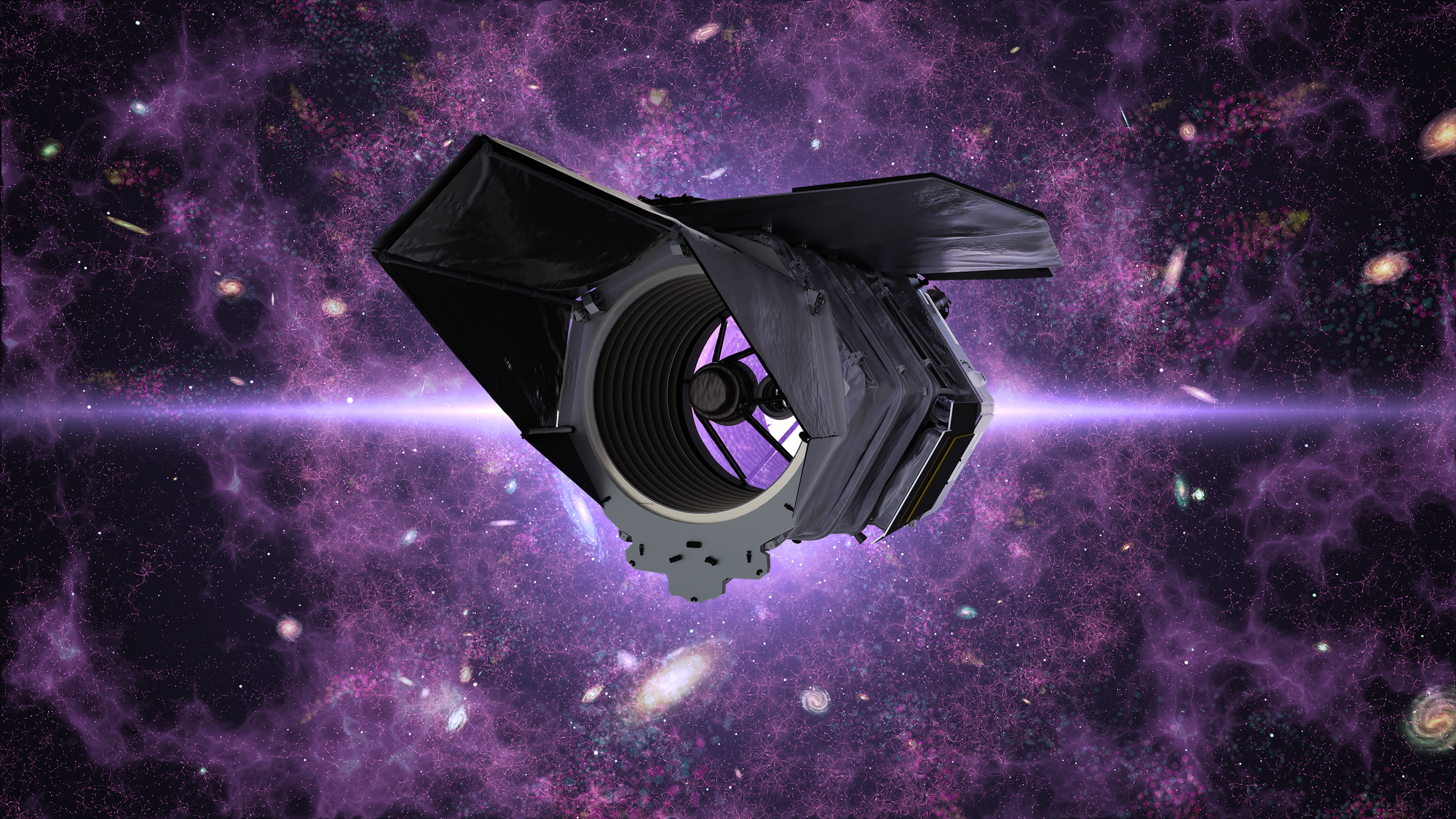
# NASA Ames' Contributions to Roman's Mission
NASA's Nancy Grace Roman Space Telescope launches August 30 as one of the most ambitious observatories ever built. The mission will tackle four of astronomy's deepest unsolved questions: the nature of dark energy, the behavior of dark matter, the inventory of exoplanets beyond our solar system, and how galaxies assemble and evolve across billions of years.
The Nancy Grace Roman Space Telescope represents a generational leap in space-based astronomy. Unlike the Hubble Space Telescope, which Roman will complement rather than replace, this observatory combines an exceptionally wide field of view with extraordinary infrared sensitivity. Its 2.4-meter primary mirror, the same diameter as Hubble's, captures light across a patch of sky roughly 100 times larger than Hubble can image in a single exposure. This combination transforms what astronomers can accomplish.
NASA Ames Research Center in Mountain View, California has played an integral role in Roman's development and integration. Ames engineers and scientists contributed expertise across multiple systems. The center's involvement spans from initial concept studies through hardware development, testing protocols, and mission operations planning. These contributions embed decades of NASA experience with space telescope design and space-based infrared science.
Roman's dark energy investigation uses a technique called weak gravitational lensing. The telescope will measure how the light from billions of galaxies bends subtly as it travels through the universe. By mapping this distortion across cosmic distances, astronomers can infer the distribution of dark matter and trace the expansion history of the universe. This data directly constrains dark energy models and may reveal whether dark energy is truly constant or evolves over time.
The exoplanet census powered by Roman reaches into territory inaccessible to ground-based surveys. The telescope will detect planets through multiple methods: direct imaging of young planets orbiting nearby stars, and microlensing, which reveals planets around distant stars by measuring the magnification of background starlight. Microlensing excels at finding planets in the outer regions of solar systems, in the habitable zones of red dwarfs, and around stars in the crowded galactic bulge. This technique complements radial velocity and transit methods used by other facilities.
Galaxy evolution studies with Roman will construct the first detailed census of how star formation rates changed across cosmic history. By observing galaxies from the present epoch back through the first few billion years after the Big Bang, astronomers will track when most stars formed and how galaxy mergers and interactions drove that assembly.
Roman operates in the infrared, penetrating dust clouds and allowing observation of distant, ancient galaxies whose light has redshifted into infrared wavelengths during billions of years of cosmic expansion. The telescope's wide field of view makes large surveys practical, while its sensitivity reaches extraordinarily faint sources.
Launch occurs from Kennedy Space Center aboard a United Launch Alliance Atlas V rocket. Roman will travel to the Sun-Earth L2 Lagrange point, about one million miles from Earth, where gravitational equilibrium allows the telescope to remain stationery relative to Earth and Sun while using minimal fuel.
The mission operates under NASA's Astrophysics Division, with contributions from the European Space Agency and the Canadian Space Agency. Science teams at universities and observatories worldwide will lead investigations using Roman's data.