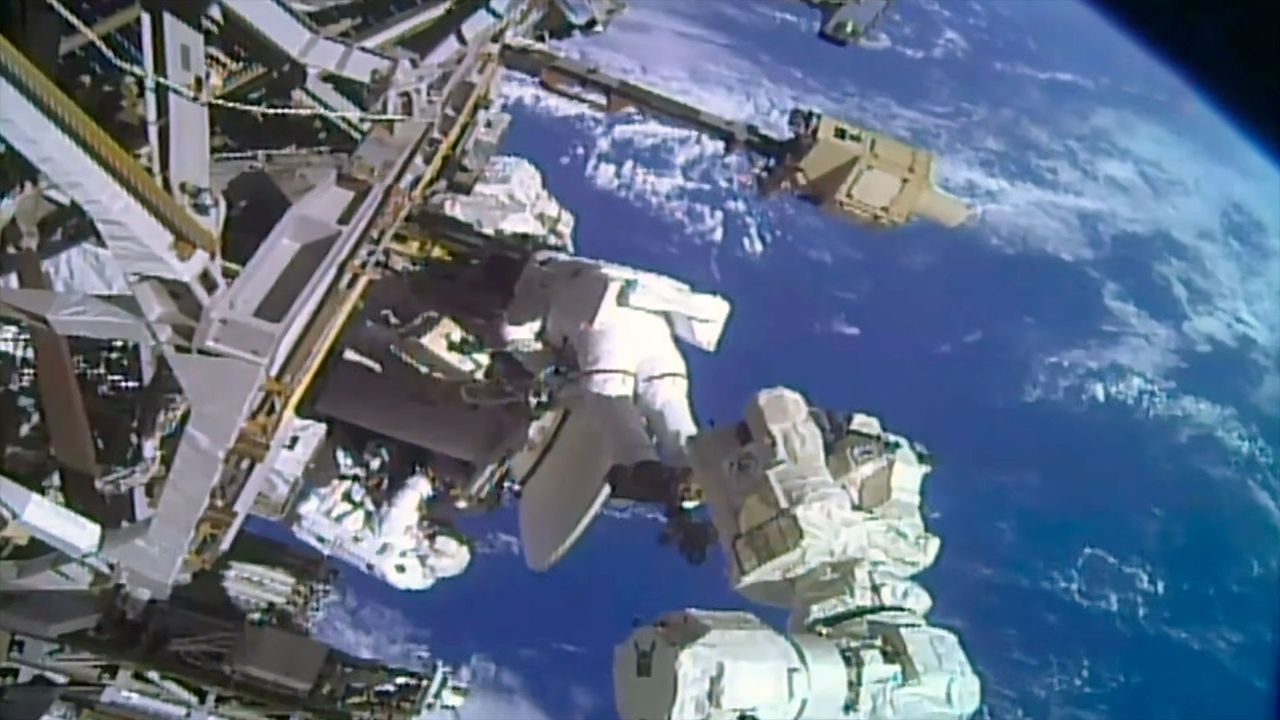
Astronauts Anil Menon and Sophie Adenot stepped outside the International Space Station on Tuesday to perform critical maintenance that will restore the orbiting laboratory's primary communication link to Earth. The spacewalk lasted six and a half hours, during which the two astronauts installed a replacement Space-to-Ground antenna on the station's exterior.
The antenna they installed replaces hardware that has been deteriorating and threatening the ISS's ability to transmit high-bandwidth data back to mission control and receiving stations on the ground. The Space-to-Ground antenna system handles the transfer of video feeds, scientific data, and communications vital to station operations. Without this system functioning properly, NASA and its international partners lose critical visibility into experiments and crew status.
Menon, a NASA astronaut and flight engineer, and Adenot, an ESA (European Space Agency) astronaut, worked in concert to carefully position the new antenna assembly and secure all electrical connections. The spacewalk required precision timing and coordination, as both astronauts had to work at height on the station's truss structure while moving in pressurized spacesuits.
This mission reflects the ongoing maintenance demands of the ISS, now in its 25th year of continuous human occupation. The station operates in the harsh environment of low Earth orbit, where equipment faces constant bombardment from micrometeorite impacts, thermal cycling between extreme temperatures, and solar radiation. Components degrade faster than on Earth, making regular servicing essential to keep the orbiting outpost functional.
The successful antenna replacement underscores NASA's commitment to extending ISS operations. Last year, NASA extended the station's timeline through 2030, partnering with commercial companies to develop successor platforms for low Earth orbit. Until those facilities are operational, the ISS remains humanity's only permanently crewed research facility in space, hosting experiments in materials science, biology, physics, and earth observation.
Menon and Adenot's spacewalk continues a long tradition of orbital maintenance performed by astronauts since the 1970s. Their work demonstrates the enduring reliance on human ingenuity and hands-on problem-solving in space exploration. Robots and robotic arms can perform certain tasks, but the dexterity, judgment, and real-time decision-making that trained astronauts bring to spacewalks remain irreplaceable for complex repair work.
The replacement antenna now transmits data through the station's Ku-band communication system, ensuring uninterrupted data flow for the crews living and working aboard. Mission control confirmed successful system checks following the installation, validating the antenna's performance and reliability.
This spacewalk represents one of dozens of extravehicular activities planned annually to maintain the ISS. Engineers on the ground identify components reaching end-of-life, schedule replacements during crew rotations, and train astronauts in the specific procedures required. The coordination between ground teams, flight surgeons, and spacewalking crews demonstrates the complexity of sustained human spaceflight operations.