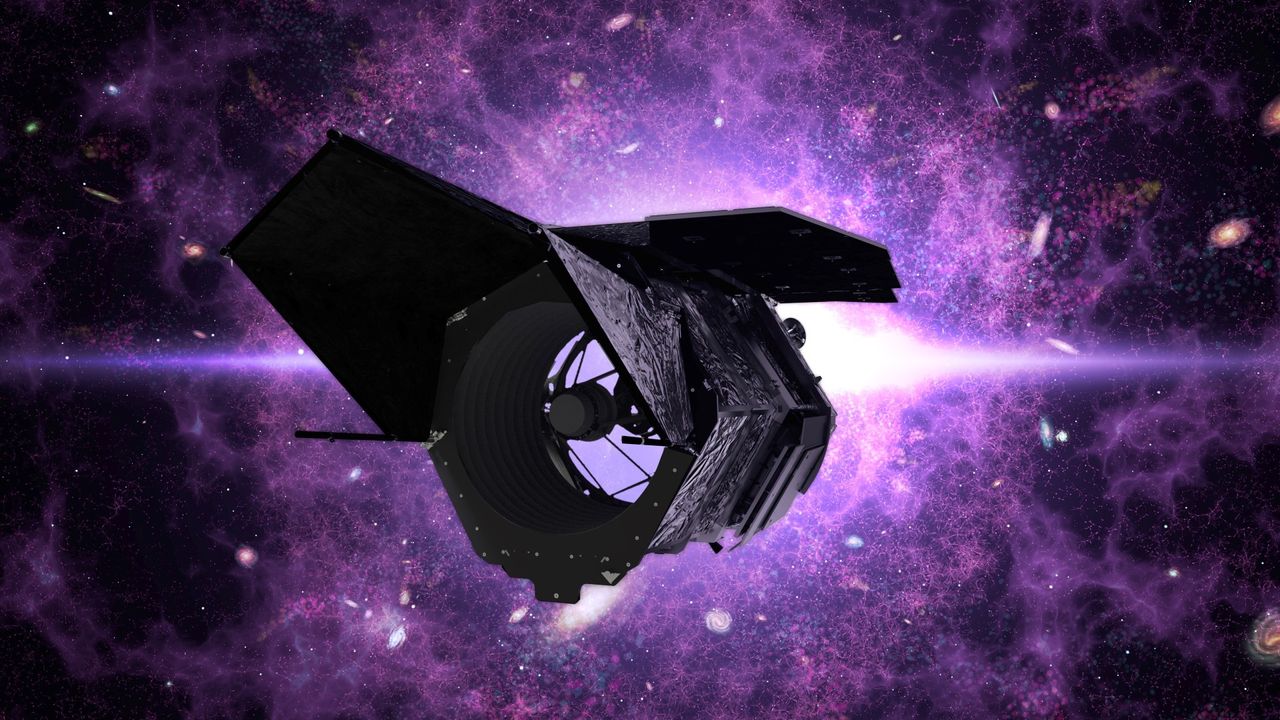
NASA's Roman Space Telescope will rely on optical hardware salvaged from decommissioned spy satellites, a repurposing that transforms Cold War-era reconnaissance technology into an instrument for deep cosmology. The agency acquired imaging optics originally designed for the National Reconnaissance Office's classified surveillance programs, then adapted them for astronomical observation across the ultraviolet and infrared spectrum.
The Roman telescope's 2.4-meter primary mirror derives from spy satellite components that the U.S. military once used to conduct high-resolution Earth imaging. Rather than letting this proven hardware languish in storage, NASA engineers retrofitted the optics for space science missions. The conversion required substantial engineering work. Scientists had to recalibrate the optical systems, integrate new detectors sensitive to ultraviolet and infrared wavelengths, and redesign supporting structures for astronomical rather than surveillance purposes.
This unconventional sourcing strategy delivers concrete advantages. The mirror and supporting structures already underwent rigorous testing under extreme conditions. Their heritage meant fewer unknowns in the design phase. The agency avoided years of development time and billions in manufacturing costs by leveraging existing hardware. Roman's budget, currently estimated near $2.4 billion, remains manageable partly because of this repurposing approach.
Roman will conduct observations across a wavelength range critical for answering fundamental questions about the universe. The telescope will map dark energy's effects on cosmic expansion, study the prevalence of exoplanets around distant stars, observe the formation and evolution of galaxies across cosmic time, and examine supernovae in detail. These scientific objectives demand the light-collecting power and sensitivity that only a space-based observatory can provide from beyond Earth's atmosphere.
The mission represents a broader trend in aerospace engineering. The Hubble Space Telescope also contained optics originally designed for military reconnaissance purposes. When Hubble launched in 1990, its mirror drew on technologies developed for spy satellite programs. That heritage did not diminish Hubble's scientific output. Over three decades, Hubble has fundamentally reshaped astronomy, producing observations that anchored our understanding of cosmic distance, the age of the universe, and the prevalence of black holes.
Roman's launch, currently scheduled for October 2027, will place the observatory at the Sun-Earth L2 point, a gravitationally stable location roughly one million miles from Earth. This vantage point provides thermal stability and unobstructed views of deep space. The mission carries a primary camera and the coronagraph instrument, the latter designed specifically to block stellar glare and detect faint exoplanets directly.
The repurposing of classified hardware demonstrates how dual-use technology benefits both national security and scientific discovery. The National Reconnaissance Office recognized that astronomy would gain from optics no longer needed for surveillance. This cooperation between intelligence and civilian space agencies rarely receives public attention, yet it remains essential to the infrastructure supporting modern astronomy.
Roman joins a growing fleet of space telescopes. The James Webb Space Telescope, launched in 2021, already revolutionized infrared astronomy. The Chandra X-ray Observatory continues its work studying black holes and galaxy clusters. Roman will complement these observatories, covering wavelengths and fields of view that neither JWST nor Chandra can efficiently address. Together, these instruments will map the observable universe with unprecedented precision.