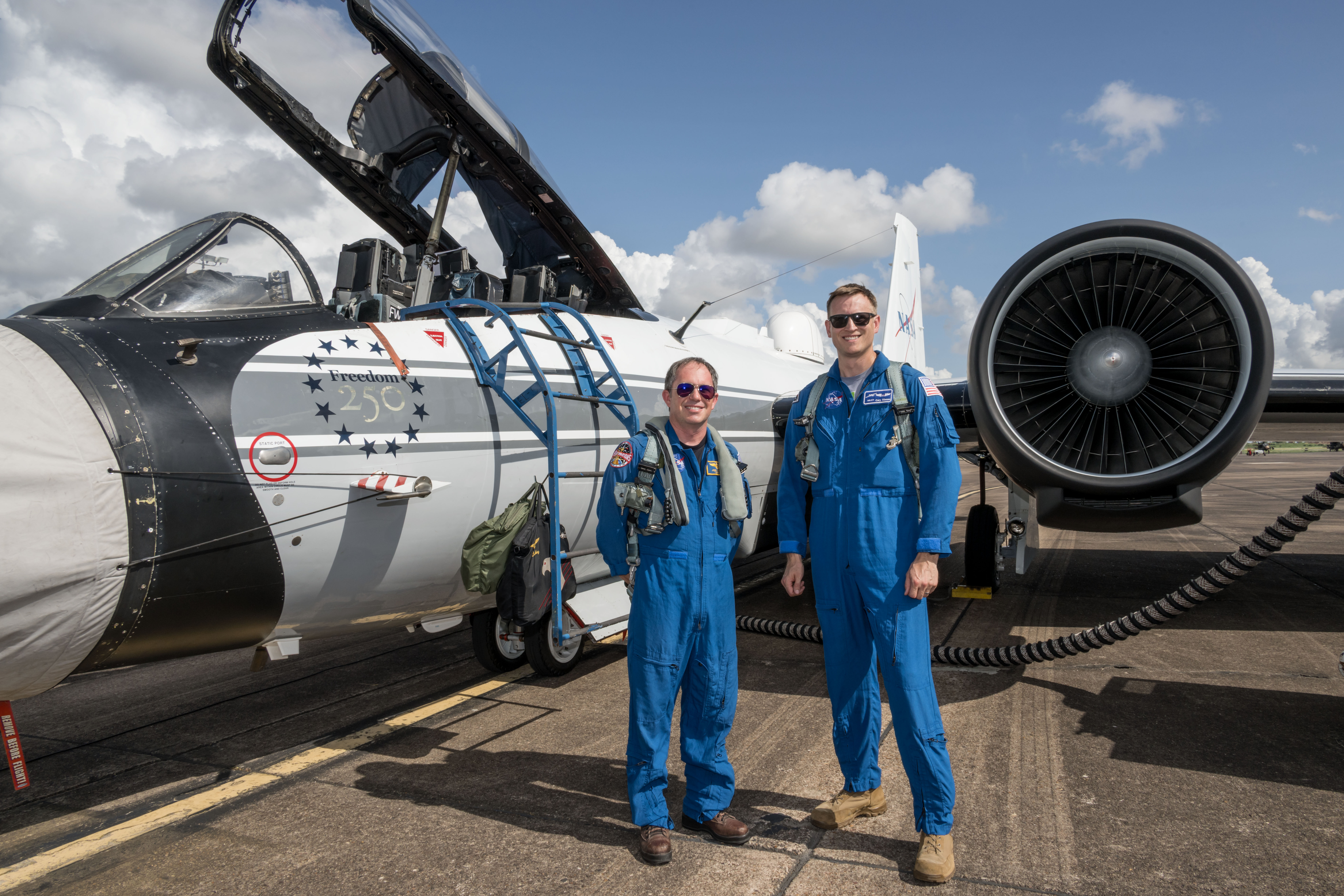
NASA Johnson Space Center pilots flew a specially equipped WB-57F research aircraft to Iceland on August 12 to chase the Moon's shadow during a total solar eclipse. The mission targeted one of astrophysics' enduring puzzles: why the Sun's corona, or outer atmosphere, reaches temperatures exceeding one million Kelvin while the visible photosphere directly beneath it stays around 5,800 Kelvin.
The WB-57F departed Ellington Field in Houston and positioned itself along the eclipse path over Europe. High-altitude aircraft offer eclipse researchers a distinct advantage. Flying at 50,000 feet extends observation windows and reduces atmospheric distortion, allowing instruments to collect unfiltered data during the brief moments of totality. The aircraft's altitude also keeps observers above most water vapor and aerosols that degrade ground-based measurements.
This coronal heating problem has frustrated solar physicists for decades. Standard thermal models predict the corona should be cooler than the photosphere, not hotter. Yet spectroscopic observations consistently show the opposite. Theories abound: magnetic reconnection events, wave dissipation, nanoflare heating in the chromosphere. Each requires precise observational evidence to test.
Eclipse observations provide scientists a rare window. During totality, the Moon blocks the blinding photosphere, revealing the corona's faint structure directly. Specialized instruments aboard the WB-57F captured high-resolution imagery and spectroscopy of the corona's magnetic field geometry and temperature distribution during the August 12 eclipse. The data gathered helps distinguish between competing heating mechanisms.
NASA's eclipse aviation program has a proven track record. The agency has flown high-altitude missions during previous solar eclipses, including flights to capture observations during the 2017 total solar eclipse across North America. These airborne platforms have collected critical data on coronal temperature gradients, plasma diagnostics, and magnetic topology that ground stations cannot match.
The August 12, 2026 eclipse path crossed northern Spain, Portugal, Iceland, Greenland, and the Arctic. Iceland's location offered extended observation time as the Moon's shadow traversed the region. NASA pilots and engineers coordinated departure timing and altitude profiles to maximize the aircraft's position within the path of totality, maximizing the duration of unobstructed observations.
Coronal heating research extends beyond pure science. Understanding how magnetic fields accelerate and heat plasma in the solar corona informs predictions of solar wind behavior, coronal mass ejections, and space weather events that impact power grids, satellite communications, and GPS systems on Earth. Improved coronal models advance space weather forecasting capabilities.
The WB-57F carries a heritage of high-altitude research. Originally a Cold War era reconnaissance platform, the aircraft underwent conversion into a scientific platform capable of flying at extreme altitudes where instruments maintain clarity. Its design allows for custom payload configurations, making it ideal for time-sensitive eclipse missions requiring specialized optical and spectroscopic equipment.
Data from this mission will be processed and analyzed over coming months. Results will contribute to NASA's broader solar physics research agenda, complementing observations from dedicated solar satellites like the Parker Solar Probe and the Solar Dynamics Observatory in orbit. Combined datasets from airborne and space-based platforms provide comprehensive understanding of coronal physics across multiple spatial and temporal scales.