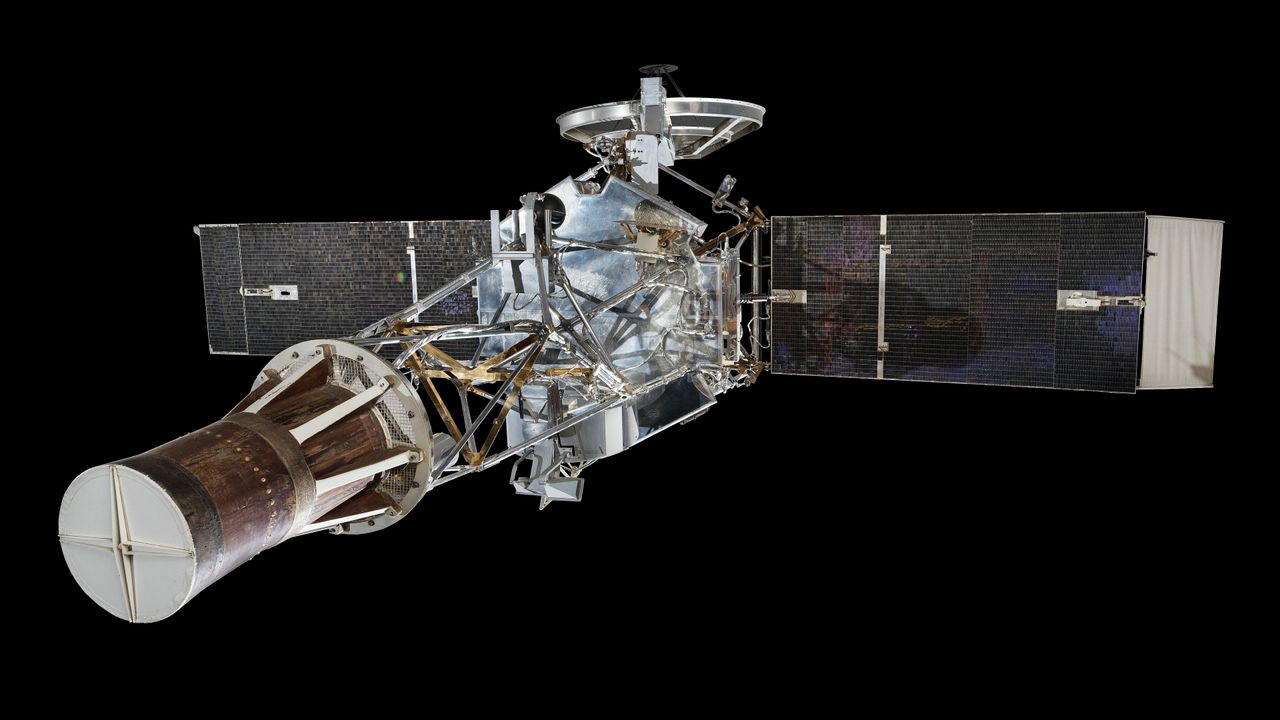
NASA's Mariner 2 lifted off on August 27, 1962, embarking on humanity's first successful interplanetary mission. The spacecraft reached Venus on December 14, 1962, after a 109-day journey, fundamentally transforming our understanding of the solar system and proving that robotic exploration beyond Earth orbit was achievable.
Mariner 2 weighed only 408 pounds and carried five scientific instruments designed to measure solar wind, cosmic radiation, and planetary conditions. As it approached Venus, the spacecraft transmitted data revealing temperatures at the Venusian surface exceeding 900 degrees Fahrenheit. Hot enough to melt lead. Previous ground-based observations had suggested Venus might harbor life or possess Earth-like conditions. Mariner 2 shattered that hope with hard evidence of an inferno wrapped in clouds.
The mission's success came after the Soviet Union's Mariner 1 attempt failed on July 22, 1962, just 294 seconds after launch when the Agena upper stage suffered a guidance failure. That catastrophic loss intensified American commitment to achieving the first planetary reconnaissance. NASA's Jet Propulsion Laboratory engineers refined the Mariner 2 design, installing redundant systems and more robust guidance software. The gamble paid off.
Mariner 2 performed a close encounter at just 21,600 miles from Venus' surface. This proximity allowed direct measurement of the planet's magnetic field, atmospheric composition, and thermal radiation signature. The spacecraft detected no magnetic field around Venus, contradicting earlier predictions. It confirmed atmospheric pressures 90 times higher than Earth's at sea level, composed primarily of carbon dioxide. The probe also measured solar wind particles as they collided with the Venusian atmosphere, providing the first direct evidence of the solar wind's interaction with planetary bodies.
The data Mariner 2 transmitted changed planetary science from speculation to empirical study. Scientists recognized Venus as a runaway greenhouse effect example. Carbon dioxide and sulfuric acid clouds trapped solar heat, creating surface conditions utterly hostile to known life forms. This knowledge proved essential decades later when studying Earth's climate and understanding how planetary atmospheres behave under extreme conditions.
The mission demonstrated that interplanetary trajectories calculated by American engineers could reliably transport instruments across millions of miles of space. Mariner 2 validated the Hohmann transfer orbit concept and proved spacecraft could survive the radiation environment between Earth and Venus. Every subsequent Venus mission, from the Soviet Venera landers that followed to Japan's Akatsuki orbiter operating today, built upon Mariner 2's pioneering accomplishment.
Mariner 2 operated for 129 days after launch, far exceeding its 42-day design life. The spacecraft's last transmission occurred January 4, 1963, after traveling 449 million miles. It remains in orbit around the sun, still carrying the legacy of humanity's first successful voyage to another world. The mission stands as a watershed moment when planetary exploration transitioned from dreams sketched on paper to instruments returning real data from hostile alien worlds.