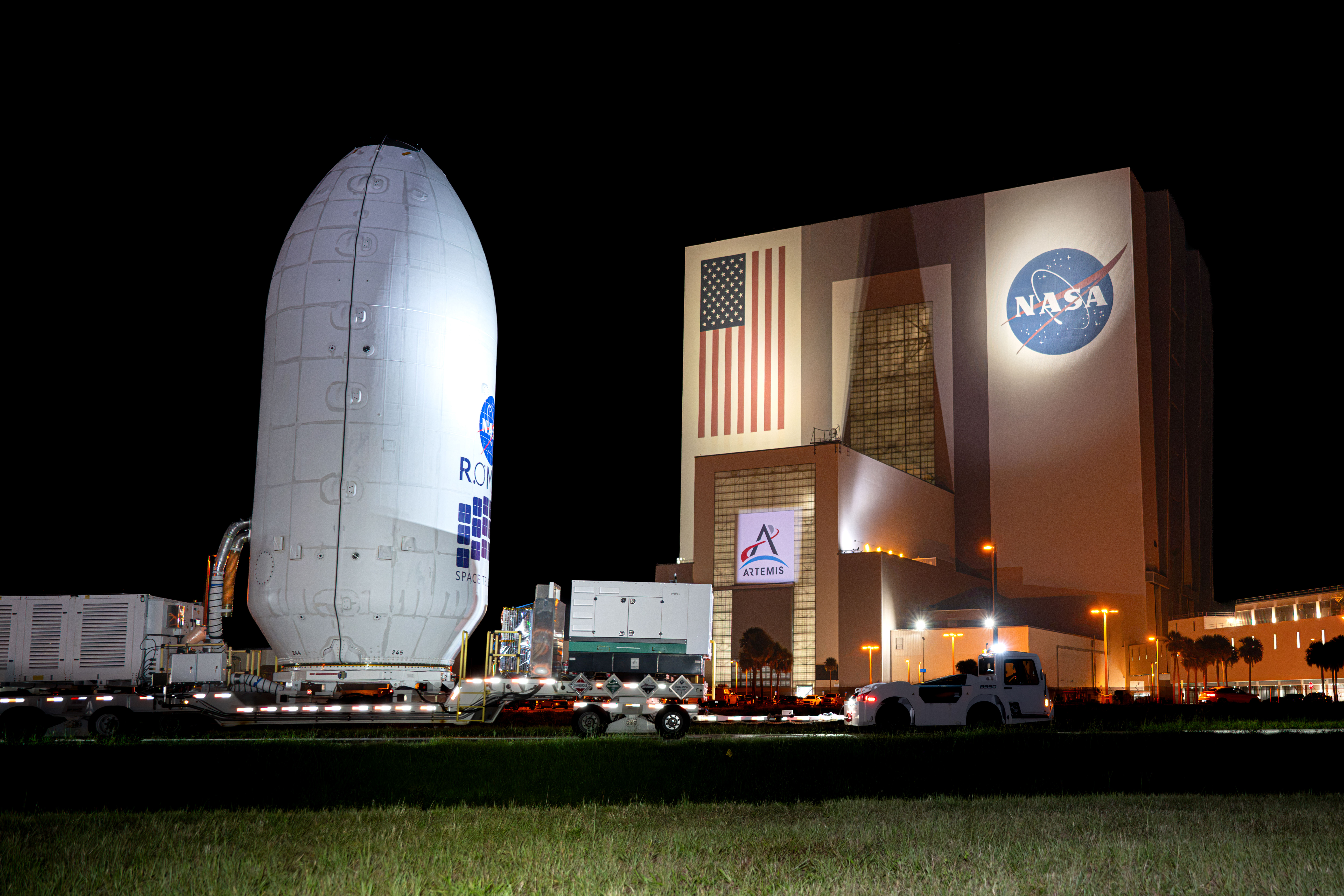
NASA's Nancy Grace Roman Space Telescope has arrived at SpaceX's hangar at Kennedy Space Center's Launch Complex 39A, marking a critical milestone toward its scheduled launch atop a Falcon Heavy rocket. The observatory, encased in its payload fairing, traveled from the Payload Hazardous Servicing Facility on August 25, 2026, positioning it for the next phase of launch preparation: mating to the rocket booster.
The Roman Space Telescope represents a generational leap in infrared astronomy and dark energy research. Named after Nancy Grace Roman, NASA's first chief of astronomy, the observatory will operate at a wavelength range that complements observations from the James Webb Space Telescope while pushing into new scientific territory. Its primary mission focuses on understanding dark energy, the mysterious force accelerating the universe's expansion, alongside wide-field surveys of galaxies, exoplanets, and stellar phenomena.
The hangar arrival signals that Roman has cleared critical assembly and testing phases. NASA's Payload Hazardous Servicing Facility conducted final checks on the telescope's instruments and structural systems before transport. The payload fairing, which protects Roman during launch, remained sealed during transit to maintain pristine conditions for the sensitive optics and electronics within.
SpaceX's Falcon Heavy provides the necessary lift capacity for Roman's mission architecture. The rocket's three core configuration delivers the performance required to send the roughly 14,000-pound observatory beyond Earth orbit toward its operational location at the Sun-Earth L2 Lagrange point, approximately one million miles from Earth. This location offers thermal stability and allows Roman's heat shield to simultaneously block infrared radiation from the Sun, Earth, and Moon, preserving the telescope's cryogenic instrument performance.
Roman's science instruments include an infrared coronagraph for direct imaging of exoplanets and a wide-field instrument designed to conduct deep surveys spanning areas of sky larger than previous infrared observatories. These capabilities will enable researchers to detect galaxies across cosmic history, trace the structure of the universe on the largest scales, and identify potentially habitable worlds around distant stars.
The move into the SpaceX hangar initiates the final assembly sequence. Technicians will prepare the Falcon Heavy's payload adapter, perform interface verification tests, and execute the delicate mating procedures that attach Roman to the rocket. These steps involve precise alignment and electrical checkout to ensure the telescope's systems remain fully functional throughout the launch vibration environment.
The launch campaign reflects collaborative coordination between NASA, SpaceX, and industry partners. Roman's mission represents the largest space telescope project since James Webb, demanding rigorous quality assurance at every manufacturing and assembly stage. Delays in complex space missions are routine rather than exceptional, but the August 2026 transport suggests the program maintains momentum through its final ground preparation phase.
Once launched, Roman will spend roughly six months traveling to L2 and undergoing deployment and calibration procedures. Scientific operations are expected to begin approximately nine months after launch. The observatory's anticipated mission duration spans five years, with potential extensions based on fuel reserves and instrument health.