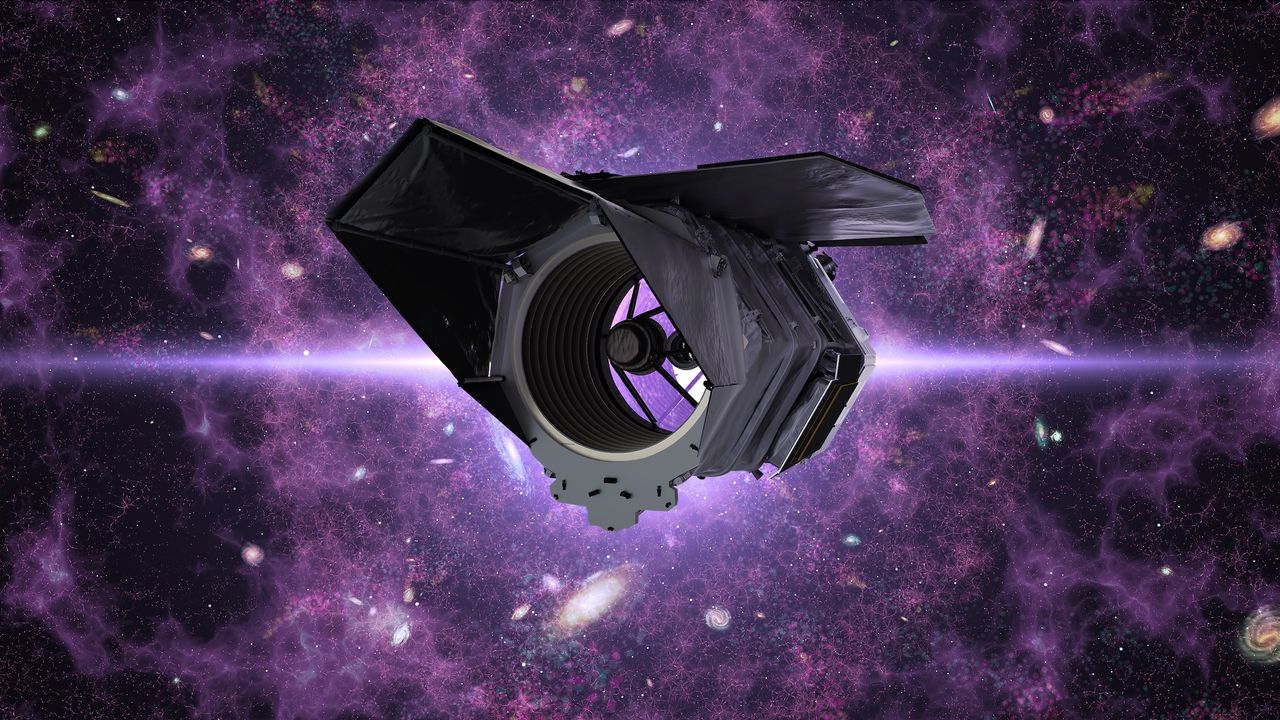
NASA's Nancy Grace Roman Space Telescope moves toward launch after surviving an existential threat. The observatory faced cancellation under a leaked Trump administration budget proposal last year but has advanced through development and now stands ready for deployment.
The Roman Space Telescope represents a $2.4 billion investment in infrared astronomy and represents NASA's answer to persistent questions about dark energy, exoplanet characterization, and the structure of the universe itself. Named after astrophysicist Nancy Grace Roman, a pioneering figure in space telescope design, the mission carries a 2.4-meter primary mirror and will operate in the infrared spectrum from a vantage point near the Sun-Earth L2 Lagrange point, about one million miles from Earth.
The telescope's capabilities dwarf those of earlier infrared missions. Its wide field of view spans 100 times the area that the James Webb Space Telescope can image in a single observation. This breadth enables surveys of billions of galaxies, searches for distant supernovae that illuminate cosmic expansion, and detailed study of exoplanetary systems. The mission addresses fundamental cosmology: understanding dark energy's nature and role in accelerating the universe's expansion.
The budget threat came amid broader administrative scrutiny of NASA spending. Leaked proposals indicated the Roman telescope faced elimination to redirect funds toward lunar exploration priorities and other programs. The decision to preserve the mission reflects recognition of its unique scientific contribution and the costs already sunk into its development.
Roman's launch window approaches as ground teams complete final assembly and testing. The mission operates under the Astrophysics Division of NASA's Science Mission Directorate, with contributions from the Johns Hopkins University Applied Physics Laboratory serving as mission operations center. Partnerships extend to Goddard Space Flight Center, where much of the telescope's hardware underwent development and validation.
The observatory's construction follows decades of conceptual work. Original concepts for such a mission emerged in the 1990s, but budget constraints and technical challenges delayed development multiple times. The current design represents engineering refinements that maintain scientific capability while managing cost growth that characterized earlier phases.
Exoplanet science anchors a substantial portion of Roman's planned observations. The telescope can directly image young, hot planets orbiting distant stars and characterize their atmospheres through spectroscopy. This capability complements ground-based discoveries from surveys like TESS, which identifies exoplanet candidates. Roman will provide detailed follow-up observations that determine habitability potential and atmospheric composition.
Supernovae surveys represent another core investigation. Roman's sensitivity and survey speed enable detection of distant Type Ia supernovae, those stellar explosions that serve as cosmic distance markers. These observations constrain the expansion history of the universe and reveal dark energy's behavior across cosmic time.
The telescope also carries a technology demonstration instrument. The Coronagraphic Instrument represents advances in starlight suppression, techniques that enable imaging of faint objects near bright stars. Successful demonstration prepares technology for future missions targeting habitable exoplanets directly.
Launch represents a watershed moment for infrared astronomy. After years of development, budget scrutiny, and technical maturation, Roman enters the fleet of NASA's flagship science observatories. The mission joins the James Webb Space Telescope in providing unprecedented views of the cosmos at infrared wavelengths, each instrument complementing the other through different capabilities and vantage points. Success ensures that the investment survives not just budget cuts but justifies its place in advancing human understanding of the universe's deepest mysteries.