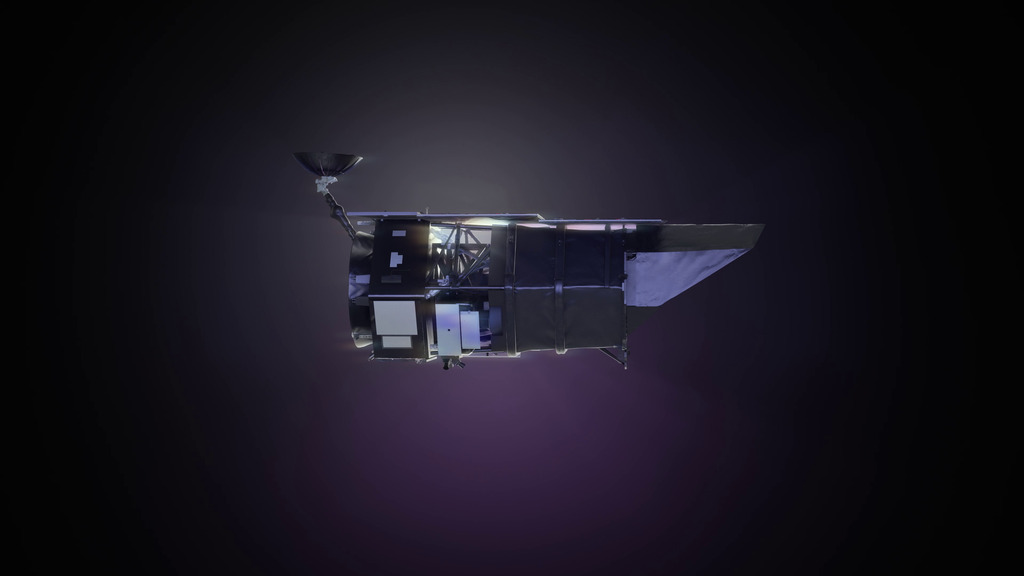
NASA launches the Nancy Grace Roman Space Telescope on August 30 at 7:26 a.m. EDT, marking one of the most ambitious astrophysics missions in the agency's fleet. The telescope bears the name of Nancy Grace Roman, the pioneering astronomer who led NASA's astrophysics program during the 1960s and 1970s and shaped the vision for space-based astronomy.
The Roman Space Telescope operates as a wide-field infrared observatory designed to map vast regions of the cosmos in a single exposure. Its primary mirror spans 2.4 meters, matching the Hubble Space Telescope's diameter, but Roman's instrument suite delivers a field of view roughly 100 times broader than Hubble's. This capability allows the mission to survey enormous swaths of sky while maintaining the resolution needed to resolve individual stars and galaxies.
The telescope addresses three cornerstone science goals. First, it will characterize dark energy, the mysterious force accelerating cosmic expansion, by measuring the distances and properties of Type Ia supernovae across billions of light-years. Second, Roman will perform a census of exoplanets using the microlensing technique, detecting planets that orbit far from their host stars and identifying Earth-mass worlds in habitable zones. Third, the mission will conduct deep infrared surveys to study galaxy formation and evolution across cosmic history.
Roman's instrumentation includes the Wide Field Instrument, which delivers imaging and spectroscopy across the infrared spectrum from 0.6 to 2.3 microns. The Coronagraph Instrument represents a technological leap forward, featuring advanced wavefront sensing and starlight suppression systems that enable direct imaging of faint exoplanets orbiting bright stars. This coronagraph serves as a testbed for technologies that future missions like the Habitable Worlds Observatory will employ.
The mission launches aboard a SpaceX Falcon Heavy rocket, which will propel Roman toward a Sun-Earth Lagrange point 1 million miles from Earth. This orbital location provides thermal stability and gravitational equilibrium, allowing the telescope to observe continuously without interference from Earth's shadow or heat.
The observatory carries infrared detectors manufactured using H4RG technology, detector arrays that push sensitivity into the near-infrared region. These sensors enable Roman to detect extremely faint objects and measure subtle shifts in wavelength that reveal physical processes in distant galaxies and stellar systems.
Cost estimates place Roman's total development and operations budget at approximately 2.4 billion dollars through the initial mission phase. The project faced schedule delays and budget pressures over its development cycle, but NASA and contractor teams resolved technical challenges to advance toward launch.
Roman's science legacy builds directly on infrastructure created by decades of space telescope missions. Hubble revolutionized observational astronomy through visible-light imaging. The James Webb Space Telescope opened the infrared universe at longer wavelengths than Roman observes. Roman fills the gap between these observatories, operating at mid-infrared wavelengths while covering the sky's larger regions.
The mission opens new discovery pathways for understanding the universe's fundamental physics. By characterizing dark energy's properties, Roman advances cosmology's understanding of spacetime itself. By detecting exoplanets through microlensing, the mission reveals planetary populations invisible to other detection methods. The telescope promises to transform knowledge of how galaxies assemble, merge, and evolve across 13 billion years of cosmic time.