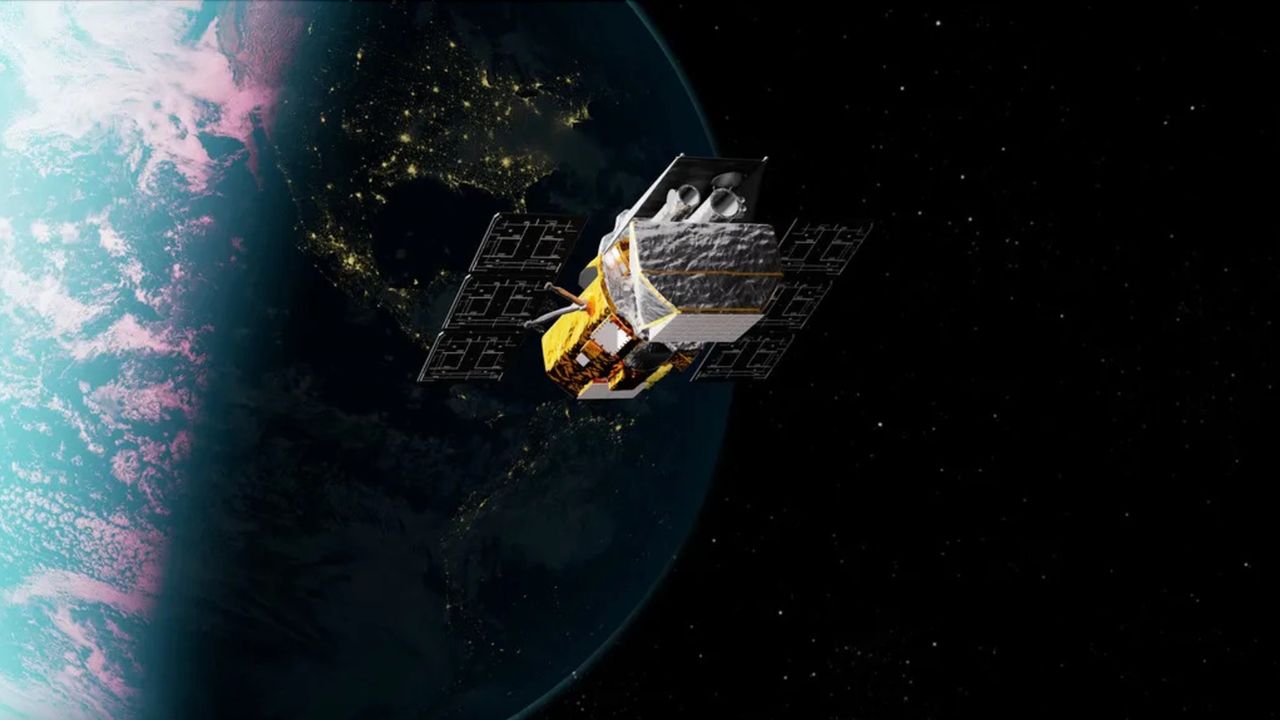
NASA's Swift gamma-ray observatory will plunge back to Earth after a private rescue attempt failed to save the aging spacecraft. The mission, contracted through commercial spaceflight providers, fell short of restoring the telescope to functional orbit, leaving the agency without a viable recovery option for one of its most productive space observatories.
Swift launched in November 2004 aboard a Delta II rocket from Cape Canaveral. For two decades, the spacecraft detected and localized gamma-ray bursts, transient x-ray sources, and other high-energy phenomena across the universe. Its rapid-response capability allowed ground astronomers to coordinate observations with other telescopes within minutes of a burst detection, fundamentally changing how the astronomical community studies the most violent events in the cosmos. The mission far exceeded its original five-year design life, becoming a workhorse for time-domain astrophysics.
The telescope began experiencing mechanical degradation in recent years. Its pointing system suffered failures that progressively limited its ability to slew to new targets and maintain orientation. NASA contracted with a private spaceflight company to attempt a servicing or repositioning mission, representing a new frontier in orbital rescue operations. These missions remain technically challenging and expensive, requiring precise orbital rendezvous, docking or robotic manipulation, and controlled maneuvers in the crowded low-Earth orbit environment.
The failed rescue attempt leaves Swift on a collision course with the atmosphere. The spacecraft orbits at roughly 600 kilometers altitude in a sun-synchronous trajectory, making its reentry path difficult to predict with precision. Atmospheric drag will gradually lower the orbit over weeks or months until aerodynamic heating causes structural failure and breakup during reentry.
NASA will monitor Swift's orbital decay and work to predict reentry timing and ground impact zones. Space agencies coordinate through the Inter-Agency Space Debris Coordination Committee to track large objects reentering the atmosphere and assess collision risks with populated areas. The probability of debris striking an inhabited location remains low for most satellites, though large spacecraft like Swift pose greater debris risk than smaller payloads.
The loss of Swift represents a significant blow to gamma-ray astronomy. No direct replacement exists in NASA's current portfolio. The agency operates the Fermi Gamma-ray Space Telescope, which targets lower-energy gamma rays, and several x-ray observatories, but Fermi will itself face eventual deorbit. The astronomical community has advocated for sustained funding of gamma-ray missions to maintain observational continuity.
Swift's failure underscores the challenges of aging space infrastructure and the limitations of rescue operations beyond low-Earth orbit or on simpler spacecraft. While commercial spaceflight companies are developing on-orbit servicing capabilities for future missions, the technology remains in early stages. NASA and other agencies increasingly design new observatories with extended lifespans and redundant systems, but Swift's unexpected pointing degradation occurred faster than predicted models suggested.
The agency will release more details about reentry predictions as Swift's orbital decay progresses. Amateur astronomers and citizen satellite trackers monitor spacecraft trajectories using radar data and optical observations, often providing independent verification of professional predictions as reentry approaches.