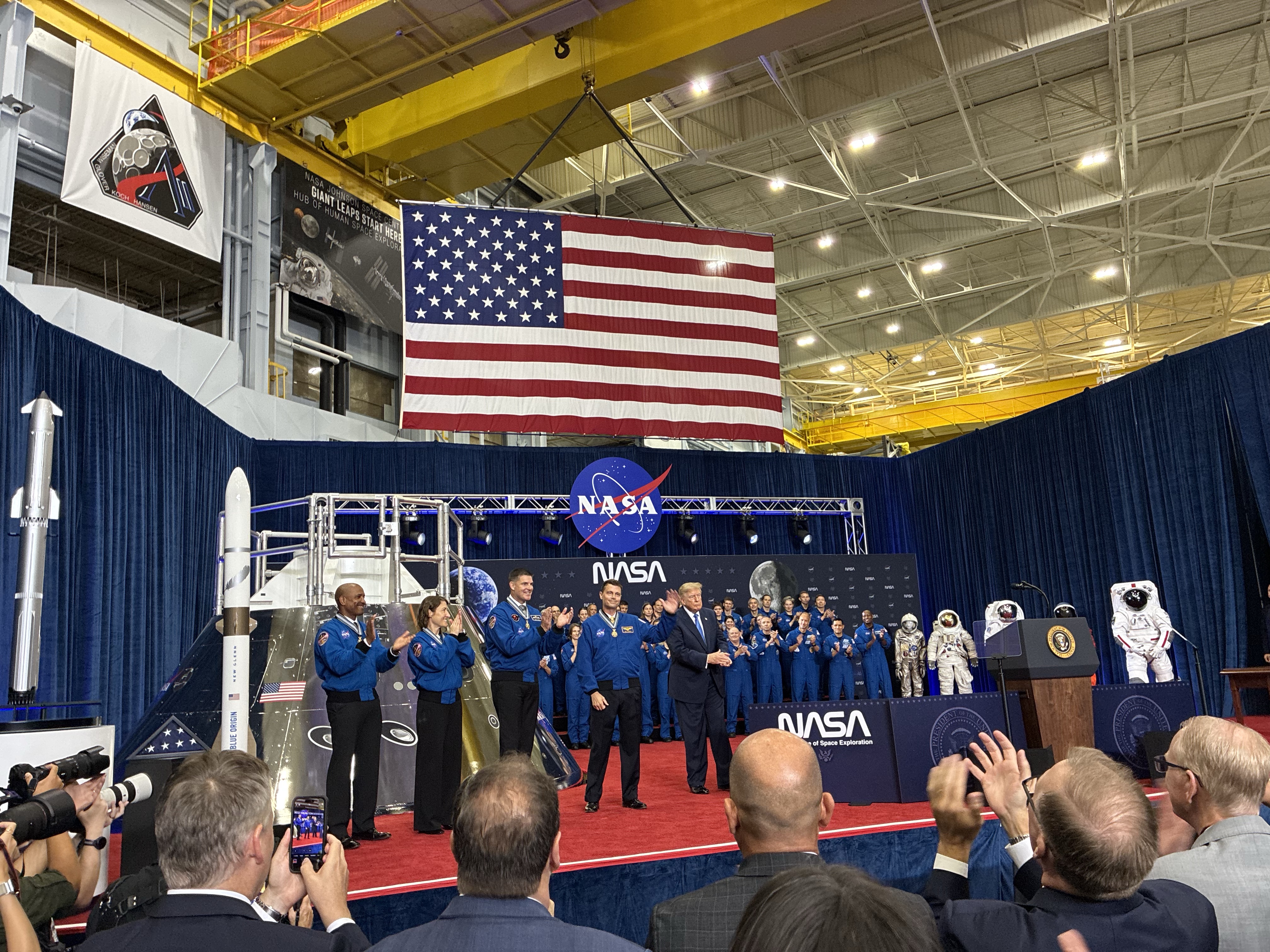
President Donald J. Trump awarded the Congressional Space Medal of Honor to four astronauts selected for NASA's Artemis II mission during a Friday ceremony at Johnson Space Center in Houston. The recipients include NASA astronauts Reid Wiseman, Victor Glover, and Christina Koch, along with Canadian Space Agency astronaut Jeremy Hansen.
The Congressional Space Medal of Honor represents the highest civilian space award in the United States. The Artemis II crew earned this recognition for their preparation to execute one of the most demanding missions in human spaceflight history. Artemis II will send a crewed spacecraft around the Moon, marking humanity's return to lunar exploration after a 50-year hiatus since the Apollo program.
Reid Wiseman commands the mission. A veteran of two Space Shuttle flights and two extended stays aboard the International Space Station, Wiseman brings decades of orbital experience to the pilot's seat. Victor Glover serves as pilot. Glover flew on Space Shuttle Atlantis and spent extended time on the ISS, becoming the first African American to live and work in space for an extended duration. Christina Koch, a mission specialist, previously spent 328 days aboard the ISS, holding the record for the longest single spaceflight by a woman at the time of her mission. Jeremy Hansen, the Canadian contribution to the crew, becomes the first non-American to join a crewed Moon mission since the Apollo era.
Artemis II represents a watershed moment for NASA's lunar return program. The mission will validate the Space Launch System heavy-lift rocket and the Orion spacecraft in a crewed lunar environment before Artemis III attempts a crewed Moon landing. The trajectory carries the crew out to lunar orbit and back, following a path similar to Apollo 8 but with modern technology and international partnership.
The award ceremony at Johnson Space Center underscores the national significance of the Artemis program. Johnson Space Center, located in Houston, served as mission control for the Apollo Moon landings and remains the training hub for NASA astronauts. The selection of these four astronauts reflects NASA's commitment to drawing from the agency's most experienced personnel for this high-stakes mission.
Artemis II's importance extends beyond individual achievement. The mission establishes the operational foundation for sustained lunar exploration, incorporating lessons learned from five decades of spaceflight. It demonstrates international cooperation through Hansen's participation, linking American Moon exploration to Canadian space operations. The crew composition reflects NASA's evolving standards of inclusion in astronaut selection, with Glover and Koch representing the diversity of modern space exploration.
The mission timeline remains fluid, but NASA continues preparations for launch. Orion spacecraft construction, heat shield testing, and SLS rocket assembly all proceed toward flight readiness. The Congressional Space Medal of Honor recognizes not only the crew's qualifications but the broader mission's role in advancing human spaceflight capabilities for the coming decades.
This award ceremony marks a formal acknowledgment that Artemis II carries the weight of national expectation and international partnership. These four astronauts now stand as symbols of American commitment to return humans to the Moon and establish sustained presence there.