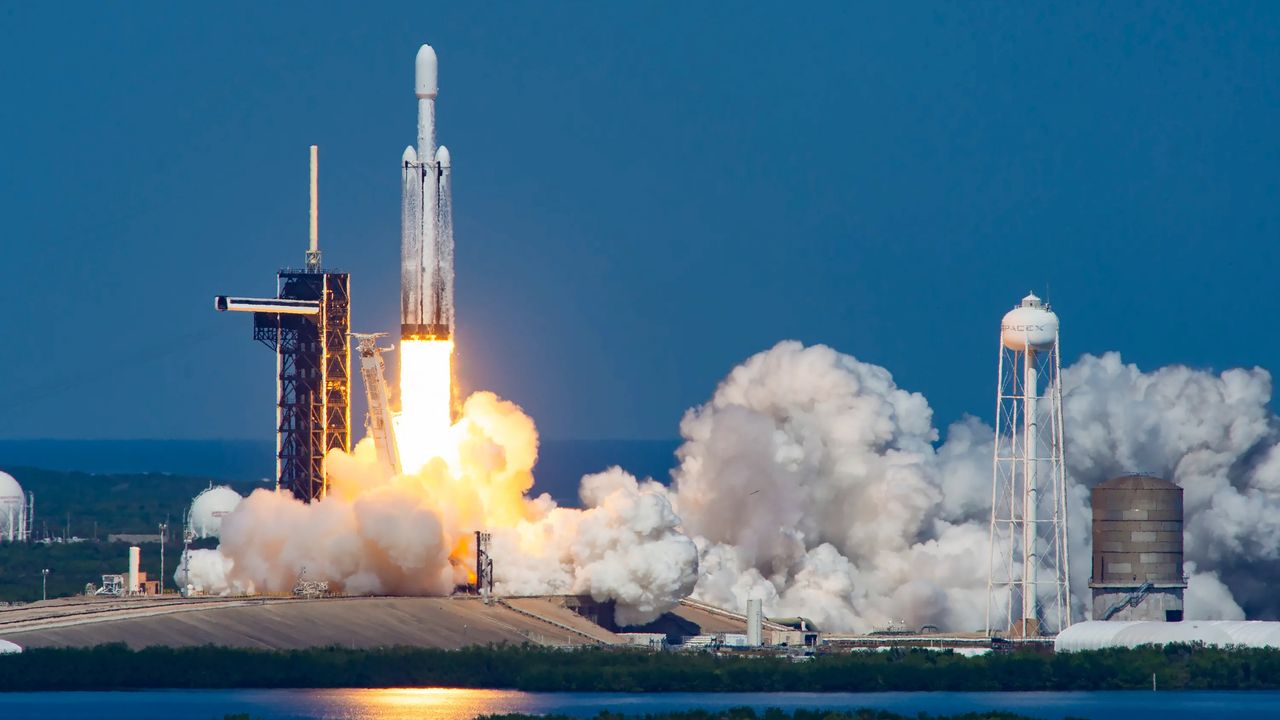
SpaceX's Falcon Heavy rocket will carry NASA's Nancy Grace Roman Space Telescope into orbit on Sunday, August 30, marking a watershed moment for infrared astronomy and dark energy research. The launch represents the heaviest payload Falcon Heavy has ever deployed to space, testing the limits of the world's most powerful operational rocket.
Roman, named after pioneering NASA astrophysicist Nancy Grace Roman, functions as the successor to the Hubble Space Telescope and a complement to the James Webb Space Telescope. The observatory carries a 2.4-meter primary mirror and operates primarily in infrared wavelengths, enabling it to observe distant galaxies, supernovae, and exoplanet systems with unprecedented clarity. NASA designed Roman to answer fundamental questions about dark energy, the mysterious force accelerating the universe's expansion, and to conduct wide-field surveys across billions of years of cosmic history.
The telescope's mission objectives span multiple scientific frontiers. Roman will conduct a census of exoplanets using gravitational microlensing techniques, detect and study supernova explosions to refine measurements of cosmic acceleration, and map the large-scale structure of the universe with greater sensitivity than any previous observatory. Its infrared capabilities penetrate dust clouds that obscure visible-light telescopes, revealing star-forming regions and the earliest galaxies formed after the Big Bang.
Falcon Heavy's involvement underscores SpaceX's expanding role in deep space exploration beyond Earth orbit. The rocket's three core booster configuration produces 5.1 million pounds of thrust at liftoff, necessary to achieve the velocity and trajectory required to deliver Roman to its destination orbit around the Sun-Earth Lagrange Point 2, approximately one million miles from Earth. This location provides stable conditions for long-term observations while minimizing thermal fluctuations from solar radiation.
Roman's total mass reaches approximately 4,200 pounds, making it substantially heavier than previous space telescope launches. NASA engineers spent years optimizing the observatory's design to remain within Falcon Heavy's payload capacity while maximizing scientific instrumentation. The mission cost 1.9 billion dollars and required unprecedented collaboration between NASA centers including the Goddard Space Flight Center, which manages Roman's development.
The launch window opens on August 30 at 8:17 a.m. Eastern Time from Kennedy Space Center's Launch Complex 39A. Live coverage begins approximately 15 minutes before liftoff on NASA's official website, Space.com, and SpaceX's launch channel. Weather conditions throughout August typically favor successful launches from Florida's Space Coast, though launch teams monitor atmospheric stability and wind shear in the upper atmosphere before confirming final go-no-go decisions.
Roman's deployment will conclude a multi-year gap since NASA's most recent space telescope launch, during which the James Webb Space Telescope achieved operational status and captured unprecedented images of the early universe. Roman's infrared capabilities complement Webb's observations, providing broader field-of-view coverage across larger cosmic volumes. Together, these observatories position humanity to answer questions about the universe's composition, age, and ultimate fate that astronomers have pursued for centuries.