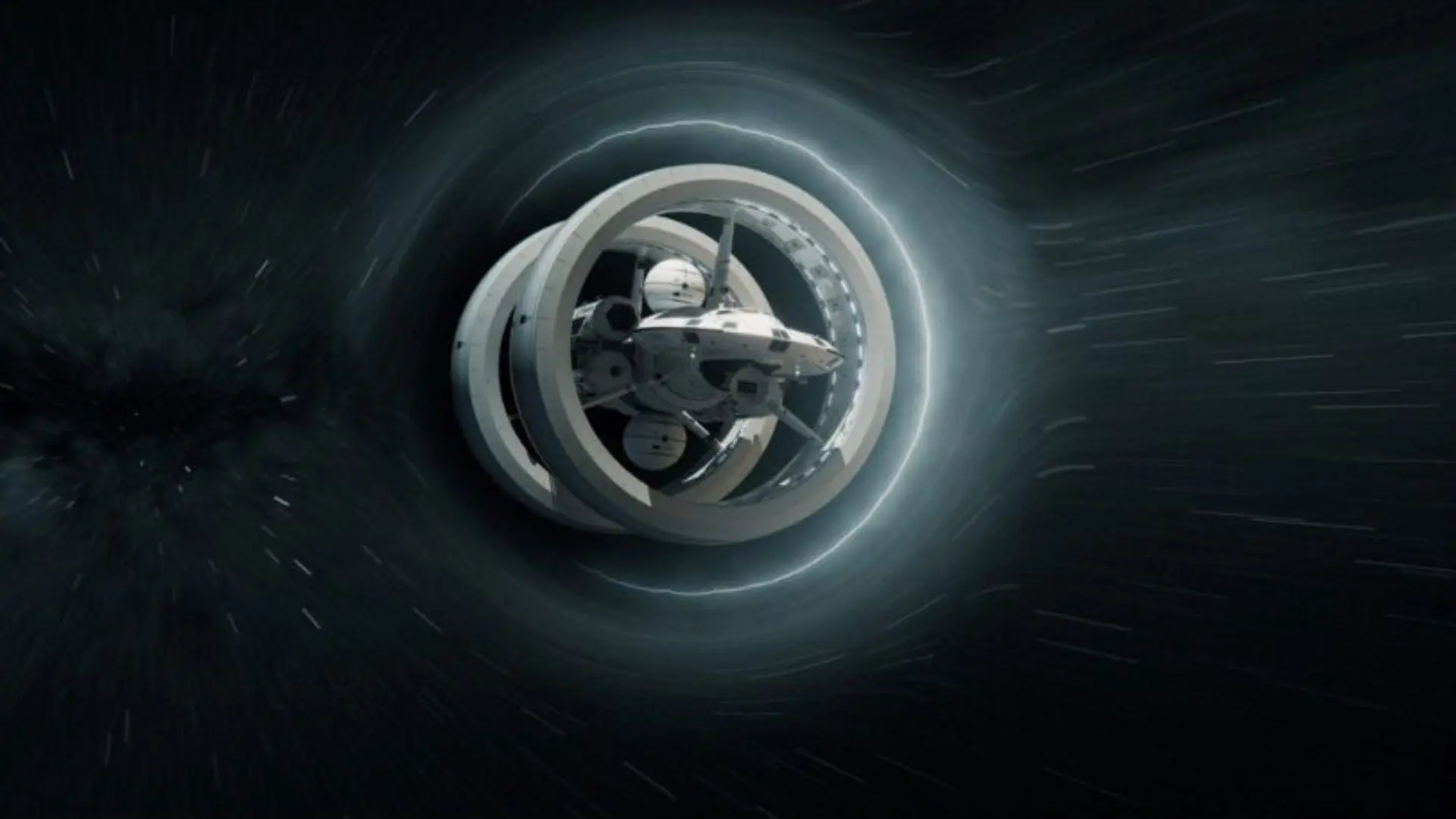
The physics community continues to probe the mathematical boundaries of general relativity, testing whether exotic spacetime geometries could enable faster-than-light travel without violating Einstein's speed limit. These proposals rank among the most speculative frameworks in theoretical physics, yet they emerge from rigorous equations rather than pure imagination.
The Alcubierre Warp Metric, proposed by Mexican physicist Miguel Alcubierre in 1994, describes a bubble of warped spacetime that contracts in front of a spacecraft and expands behind it. The vessel itself remains stationary within this bubble, moving at subluminal speeds relative to the local spacetime around it. The metric mathematically preserves causality and avoids the paradoxes associated with true faster-than-light travel. However, the energy requirements prove astronomical. Early calculations suggested a warp bubble would demand negative energy equivalent to the mass-energy of Jupiter, concentrated in an impossibly thin shell. More recent refinements by physicists like Harold White have reduced these estimates, but the engineering hurdles remain formidable.
Wormholes, or Einstein-Rosen bridges, represent another pathway through spacetime. These theoretical tunnels connect distant regions of the universe, potentially shortening travel times between points that would otherwise require decades or centuries. A traversable wormhole would require exotic matter with negative energy density, maintaining the throat open against gravitational collapse. Like warp drives, wormholes demand energy scales far beyond current technological capability. The throat stability problem persists: any perturbation could collapse the passage before a spacecraft transits.
The Halo Drive concept builds on warp drive physics but proposes a more modest approach. Rather than accelerating a spacecraft to relativistic velocities through conventional propulsion, a halo drive would generate a localized spacetime distortion around the vessel. This reduces the energy requirements compared to full Alcubierre implementations, though still speculative. The mechanism relies on manipulating the quantum vacuum to generate the necessary negative energy density.
Each proposal confronts the same fundamental obstacles. Negative energy density, predicted by quantum field theory through phenomena like the Casimir effect, has never been generated or harvested at scales relevant to spacetime engineering. The laws of thermodynamics and causality impose strict constraints. Creating a warp bubble or wormhole might require harnessing energy on galactic scales. The exotic matter problem remains unsolved: physicists know the mathematics but not the engineering.
These concepts serve purposes beyond speculation. They test the limits of general relativity and quantum mechanics. They probe whether nature permits closed timelike curves, violations of causality, or other exotic solutions. They inform discussions about the ultimate capabilities and constraints of advanced civilizations. They clarify what would be physically necessary to achieve interstellar travel on timescales measured in years rather than millennia.
The gap between current physics and practical implementation remains immense. No laboratory experiment demonstrates negative energy density sufficient for spacetime warping. No material science exists for building warp bubble structures. Yet the equations work. They obey conservation laws. They respect relativity. This mathematical consistency suggests that nature leaves the door open to possibilities, even if turning theory into hardware remains beyond foreseeable engineering.