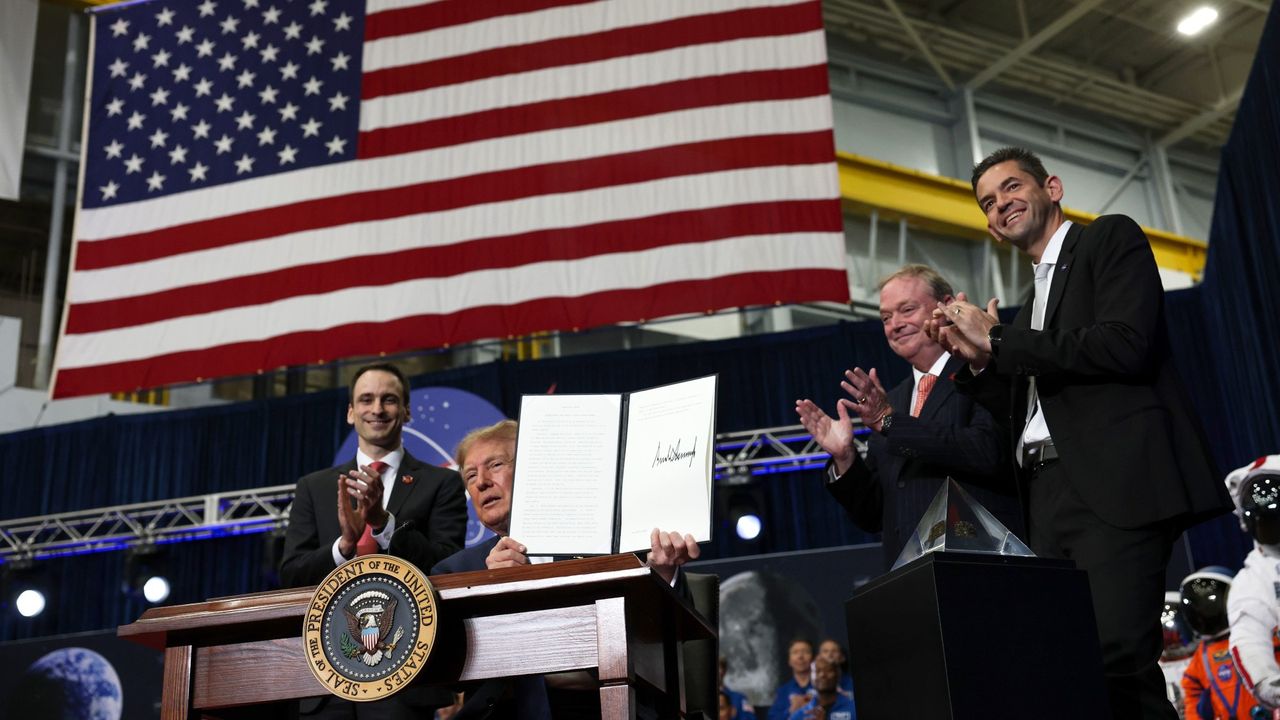
President Donald Trump signed an executive order establishing the U.S. Space Academy on Monday, formalizing the creation of an institution designed to develop a specialized workforce for American space operations and exploration.
The Space Academy will train students for careers spanning the breadth of space activity: scientific research, exploration missions, commercial space ventures, and space defense operations. The executive order represents a formal government commitment to building institutional capacity for long-term space engagement at a time when commercial companies like SpaceX and Blue Origin have accelerated launch capabilities and when international space competition intensifies.
The move builds on existing momentum in American space policy. The Trump administration has previously emphasized space as a domain of strategic national interest. The creation of the U.S. Space Force in 2019 established a dedicated military branch for space operations, and the Space Force Academy in Colorado Springs trains officers for that service. The new Space Academy expands this framework beyond military personnel to encompass civilian scientists, engineers, and space industry professionals.
Details regarding the Space Academy's operational structure, location, curriculum, and funding remain to be announced. Comparable institutions include the Air Force Academy, which educates officer candidates, and NASA's astronaut selection programs, which draw from military and civilian backgrounds. The Space Academy likely will combine elements of both models, offering structured education in space sciences, engineering disciplines, and operational training for students pursuing civilian space careers.
The timing reflects escalating competition in space exploration. China continues advancing its lunar program with crewed missions planned within this decade. The European Space Agency, Russia's space program, and emerging spacefaring nations all invest heavily in space infrastructure. Private American companies like SpaceX are developing heavy-lift capability and deep space transportation systems, while competitors worldwide pursue similar technologies.
Trump's order also addresses workforce development. The space industry reports persistent shortages of trained personnel in specialized fields including propulsion engineering, mission control operations, materials science, and autonomous systems. A dedicated Space Academy could accelerate training pipelines and ensure American personnel reach operational capability without lengthy apprenticeships in commercial or military settings.
The Space Academy joins other recent space policy initiatives. The NASA Artemis program targets crewed lunar landings and sustained surface operations. SpaceX develops Starship for lunar cargo delivery and Mars missions. Commercial space stations are entering orbit to replace the International Space Station as a research platform. Each initiative requires personnel trained specifically for space operations rather than traditional aerospace or engineering backgrounds.
The executive order signals that space activity ranks as a sustained national priority extending across civilian, commercial, and military domains. By creating a dedicated academy, the administration positions the United States to maintain technological advantage and operational capacity as space becomes increasingly contested and economically important.
Implementation will determine the academy's actual impact. Curriculum development, faculty recruitment, facility construction, and initial class enrollment take years to establish. The success of comparable service academies suggests the framework works for specialized military training, though civilian space workforce development faces different challenges.