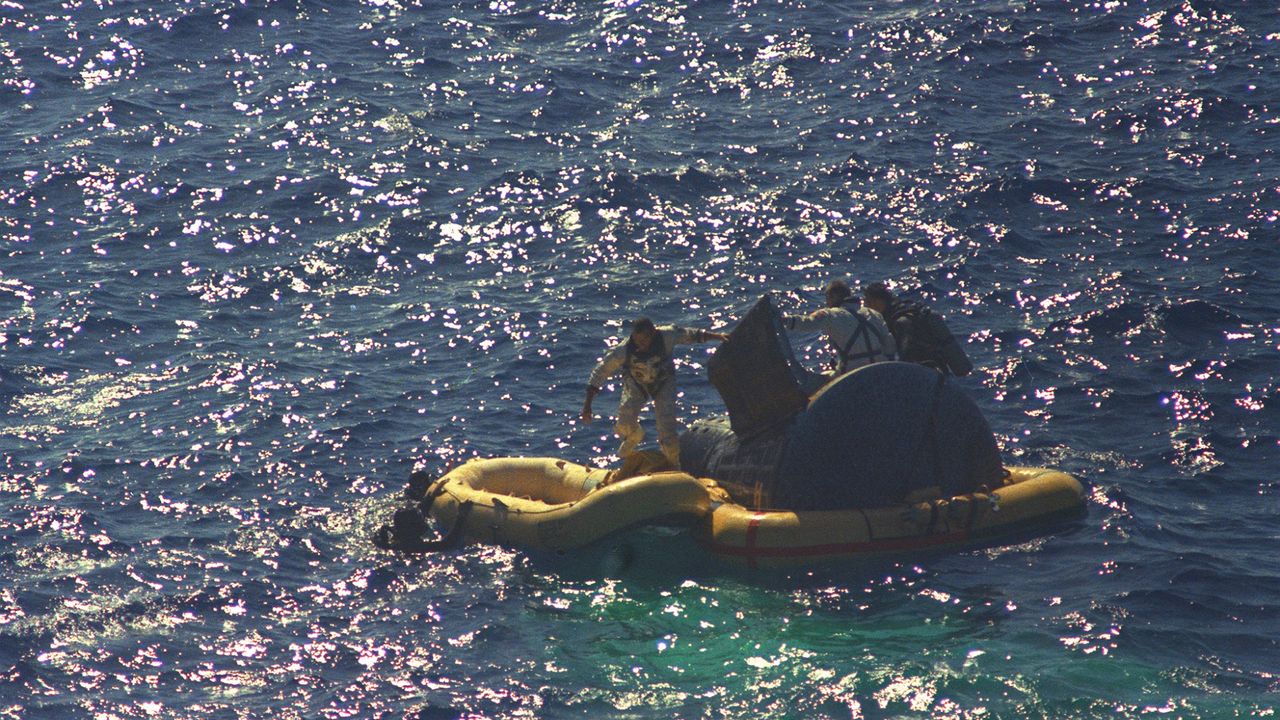
Gemini 5 splashed down on August 29, 1965, after eight days in orbit, a duration that shattered the previous spaceflight record and proved humans could survive the extended confinement necessary for lunar missions. Astronauts Wally Schirra and Thomas Stafford piloted the capsule, an achievement that directly enabled Apollo's eventual moon landings by demonstrating that crews could function in tight quarters for the time required to reach the lunar surface.
The mission launched on August 21 aboard an Atlas-Agena rocket, carrying enough consumables and power for a planned eight-day endurance test. Schirra and Stafford lived and worked in a spacecraft that early astronauts informally called "a garbage can" because of its cramped interior. The capsule measured just 11 feet long, forcing the two men to operate in extraordinary proximity while monitoring systems, conducting experiments, and managing their bodily needs during an era before modern life support amenities.
Duration records meant everything in the space race. The Soviet Union held the previous benchmark, set during Voskhod 1 in October 1964 with a mere five days in space. Gemini 5's eight-day achievement extended human spaceflight capability by 60 percent, a quantum leap that proved NASA's hardware could sustain crews far longer than anyone had flown before. This was not a symbolic victory. Every hour of Schirra and Stafford's flight gathered data on metabolic changes, psychological stress, radiation exposure, and equipment reliability that directly informed Apollo's design requirements.
The mission also tested fuel cells, a then-revolutionary power system that would become central to Apollo missions. Fuel cells converted hydrogen and oxygen into electricity while producing water as a byproduct, offering advantages over batteries for long-duration flights. Schirra and Stafford monitored cell performance continuously, recording how these systems behaved over sustained operation, work that shaped decisions about Apollo's electrical architecture.
Navigation represented another critical test. Schirra conducted rendezvous experiments with an uncrewed Agena target vehicle in space, practicing the manual control techniques that Gemini and Apollo crews would use repeatedly. The crew performed a crewed space rendezvous for the first time on Gemini 7, but Gemini 5 laid groundwork with automated systems and procedures development.
Schirra and Stafford's capsule experienced a fuel cell failure during the mission, forcing Schirra to curtail some planned activities and demonstrate the kind of real-time problem-solving that deep space operations demanded. Rather than panic, he adapted the mission profile to preserve power and still achieve the primary objective: surviving eight days.
The return to Earth validated Gemini's design. The capsule's heat shield performed flawlessly, protecting the crew during reentry heating. Landing occurred in the Atlantic Ocean, where recovery vessels retrieved Schirra and Stafford in good health, proving the spacecraft could sustain human life over extended periods and return crews safely to Earth.
Gemini 5 fundamentally changed what was possible in space exploration. By the time Apollo 11 launched in July 1969, astronauts knew their hardware could keep them alive for the three-day journey to the moon and back, knowledge purchased through missions like Schirra and Stafford's cramped, record-setting eight-day flight.