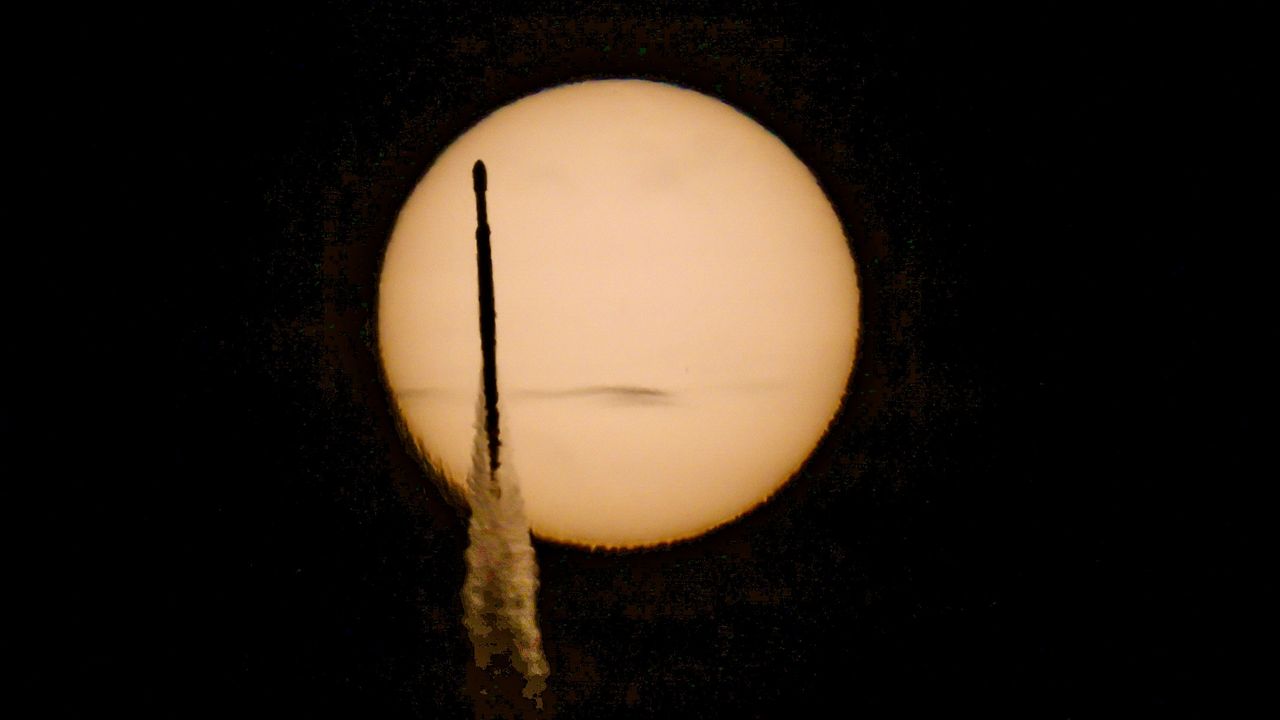
NASA's Nancy Grace Roman Space Telescope lifted off aboard a SpaceX Falcon Heavy on August 30, marking a watershed moment for observational astronomy. The mission begins a transformative chapter in how astronomers will map dark energy, hunt for exoplanets, and study the universe's large-scale structure.
Roman represents the most ambitious infrared observatory launched since the James Webb Space Telescope. Named after pioneering NASA astrophysicist Nancy Grace Roman, the 2.4-meter telescope carries a primary mirror equal in diameter to Hubble's, but with capabilities that extend far beyond its predecessor. The observatory operates primarily in the infrared spectrum with ultraviolet and visible light sensors, enabling it to detect faint galaxies billions of light-years distant and trace the expansion history of the universe itself.
The Falcon Heavy's triple-core configuration delivered sufficient payload capacity to loft Roman's roughly 5,600-kilogram mass into space. SpaceX's heavy-lift vehicle proved essential for this deployment, as Roman requires a direct trajectory to its operational station at Sun-Earth Lagrange Point 2, approximately 1.5 million kilometers from Earth. This location positions the telescope beyond Earth's shadow, allowing uninterrupted observations and protecting sensitive optics from thermal interference.
Roman's science portfolio addresses three primary investigations. First, it will conduct a vast survey of dark energy by observing supernovae and measuring the universe's expansion rate across cosmic time. Second, the telescope includes a coronagraph instrument designed to directly image exoplanets around nearby stars, potentially revealing atmospheric compositions and habitability markers. Third, Roman will conduct deep-sky surveys to study galaxy formation, evolution, and distribution across billions of years.
The mission cost approximately 2.4 billion dollars over its development and launch phases. NASA partnered with the Johns Hopkins University Applied Physics Laboratory for construction and management. The agency estimates Roman will operate for at least 5 years, with potential for extended service depending on propellant reserves and component health.
Engineers designed Roman for servicing redundancy. Unlike Hubble, which astronauts accessed multiple times in low Earth orbit, Roman operates at a distant Lagrange point where human retrieval remains impractical with current spaceflight technology. This constraint drove more conservative engineering standards and rigorous testing protocols before launch.
The Roman telescope complements rather than replaces existing observatories. While James Webb probes the earliest galaxies and provides unmatched infrared spectroscopy, Roman covers broader sky areas and operates across multiple wavelengths. This complementary approach allows astronomers to use Webb for detailed follow-up observations of objects Roman identifies during its surveys.
NASA plans to release Roman's first science data and images within the first year of operations. The agency anticipates the mission will answer fundamental questions about the universe's composition, age, and ultimate fate. Estimates suggest Roman's infrared surveys will discover millions of previously unknown galaxies and thousands of potentially habitable exoplanets orbiting distant stars.
The launch represents validation of SpaceX's Falcon Heavy for NASA's most demanding scientific payloads. Following this success, the agency continues to depend on commercial heavy-lift capacity for future large observatories and deep-space exploration infrastructure.