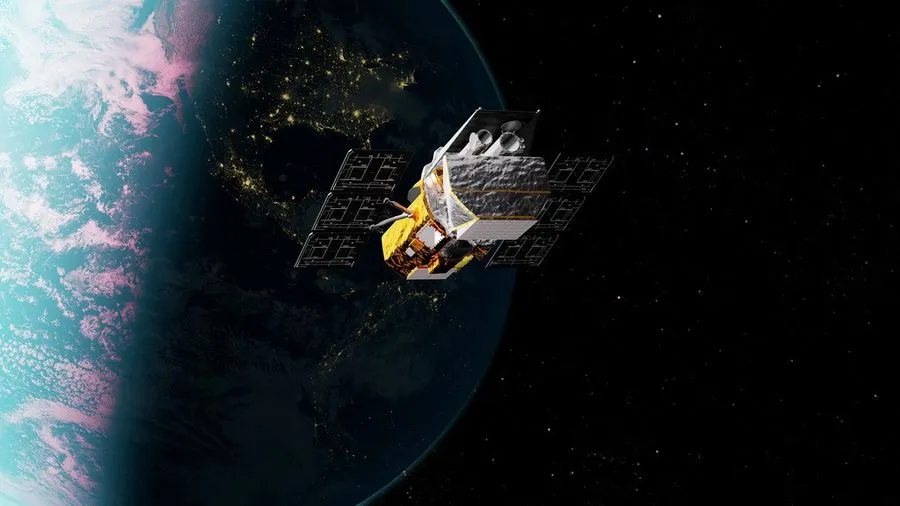
NASA and Katalyst Space have initiated plans for an unprecedented rescue operation targeting the Neil Gehrels Swift Observatory, a 20-year-old gamma-ray telescope that has become stranded due to attitude control problems on its host spacecraft.
The LINK spacecraft, operated by Katalyst Space, will attempt to rendezvous and conduct proximity operations with Swift in orbit. This mission represents a test of technologies essential for future on-orbit servicing, repair, and satellite recovery operations. The demonstration comes at a critical moment for Swift, which has provided continuous observations of gamma-ray bursts, supernovae, and other transient cosmic events since its 2004 launch.
Swift orbits Earth carrying three instruments: the Burst Alert Telescope, X-ray Telescope, and Ultraviolet/Optical Telescope. The observatory has logged over two decades of discoveries, detecting some of the most violent events in the universe. Its recent attitude control difficulties threaten to silence an instrument that still produces valuable science data and maintains operational redundancy for transient event detection across the globe.
The commercial spacecraft experiencing the attitude control issue creates the necessity for this rescue operation. Rather than allowing Swift to become another piece of orbital debris, NASA and Katalyst Space recognized the opportunity to test servicing technologies while preserving a functioning science instrument. This approach aligns with the space agency's strategy to extend mission life through commercial partnerships.
LINK is designed specifically for autonomous rendezvous with non-cooperative targets, meaning spacecraft not equipped with cooperative docking systems. This capability opens possibilities for retrieving aging satellites, retrieving valuable hardware from orbit, and conducting repairs on instruments never designed for servicing. The demonstration will prove whether these technologies function reliably in the actual orbital environment rather than in simulation.
Success would validate methods applicable to dozens of satellites currently in orbit. Many space telescopes and earth observation satellites lack built-in servicing ports or attitude control systems capable of assisting with docking procedures. Developing autonomous proximity operations technology addresses a gap in space infrastructure that has limited repair and extension options for disabled spacecraft.
The mission also carries implications for space sustainability. Satellites that malfunction or lose power typically remain in orbit indefinitely, contributing to collision hazards and orbital debris. The ability to rendezvous with and stabilize disabled spacecraft creates pathways for active debris removal and responsible end-of-mission procedures, reducing long-term contamination of orbital space.
Swift itself carries historical weight. Named after Neil Gehrels, the principal investigator of the Burst Alert Telescope who died in 2017, the observatory represents decades of gamma-ray astronomy development. Its discoveries have reshaped understanding of stellar explosions, neutron star mergers, and the universe's most energetic phenomena. Preserving its operational capability through this rescue attempt honors both Gehrels' legacy and the broader scientific mission.
Katalyst Space's involvement marks another step in the commercialization of orbital services. Private companies increasingly handle tasks traditionally reserved for space agencies, from debris removal to satellite servicing. This partnership demonstrates how commercial innovation and NASA's scientific objectives can align toward mutual benefit.
The LINK spacecraft rescue attempt represents more than solving one spacecraft's technical problem. It demonstrates proof of concept for infrastructure that will define space operations for decades ahead, whether conducting repairs, collecting defunct satellites, or extending the working life of valuable instruments already in orbit.