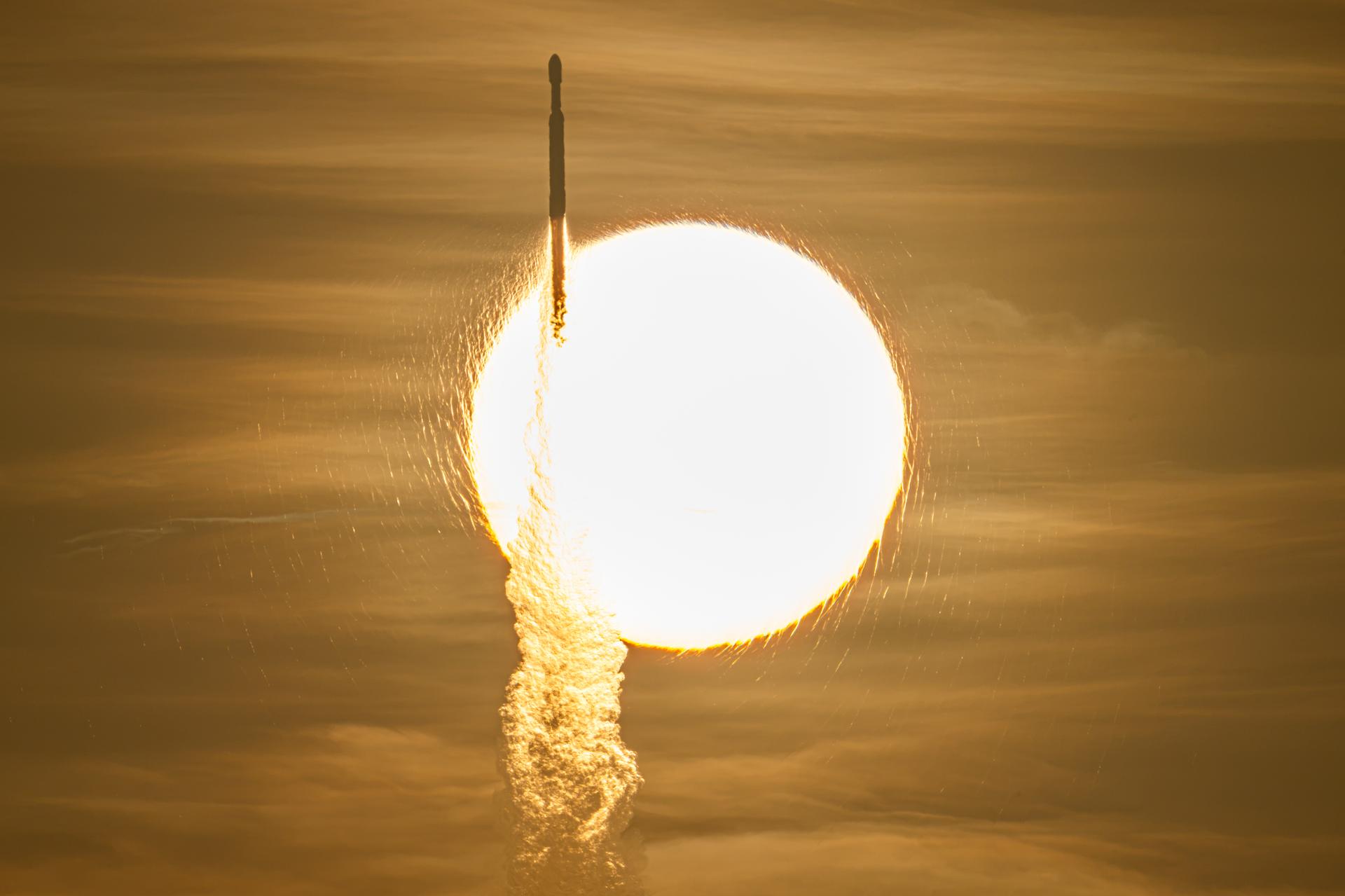
NASA deployed its Nancy Grace Roman Space Telescope to orbit on Sunday, lifting off at 7:26 a.m. EDT aboard a SpaceX Falcon Heavy rocket from Kennedy Space Center's Launch Complex 39A. The observatory now travels a million-mile journey toward its destination at the Sun-Earth L2 Lagrange point, a gravitational balance zone roughly one million miles from Earth where it will operate for its mission lifetime.
Roman represents a watershed moment in dark energy and dark matter research. The 2.4-meter telescope carries infrared instruments designed to map the geometry of the universe itself, measuring how cosmic expansion accelerates over time. This acceleration defies the expected gravitational pull of visible matter alone, pointing to dark energy as the dominant force shaping the universe's fate. Roman's observations will test competing theories about whether dark energy remains constant or evolves as the universe ages.
The Falcon Heavy delivered Roman into a trajectory toward L2, the same distant vantage point where NASA's James Webb Space Telescope currently operates. L2 orbits exist in a region of space where gravitational forces from Earth, Sun, and Moon balance in a way that keeps observatories in stable position with minimal fuel consumption for station-keeping maneuvers.
Named after Nancy Grace Roman, the late astrophysicist who pioneered space telescope development at NASA, the mission carries scientific instruments built to detect light from distant supernovae and map the distribution of dark matter through gravitational lensing. Roman's wide field of view surpasses the capabilities of current infrared telescopes, allowing it to survey large portions of sky quickly. This speed enables scientists to construct comprehensive surveys of billions of galaxies across cosmic time.
The telescope's primary science goals include using Type Ia supernovae as standard candles to measure cosmic distances and expansion rates across the universe's history. By observing thousands of these stellar explosions at various distances, Roman will create a timeline of the universe's acceleration. Gravitational lensing measurements will independently confirm findings about dark matter distribution and total mass density in cosmic structures.
Roman's infrared sensors operate across wavelengths ranging from visible light into the near-infrared spectrum, allowing the telescope to observe distant galaxies whose light has shifted into infrared due to cosmic expansion. This capability lets astronomers see galaxies as they existed billions of years in the past, revealing how the rate of cosmic expansion has changed over time.
The three-month journey to L2 provides time for the observatory's systems to stabilize and for NASA engineers to verify all components function correctly during transit. Once Roman reaches its orbital position, a months-long commissioning phase will follow before science observations begin. Initial surveys are expected to generate datasets that fundamentally reshape understanding of dark energy's nature and the universe's ultimate fate.
Roman joins an era of transformative space-based astronomy. Webb's observations of the earliest galaxies, Euclid's dark matter mapping mission from the European Space Agency, and Roman's measurements of cosmic expansion collectively form a unified effort to decode the universe's composition and history. The launch marks a transition point where dark energy becomes not merely theoretical abstraction but observable phenomenon.