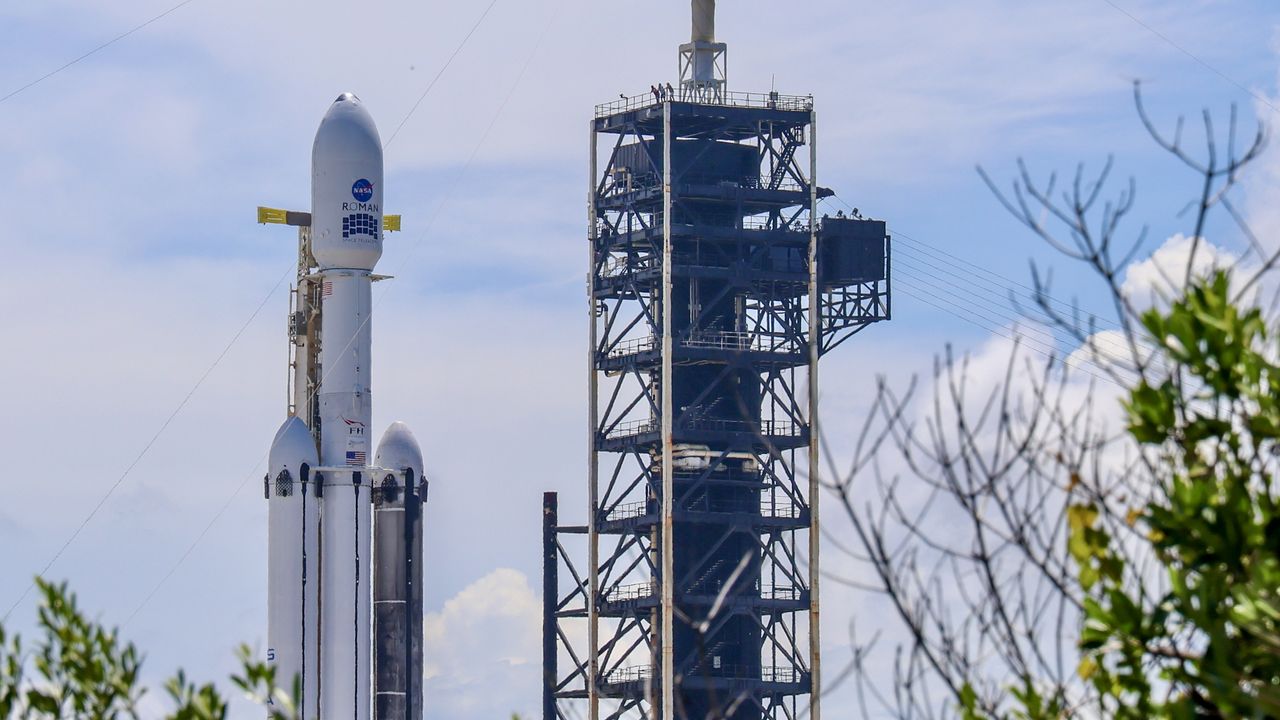
NASA's Nancy Grace Roman Space Telescope has entered final launch preparations for liftoff aboard SpaceX's Falcon Heavy rocket on August 30, marking the beginning of a transformative chapter in observational astronomy.
The Roman telescope represents one of the most ambitious infrared observatories NASA has ever built. Operating in the infrared spectrum, Roman will conduct surveys that fundamentally reshape our understanding of the cosmos, from the earliest galaxies formed after the Big Bang to the search for potentially habitable exoplanets orbiting distant stars.
The mission carries the name of Nancy Grace Roman, the pioneering NASA astrophysicist who led the development of the Hubble Space Telescope and earned recognition as the "mother of Hubble." Her legacy directly connects to Roman's scientific objectives, which build on and extend far beyond Hubble's visible-light capabilities by peering deeper into infrared wavelengths where dust-shrouded objects and distant galaxies reveal themselves.
The Falcon Heavy configuration provides sufficient payload capacity to deliver Roman's 2.4-meter primary mirror and sophisticated instrumentation to its destination orbit approximately one million miles from Earth, at a region called the Sun-Earth L2 Lagrange point. This location offers thermal stability and minimal gravitational interference, allowing the telescope to maintain its infrared sensitivity without the distortions that Earth's heat would introduce.
Roman's primary instruments include the Wide Field Instrument, designed to map vast areas of sky with unprecedented clarity, and the Coronagraph Instrument, engineered to block starlight and directly image exoplanets that would otherwise be lost in their host star's glare. These capabilities position Roman to conduct large-area surveys that identify potential targets for future missions, including direct imaging of potentially habitable worlds.
The telescope will conduct several research programs. A survey called the High Latitude Time Domain Survey will systematically observe millions of galaxies, measuring their distances and properties to construct a three-dimensional map of the universe's expansion history. This data will probe the nature of dark energy, the mysterious force accelerating cosmic expansion. Additionally, Roman will execute the Exoplanet Microlensing Survey, using gravitational lensing events to detect and characterize exoplanets, particularly around distant stars where traditional detection methods fall short.
SpaceX's Falcon Heavy rocket selection reflects NASA's commitment to partnering with commercial launch providers. The rocket's ability to lift roughly 64,000 kilograms to low Earth orbit exceeds the requirements for Roman's trajectory, providing margin for mission success.
The August 30 launch window opens a new era of infrared astronomy. Roman will operate for five years minimum, though its design accommodates extended operations if fuel reserves permit. The mission will generate datasets that astronomers worldwide will analyze for decades, answering fundamental questions about how the universe expanded, how galaxies formed, and whether potentially habitable worlds orbit nearby stars.
With this launch, NASA advances its ambition to understand cosmic history from the universe's infancy through the present day, while simultaneously searching for worlds that might harbor life beyond Earth.