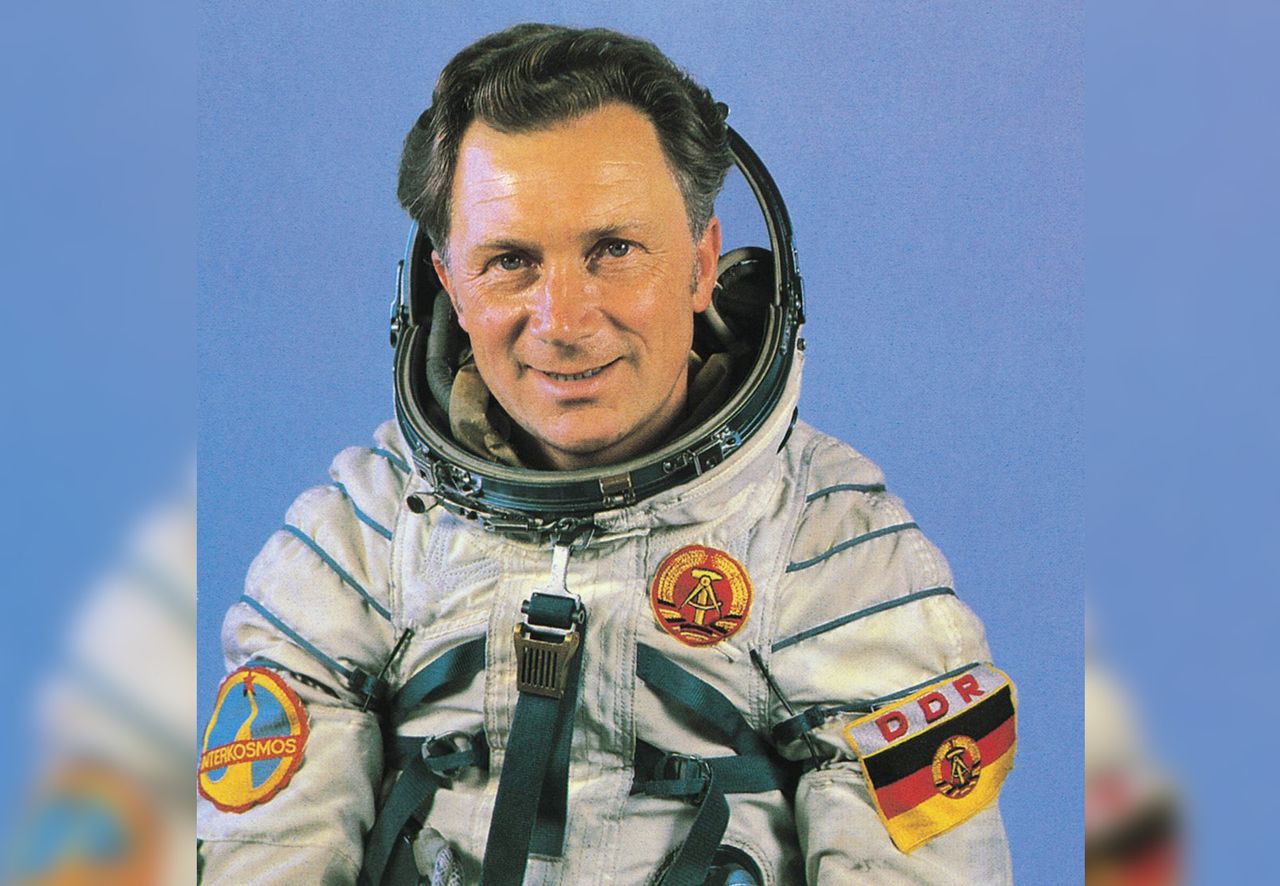
Sigmund Jähn launched aboard Soyuz 31 on August 26, 1978, becoming the first German citizen to reach space. The East German cosmonaut and pilot lifted off from the Baikonur Cosmodrome in Kazakhstan, docking with the Salyut 6 space station where he spent nearly eight days conducting scientific experiments and observations.
Jähn's flight represented a watershed moment in Cold War space politics. The Soviet Union had orchestrated his mission through the Interkosmos program, a diplomatic initiative that sent cosmonauts from allied Warsaw Pact nations into space. By launching Jähn before West Germany could send an astronaut into orbit, the USSR claimed a propaganda victory during the divided nation's tense geopolitical standoff. East Germany, officially the German Democratic Republic, seized the achievement as proof of socialist technological prowess.
Born in 1937 in Moravia (now part of the Czech Republic), Jähn trained extensively in the Soviet system. His background as a military pilot made him an ideal candidate for the Interkosmos roster. The program, which began in 1967, had already sent cosmonauts from Czechoslovakia, Poland, Hungary, and Vietnam into space. Jähn's selection underscored East Germany's status as the Soviet Union's most technologically advanced satellite state.
During his Soyuz 31 mission, Jähn conducted experiments in materials science, Earth observation, and medical research aboard Salyut 6. He worked alongside Soviet cosmonaut Vladimir Dzhanibekov, who commanded the orbital laboratory. The eight-day stay allowed Jähn to complete a full research agenda that contributed to Soviet understanding of how humans and equipment performed in extended microgravity.
The mission's timing held political weight. Just weeks before Jähn's launch, the Soviet Union faced international condemnation over its invasion of Afghanistan. The successful flight of the first German in space redirected global attention toward Soviet achievements in space exploration, a domain where the USSR maintained undisputed technical mastery throughout the 1970s.
Jähn returned to Earth aboard Soyuz 31 on September 3, 1978, landing in the steppes of Kazakhstan. He became an instant celebrity in East Germany, receiving state honors and recognition from the Socialist Unity Party leadership. His achievement remained a defining moment in East German history until the nation's reunification in 1990.
The broader context of Jähn's flight illustrates how space exploration served geopolitical ends during the Cold War. While American and Soviet astronauts competed directly for lunar dominance earlier in the space race, by the late 1970s both superpowers had shifted strategies. The Soviets emphasized the international nature of their space program through Interkosmos, demonstrating the appeal of socialism to allied nations. The United States countered with its own international cooperation efforts, eventually leading to the Apollo-Soyuz Test Project in 1975 and, decades later, partnership aboard the International Space Station.
Sigmund Jähn's legacy persists in the history of human spaceflight. He remains the only German from East Germany to fly in space, a distinction preserved even after reunification brought German space activities under a unified framework. His eight days aboard Salyut 6 opened a chapter in spaceflight where smaller nations could access orbital operations through superpower partnerships, a model that continues today across multiple space agencies worldwide.