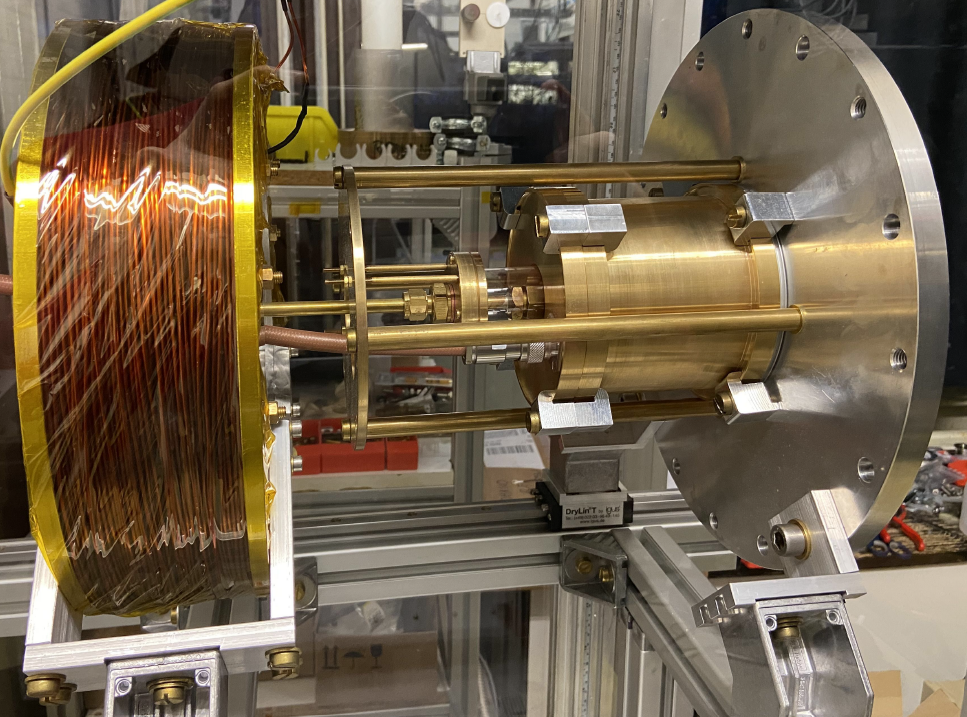
Researchers have developed a plasma thruster that converts atmospheric particles directly into propellant, eliminating the need to carry expensive onboard fuel like xenon for satellites operating in Very Low Earth Orbit.
The RF Helicon-based Plasma Thruster represents a fundamental shift in how satellites maintain altitude in the densest regions of near-Earth space. Between 100 and 450 kilometers altitude, VLEO provides exceptional advantages for Earth observation and communications. Imaging satellites achieve superior resolution. Radio and radar systems operate with reduced power consumption. Dead spacecraft naturally deorbit within years, mitigating space debris accumulation. The critical trade-off has always been atmospheric drag. Thin wisps of oxygen and nitrogen at VLEO altitudes create constant friction that forces satellites to burn fuel continuously just to maintain orbit.
The new thruster design transforms this constraint into opportunity. Instead of carrying limited quantities of dense propellants, the system harvests nitrogen and oxygen molecules already present in the upper atmosphere. A radio-frequency helicon source ionizes these atmospheric particles into plasma. The resulting charged particles accelerate through a magnetic nozzle, generating thrust. The design essentially makes satellites self-sustaining within their operational environment.
The implications for mission architecture are substantial. Traditional xenon-fueled ion thrusters cost thousands of dollars per kilogram. Missions must budget substantial mass and volume for propellant tanks, directly reducing payload capacity or mission duration. A satellite launched with 100 kilograms of xenon faces hard limits on station-keeping maneuvers and operational lifespan. An atmosphere-breathing thruster removes this ceiling almost entirely. Satellites remain operational as long as they maintain altitude within VLEO's atmospheric envelope.
Remote sensing missions stand to gain the most immediate benefits. Earth observation constellations like those operated by Maxar Technologies and Planet Labs require frequent altitude adjustments to maintain sun-synchronous or specific ground-track orbits. Current systems allocate substantial fuel reserves for these maneuvers, limiting revisit frequency and spatial coverage. Atmosphere-breathing propulsion enables denser constellations with longer operational lives.
Communications satellites in VLEO orbits also benefit significantly. The lower altitude compared to geostationary orbit reduces signal latency, improving real-time applications. Current VLEO communication networks rely heavily on propellant reserves. Extended operational duration through atmospheric harvesting could transform these systems from experimental networks into permanent infrastructure.
The physics underlying RF helicon technology has existed for decades in laboratory settings. Previous efforts to adapt it for spaceflight faced engineering obstacles around ionization efficiency, plasma containment, and exhaust velocity. The new design apparently solves these challenges through optimized magnetic field geometry and helicon source configuration. Testing data appears to demonstrate sufficient thrust levels for practical satellite operations.
Development challenges remain. Atmospheric density varies unpredictably with solar activity and geomagnetic storms, affecting available propellant quantity. Plasma thruster efficiency depends on ionization rate and exhaust velocity parameters that require refinement for production systems. Integration with existing satellite power and attitude control systems demands careful engineering.
The technology represents convergence between atmospheric science and electric propulsion. Rather than fighting the environment, spacecraft now leverage it. This approach enables entirely new mission architectures for Earth observation, communications, and scientific research in the orbital region where drag has always been most problematic.