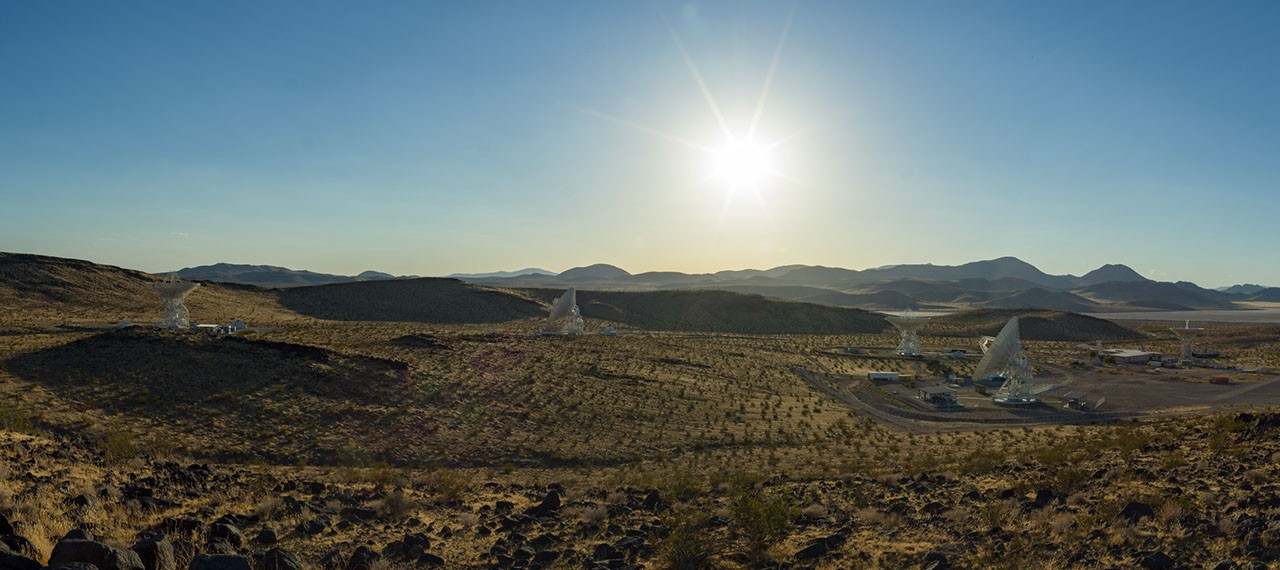
NASA completed Deep Space Station 23, a 34-meter beam-waveguide antenna, at the Goldstone complex near Barstow, California, adding critical infrastructure to humanity's most distant communication network.
The newly operational DSS-23 joins three existing 34-meter antennas at Goldstone: DSS-26, DSS-25, and DSS-14. Together, these four massive dishes form the backbone of NASA's ability to talk with spacecraft across the solar system and beyond. The Deep Space Network operates three primary complexes globally, with Goldstone serving the western hemisphere. The agency positions antennas on three continents to ensure continuous coverage as Earth rotates, maintaining contact with rovers on Mars, orbiters circling distant planets, and probes exploring the outer solar system.
The 34-meter antenna class represents the workhorse of deep space communication. Each dish weighs hundreds of tons and operates with extraordinary precision to capture whisper-faint signals traveling billions of kilometers through space. A rover on Mars transmits with power comparable to a hand-held radio, yet Earth receivers detect those signals reliably enough to command rovers in real time and receive high-resolution imagery.
Beam-waveguide technology, which DSS-23 employs, differs fundamentally from traditional parabolic dishes. Instead of focusing radio waves directly at a receiver mounted above the dish surface, waveguide antennas direct signals through a tube network to ground-based control equipment. This approach reduces interference from atmospheric conditions and ground reflections, improving signal clarity and data rates. The technology proves especially valuable for future missions requiring higher bandwidth, such as sample-return expeditions from Mars.
The completion of DSS-23 arrives as NASA pushes deeper into space exploration. The James Webb Space Telescope depends on Deep Space Network antennas to transmit its observations. Mars rovers Curiosity and Perseverance rely on Goldstone for crucial command uplinks and data downlinks. Upcoming Artemis missions to the lunar surface will require sustained communication from Goldstone antennas. Beyond Earth orbit, the network supports NASA's Voyager probes, still operating after more than four decades in interstellar space.
Maintaining network redundancy remains operationally essential. With four 34-meter antennas now in place at Goldstone, NASA gains flexibility in scheduling simultaneous missions and performing maintenance without losing communication coverage. The older DSS-14 antenna, commissioned in 1966, sometimes requires service windows. DSS-23 provides replacement capacity during those periods.
The Deep Space Network infrastructure extends back decades. Building and maintaining these facilities requires constant technological refresh. Older electronics give way to newer systems handling higher data rates. Mechanical components wear and require replacement. The addition of DSS-23 represents NASA's commitment to sustaining this aging but irreplaceable network as missions grow more ambitious.
Future exploration depends on what exists today at Goldstone and its sister complexes in Madrid, Spain, and Canberra, Australia. Without these antenna arrays, spacecraft cannot send commands or receive data. The newly completed DSS-23 ensures that capability persists for decades of exploration ahead.