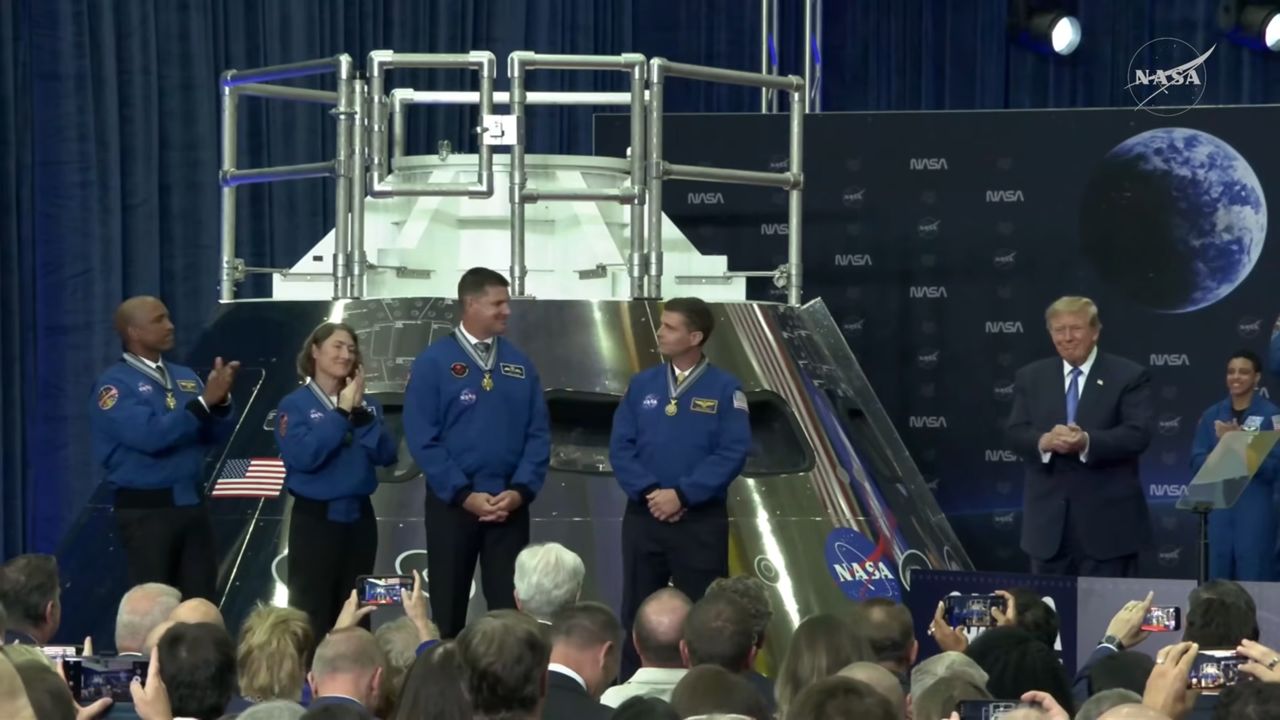
NASA's Artemis II crew received the Congressional Space Medal of Honor from President Trump, the nation's highest recognition for space exploration achievement. The four astronauts completed their historic lunar flyby mission in April 2024, orbiting the moon and returning safely to Earth without landing on the lunar surface.
The Artemis II crew included Commander Reid Wiseman, Pilot Victor Glover, Mission Specialist Christina Koch, and European Space Agency astronaut Andreas Mogensen. Their 10-day mission tested all systems required for the eventual Artemis III landing, including the Space Launch System heavy-lift rocket, the Orion capsule, and life support systems in the deep space environment.
The Congressional Space Medal of Honor recognizes individuals or groups for exceptional achievement in space exploration. Past recipients include the Apollo 11 astronauts, the Space Shuttle Columbia crew, and the Hubble Space Telescope team. The award underscores the political and public significance of the Artemis program, which aims to return Americans to the lunar surface for the first time since Apollo 17 in 1972.
Artemis II served as a critical validation mission. The crew tested Orion's heat shield during reentry, evaluated communications systems at lunar distances, and gathered data on radiation exposure beyond Earth's protective magnetosphere. These results directly informed engineering decisions for Artemis III, the crewed lunar landing mission currently targeted for 2026 or 2027.
The mission faced delays from its original 2022 launch date. Technical issues with the SLS rocket, Orion's European Service Module, and ground infrastructure pushed the timeline back. The April 2024 launch ultimately succeeded, demonstrating that NASA's next-generation human spaceflight architecture could operate reliably at the scale and complexity required for sustained lunar exploration.
Glover made history as the first African American to venture beyond Earth orbit. Koch became the fourth woman to fly to the moon region and the first to participate in a lunar-bound Artemis mission. Wiseman commanded the operation, while Mogensen represented the broader international collaboration driving Artemis forward.
The award reflects recognition that Artemis II represents a generational milestone. After 52 years without human lunar missions, this crew validated the systems, procedures, and operational concepts needed to land humans at the lunar south pole, where NASA plans to establish a research base. The south pole offers access to permanently shadowed craters containing water ice, essential resources for long-term lunar habitation and as a propellant source for deep space missions.
Artemis III, now in active development with commercial partners including SpaceX and Axiom Space, depends on Artemis II's data. The mission proved that the Space Launch System rocket could reliably deliver the Orion spacecraft and crew to lunar orbit. It confirmed that astronauts could operate effectively during multi-day missions away from Earth's protective environment.
The Congressional Space Medal of Honor recognizes more than individual achievement. It validates the public investment in Artemis and signals sustained governmental commitment to human lunar return. With Artemis III development accelerating and international partners joining the effort, the Artemis program moves from proof-of-concept to implementation. The Artemis II crew's award marks a turning point where lunar return shifts from distant aspiration to near-term operational goal.