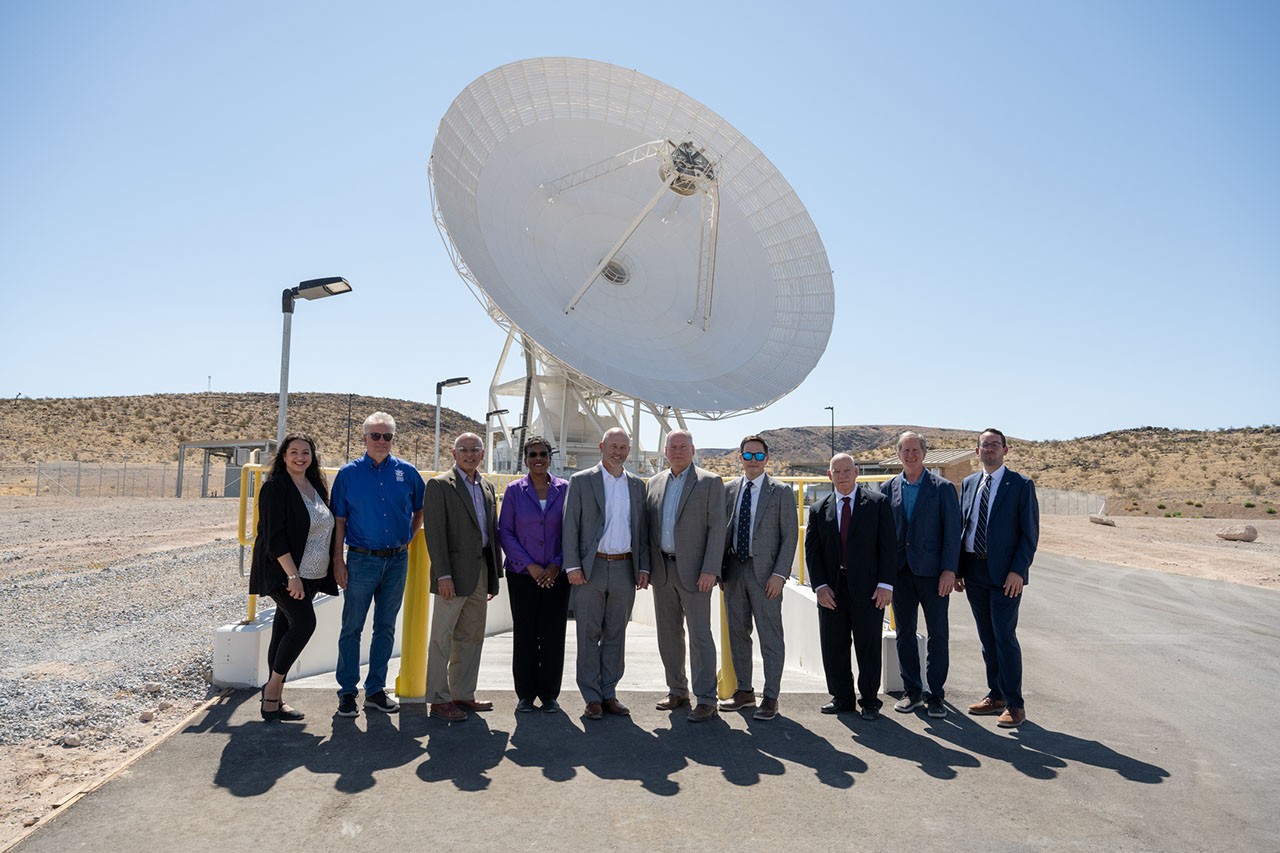
NASA formally opened Deep Space Station 23, a newly completed antenna array at the Goldstone complex near Barstow, California, on August 25, 2026. The facility represents a major infrastructure upgrade for the Deep Space Network, the agency's global system for communicating with spacecraft exploring the solar system and beyond.
The ribbon-cutting ceremony brought together leadership from NASA Headquarters, the Jet Propulsion Laboratory, and the Deep Space Network itself. Germaine Aziz, project manager for the DSN Aperture Enhancement Project at JPL, and Bradford Arnold, manager of DSN operations, attended the event marking the completion of this critical communication asset.
Deep Space Station 23 joins a constellation of ground stations positioned across Earth to maintain unbroken contact with robotic probes. The DSN operates three major complexes spaced roughly 120 degrees apart: Goldstone in California, Madrid in Spain, and Canberra in Australia. This geometric arrangement ensures that as Earth rotates, at least one facility always points toward any given spacecraft, whether that probe orbits Mars, travels to the outer planets, or ventures into interstellar space.
The Goldstone complex itself serves as the DSN's primary hub in North America. Its existing infrastructure already hosts several large antennas used to communicate with active missions including Perseverance on Mars, the Juno spacecraft orbiting Jupiter, and the Voyager probes at the edge of the heliosphere. The addition of Deep Space Station 23 expands Goldstone's capacity and redundancy.
The aperture enhancement initiative addresses a fundamental challenge in deep space exploration. As spacecraft travel farther from Earth, their radio signals weaken according to the inverse-square law. A probe at Mars transmits signals one million times weaker than equivalent transmissions from low Earth orbit. Maintaining two-way communication requires ever more sensitive receivers and powerful transmitters. New antennas and upgraded electronics improve both capabilities.
This infrastructure investment directly enables NASA's ambitious exploration roadmap. The agency's Artemis program aims to land humans on the Moon by 2026, with permanent lunar outposts to follow. Mars sample-return missions planned for the late 2020s will demand robust communication links across interplanetary distances. Future missions to the outer solar system and eventual interstellar probes depend entirely on DSN reliability.
The Deep Space Network also supports non-NASA missions. The European Space Agency's spacecraft, Japan's JAXA probes, and India's ISRO missions all rely on DSN stations for critical communications. This international cooperation extends humanity's reach into space through shared infrastructure.
Private spaceflight companies including SpaceX increasingly rely on DSN support for their deepspace ventures. As commercial space activities expand beyond Earth orbit, DSN capacity becomes essential to industry growth.
Deep Space Station 23 represents more than a single antenna. It embodies NASA's commitment to sustaining the technological foundation that has enabled four decades of robotic exploration. From Viking's first landing on Mars in 1976 to Perseverance's current discoveries in Jezero Crater, the DSN has proven indispensable. This upgrade ensures that future generations of explorers, both robotic and human, will maintain their crucial connection home.